Photo: Wikipedia
Demographics of Watford City, ND
Affluence Level in Watford City, ND
An upper-middle-class area. Household wealth, education levels, and homeownership run ahead of national benchmarks.
People of Watford City, ND
The people of Watford City, North Dakota today number roughly 6,016, forming a community that is predominantly White (67.9%) with a substantial Hispanic minority (22.8%) and smaller Black (2.4%) and East/Southeast Asian (0.9%) populations. The city is notably less diverse than the national average in foreign-born residents (3.7%) and college graduates (25.8%), reflecting its roots as a working-class oil and agricultural hub. Its distinctive identity is shaped by a boom-and-bust energy economy that has drawn successive waves of domestic migrants and, more recently, Hispanic laborers, creating a population that is younger and more transient than the state average.
How the city was settled and grew
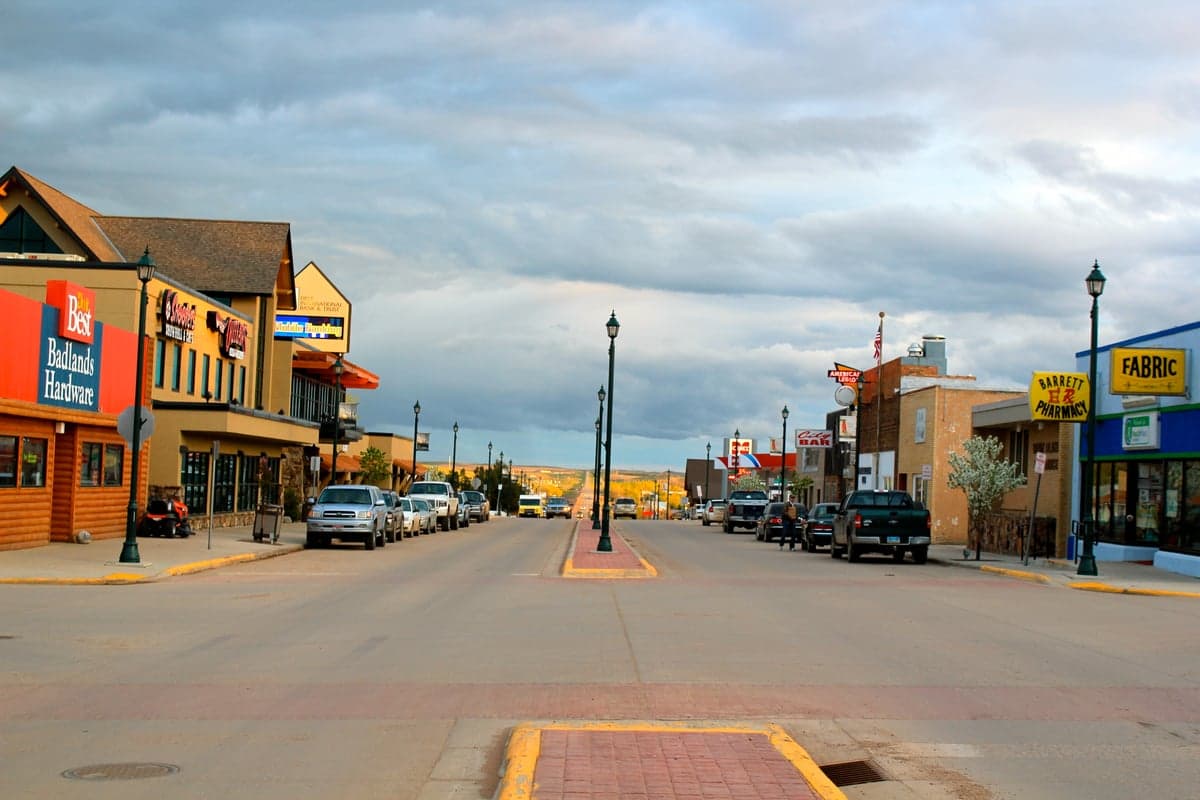
Watford City was founded in 1914 as a railroad town on the Great Northern Railway, serving as a shipping point for the surrounding agricultural region. The original settlers were predominantly homesteaders of Northern European descent—Norwegians, Germans, and Scandinavians—who took up land under the Homestead Act of 1862. These early families built the core of what is now the Historic Downtown District, centered along Main Street, where grain elevators, banks, and general stores anchored the community. A second wave arrived during the 1950s and 1960s as the area’s oil fields were first tapped, drawing workers from other parts of the Upper Midwest. These oil hands settled in the West Side Addition, a neighborhood of modest single-family homes built south of the railroad tracks to house the growing workforce. By 1970, the population hovered around 1,500, and the city remained a quiet county seat for McKenzie County, with a population that was nearly entirely White and native-born.
Modern era (post-1965)
The modern demographic transformation of Watford City began in earnest after the Hart-Cellar Immigration Act of 1965, though the city saw little direct impact until the Bakken oil boom of the 2010s. The boom, which began around 2008, triggered a massive influx of domestic migrants from across the United States—particularly from Texas, Oklahoma, and the Gulf Coast—seeking high-paying oil field jobs. These workers, mostly White and male, initially lived in man camps and temporary housing, but many eventually settled in the Bakken Heights subdivision, a planned community of apartments and townhomes built on the city’s northern edge. Simultaneously, a smaller but significant wave of Hispanic laborers arrived, drawn by construction, trucking, and service industry jobs. They concentrated in the Southside Mobile Home Park and the East End neighborhood, where lower-cost housing and proximity to industrial sites made settlement practical. The Hispanic share of the population rose from negligible levels before 2000 to 22.8% by the 2020 census, while the White share fell from over 95% to 67.9%. The Black population (2.4%) and East/Southeast Asian population (0.9%) arrived primarily as part of the broader oil-field workforce, with no single ethnic enclave forming for these groups. The Indian subcontinent population remains at 0.0%, reflecting the city’s limited draw for professional-class immigrants.
The future
The population of Watford City is likely to stabilize or decline slightly in the next decade as the Bakken boom matures and oil prices fluctuate. The city is not homogenizing; instead, it is tribalizing into distinct enclaves. The Hispanic community, concentrated in the Southside and East End, is growing through family reunification and higher birth rates, while the White population in the Historic Downtown and West Side Addition is aging and seeing slower replacement. The foreign-born share (3.7%) is below the national average and is unlikely to rise dramatically unless new industries—such as renewable energy or data centers—emerge to attract international labor. The college-educated share (25.8%) is low, suggesting that the city will remain a blue-collar destination rather than a knowledge-economy hub. Over the next 10–20 years, Watford City will likely become more Hispanic, more working-class, and more economically dependent on energy cycles, with the Historic Downtown and West Side Addition retaining their White, older character while the Southside and East End become increasingly Hispanic and younger.
For someone moving in now, Watford City offers a low-cost, high-risk environment where community ties are strong but transient, and where the dominant culture remains rooted in the oil field and the Lutheran church. The city is becoming a more diverse, younger place than its past, but it remains a predominantly White, native-born community with a growing Hispanic minority—a pattern that will continue as long as the energy economy sustains demand for manual labor.

* Values derived from national, state, county, city and local statistics and may differ in a specific area. Last updated: 2026-04-19T05:26:52.000Z
Narrative content on this page is AI-generated and may contain mistakes. Verify any details that matter before acting on them.
ReloMaps may earn a commission from affiliate links at no extra cost to you.

