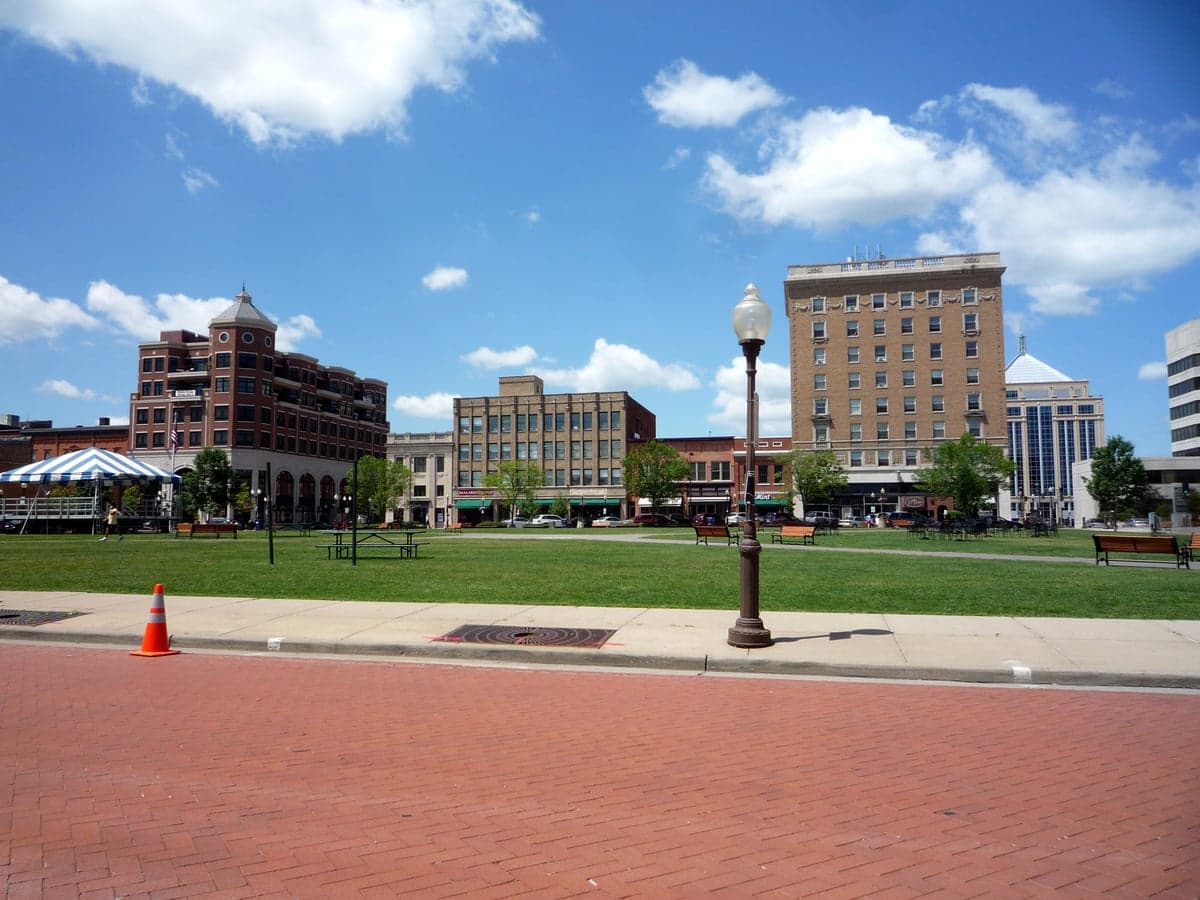
Photo: Wikipedia
Demographics of Wausau, WI
Affluence Level in Wausau, WI
A middle-class area roughly in line with national averages across income, home values, education, and employment.
People of Wausau, WI
The people of Wausau, Wisconsin today number roughly 39,893, forming a community that is predominantly white (77.8%) with a notable and growing East and Southeast Asian population (10.1%), a small but established Hispanic community (5.4%), and a very small Black population (0.5%). The city is denser than the surrounding Marathon County countryside, with a distinct identity shaped by its history as a lumber and manufacturing hub and its more recent role as a regional medical and service center. About 30% of adults hold a bachelor's degree or higher, and the foreign-born share sits at 3.4%, a figure that understates the impact of second-generation families, particularly those of Hmong heritage. Wausau’s character is one of a Midwestern city that experienced a significant demographic shift in the late 20th century and is now navigating the integration of its diverse populations within a traditionally conservative, family-oriented culture.
How the city was settled and grew
Wausau’s founding population was drawn by the region’s vast white pine forests. The first permanent European settlers arrived in the 1830s and 1840s, with the city formally platted in 1852. The lumber industry dominated, bringing a wave of Yankee entrepreneurs from New England and New York, followed by a massive influx of German, Polish, and Scandinavian immigrants who provided the labor for the mills and logging camps. These groups built distinct neighborhoods that still bear their imprint. The East Side, particularly the area around St. Mary’s Catholic Church, became the heart of the Polish community, while German families concentrated in the near-West Side and along the Wisconsin River. The downtown core, centered on the 400 Block, was the commercial and civic hub for all groups. By the early 20th century, the lumber boom had faded, but the city’s population base was solidified by the arrival of manufacturing—notably the Employers Insurance of Wausau (now Wausau Insurance) and Marathon Electric—which sustained the white, working-class character of neighborhoods like Rib Mountain and the South Side through the mid-20th century.
Modern era (post-1965)
The most transformative demographic event in modern Wausau began in the late 1970s and accelerated through the 1980s: the resettlement of Hmong refugees from Laos, who arrived after the Vietnam War. This wave, facilitated by local church sponsors and federal refugee programs, fundamentally altered the city’s ethnic landscape. The Hmong population, which now constitutes the majority of the 10.1% East/Southeast Asian share, initially clustered in lower-cost rental housing in the near-South Side and the Thomas Street area, near the Wausau School District’s elementary schools. Over time, a second generation has moved into single-family homes in the East Side and parts of Rothschild, a neighboring village, though the South Side remains the cultural and commercial anchor, with Hmong-owned grocery stores and restaurants. The Hispanic population (5.4%) grew more gradually, driven by employment in manufacturing and agriculture, and is concentrated in the West Side and along the Grand Avenue corridor. The Black population (0.5%) remains very small, with no single concentrated neighborhood. Domestic in-migration has been modest, with most new white residents arriving from other parts of Wisconsin or the Upper Midwest for jobs in healthcare (Aspirus Wausau Hospital) or insurance. Suburbanization has pulled some families to Weston and Mosinee, but Wausau’s core neighborhoods remain relatively stable.
The future
The population is heading toward greater ethnic diversity, but at a slow pace. The East/Southeast Asian share (10.1%) is likely to plateau as Hmong birth rates normalize and out-migration to larger Hmong hubs like Minneapolis-St. Paul continues among younger adults. The Hispanic share (5.4%) is expected to grow steadily through both births and continued labor migration, potentially reaching 8-10% within a decade. The white population (77.8%) is aging and declining slightly, as younger white families often move to newer subdivisions in the surrounding townships. The city is not tribalizing into hostile enclaves, but distinct residential patterns persist: the South Side remains the most visibly Asian neighborhood, while the West Side is the most Hispanic. The downtown 400 Block has seen reinvestment and is becoming a gathering place for all groups, suggesting a slow trend toward integration. For a newcomer, Wausau offers a stable, safe, family-oriented environment with a growing cultural diversity that is still contained within a predominantly white, conservative social framework.
For someone moving in now, Wausau is a city where the past—a lumber-and-manufacturing white ethnic base—is visibly layered with a more recent Asian and Hispanic presence. The schools are integrating, the economy is stable, and the neighborhoods are safe. It is not a rapidly growing or homogenizing place, but one where distinct communities coexist within a shared Midwestern civic identity. The bottom line: Wausau is becoming a more diverse, but still majority-white, small city where family and work remain the central values, and where a newcomer will find established ethnic neighborhoods and a welcoming, if reserved, social atmosphere.

* Values derived from national, state, county, city and local statistics and may differ in a specific area. Last updated: 2026-04-19T09:25:02.000Z
Narrative content on this page is AI-generated and may contain mistakes. Verify any details that matter before acting on them.
ReloMaps may earn a commission from affiliate links at no extra cost to you.

