
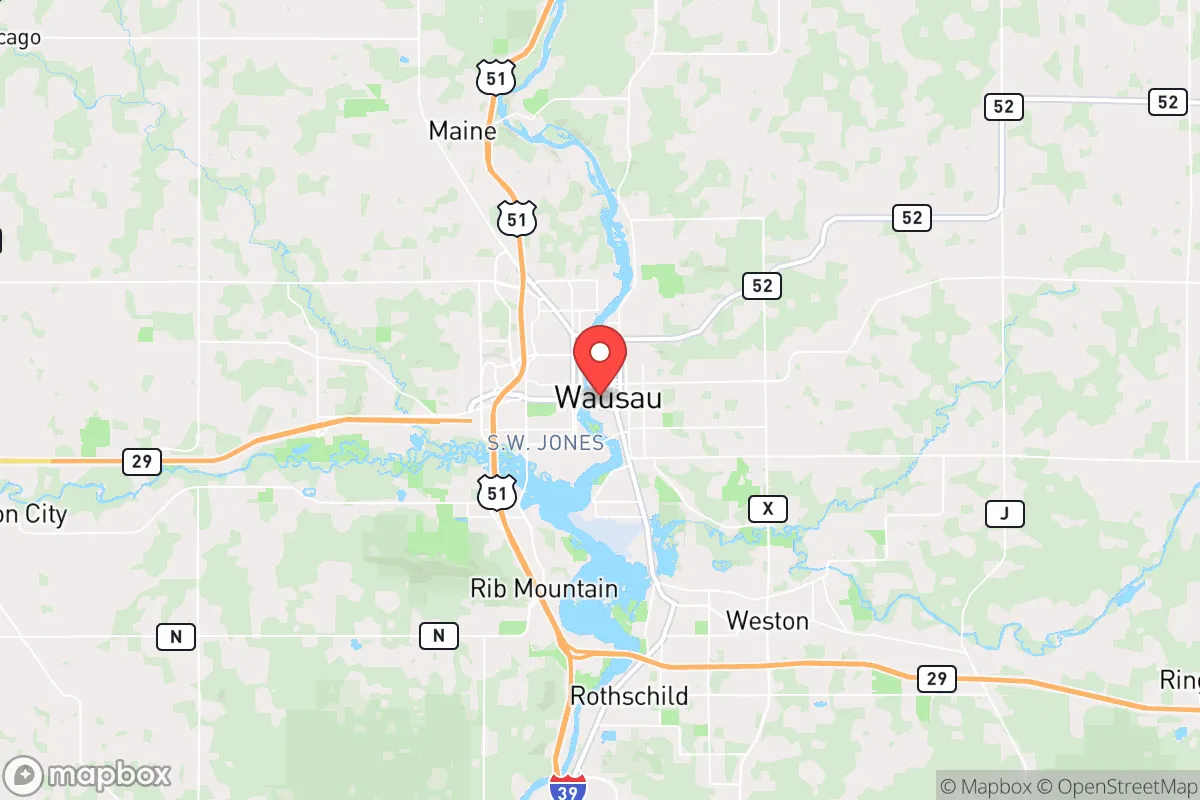
Photo: Wikipedia
Personal Sovereignty in Wausau, WI
Moderate friction. Expect trade-offs in some aspect of personal liberty and independence.
What does Personal Sovereignty tell us?
Personal Sovereignty measures your capacity for self-reliance and independence with minimal government friction. Higher scores mean fewer barriers between you and the way you want to live... but it assumes you have the space you need and good neighbors.
What does this tell us?
Personal Sovereignty measures your capacity for self-reliance and independence with minimal government friction. Higher scores mean fewer barriers between you and the way you want to live... but it assumes you have the space you need and good neighbors.
State Policy
Energy independence: Importer (15% of energy produced in-state)
Personal Liberty
Homesteading

Personal Liberty Analysis
Wausau, Wisconsin, offers a notably strong environment for personal sovereignty compared to many Midwestern cities of similar size, largely due to Wisconsin’s structural protections for individual rights and a local culture that prizes self-reliance. While no location is immune from federal overreach or state-level mandates, Wausau’s position in a politically divided state—where conservative rural and exurban voices hold significant sway—creates a buffer against the most aggressive government encroachments. For those prioritizing autonomy in their daily lives, from tax decisions to self-defense and family choices, Wausau represents a pragmatic balance of access to services and freedom from heavy-handed regulation, though it is not a libertarian utopia.
Tax burden and regulatory posture: How Wausau compares to other Wisconsin cities
Wisconsin’s tax structure is a mixed bag for sovereignty-minded individuals. The state levies a progressive income tax with rates from 3.50% to 7.65%, which is moderate nationally but higher than neighboring Minnesota’s top rate. However, Wausau benefits from being in Marathon County, which has a relatively low property tax rate—around 1.7% of assessed value—compared to Dane County (Madison) or Milwaukee County. This means a $250,000 home in Wausau carries roughly $4,250 in annual property taxes, versus $5,500+ in Madison. Sales tax is a flat 5.5% statewide (no local add-ons), keeping everyday purchases affordable. On the regulatory front, Wisconsin is a right-to-work state, meaning you cannot be forced to join a union as a condition of employment, which appeals to those wary of collective bargaining overreach. The state also has a relatively business-friendly climate, with no corporate income tax on pass-through entities (LLCs, S-corps) and streamlined permitting for small-scale manufacturing. That said, Wisconsin’s Department of Natural Resources (DNR) maintains strict environmental oversight, particularly on water rights and wetland development—something preppers eyeing rural acreage should factor in. Overall, Wausau’s tax burden is manageable, and its regulatory posture leans toward local control, but you’ll still deal with state-level bureaucracy on building permits and land use.
Self-defense and gun law specifics: What Wisconsin’s statutes mean for Wausau residents
Wisconsin is a shall-issue state for concealed carry, meaning no subjective “good cause” requirement—if you pass a background check and complete a certified training course (typically 4 hours), the county sheriff must issue a license. Wausau’s Marathon County Sheriff’s Office processes applications efficiently, with turnaround times averaging 30 days. Open carry is legal without a permit for anyone 18 or older who can legally possess a firearm, though local ordinances in Wausau’s city limits prohibit carrying in government buildings and public parks (a point of friction for some). Crucially, Wisconsin has stand-your-ground laws via statute 939.48, removing any duty to retreat before using deadly force if you are lawfully present and reasonably believe it’s necessary to prevent death or great bodily harm. This is a significant advantage over states like Minnesota or Illinois, which impose a duty to retreat. Magazine capacity is unrestricted, and there is no state-level assault weapons ban. However, Wisconsin does require a 48-hour waiting period for handgun purchases (long guns are exempt), and private sales require a background check through a licensed dealer—a compromise that rankles some purists. For preppers, the ability to stockpile ammunition and firearms without state interference is a major plus, but you must still comply with federal NFA rules for suppressors and short-barreled rifles. In Wausau, gun culture is mainstream, not fringe, so you won’t face social stigma for exercising your Second Amendment rights.
Self-reliance and homesteading viability: Lot sizes, zoning, and off-grid feasibility in Wausau
Wausau’s zoning code is surprisingly accommodating for those seeking self-sufficiency. Within city limits, standard residential lots average 0.25 to 0.5 acres, but many neighborhoods allow chickens, bees, and small livestock (goats, sheep) with a permit—something rare in larger Wisconsin cities. The city’s “Urban Agriculture” ordinance permits front-yard vegetable gardens and rain barrels without restriction. For serious homesteading, the unincorporated areas of Marathon County—like Rib Mountain, Mosinee, or rural townships within 15 minutes of downtown—offer 1- to 5-acre parcels for $20,000–$50,000, with no county-level restrictions on outbuildings, greenhouses, or root cellars. Off-grid feasibility is high: Wisconsin law does not require grid connection for new homes, provided you meet septic and well water standards. Solar panels are permitted without HOA interference in most rural areas, and net metering is available through WPS (the local utility) at a 1:1 rate for systems under 20 kW. However, the DNR enforces strict wetland buffer rules (50-foot setbacks) that can complicate building on certain lots, so a perc test and wetland delineation are non-negotiable before purchase. For those wanting to store water, rain catchment is legal but limited to 2,500 gallons per property without a permit. Overall, Wausau’s zoning is a green light for self-reliance, but you must navigate state environmental rules—a trade-off that rewards due diligence.
Personal liberties: Parental rights, medical autonomy, speech, and property protections
Wisconsin has strong statutory protections for parental rights, including a 2023 law (Act 20) that requires school districts to notify parents of any changes to a child’s health, emotional well-being, or gender identity—a direct counter to the “don’t say gay” narrative in other states. Wausau’s school board has largely complied, though some parents report pushback from individual teachers. Medical autonomy is a mixed bag: Wisconsin does not have a state-level vaccine mandate for adults, but COVID-era emergency orders (now expired) showed the governor can impose restrictions unilaterally. The state’s health freedom index is moderate—you can refuse any medical treatment, but insurance companies may not cover alternative therapies. On speech, Wisconsin is a First Amendment stronghold, with no state-level “hate speech” laws beyond federal limits. Property rights are robust: Wisconsin’s “takings” law (66.0401) requires just compensation for any regulatory taking, and Marathon County has no countywide rent control or short-term rental bans (though Wausau city limits Airbnb to owner-occupied units). For preppers, the ability to build a bunker or stockpile supplies without local interference is real, but you must still comply with building codes for habitable structures. The biggest liberty concern is eminent domain: Wisconsin’s law allows it for economic development (e.g., the 2005 Kelo precedent), though Marathon County rarely exercises it outside of highway projects. Overall, Wausau offers a solid foundation for personal liberties, but vigilance is required to prevent erosion.
In the broader landscape of personal sovereignty, Wausau ranks favorably against similar-sized cities in the Midwest. It lacks the extreme libertarian lean of rural Montana or Idaho, but it also avoids the overreach seen in Illinois or Minnesota. The combination of shall-issue gun laws, stand-your-ground protections, accommodating homesteading zoning, and strong parental rights creates a net-positive environment for those prioritizing autonomy. The main drawbacks are state-level income taxes and DNR oversight, which are manageable trade-offs for access to healthcare, schools, and infrastructure. For a conservative-leaning individual or family seeking a place where government stays mostly out of your way—while still offering the benefits of a functioning community—Wausau is a strategic choice that balances freedom with practicality. It’s not a survivalist paradise, but it’s a solid foothold in a state that still respects the individual’s right to live as they see fit.

* Values derived from national, state, county, city and local statistics and may differ in a specific area. Last updated: 2026-04-19T09:25:02.000Z
Narrative content on this page is AI-generated and may contain mistakes. Verify any details that matter before acting on them.
ReloMaps may earn a commission from affiliate links at no extra cost to you.

