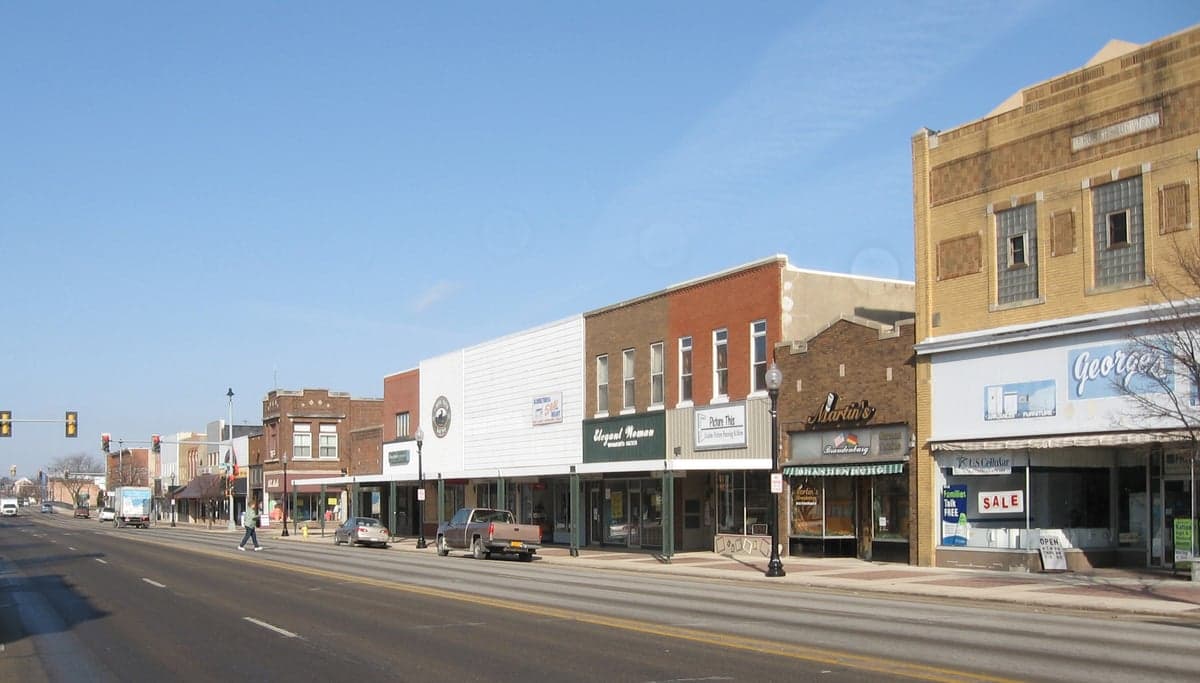
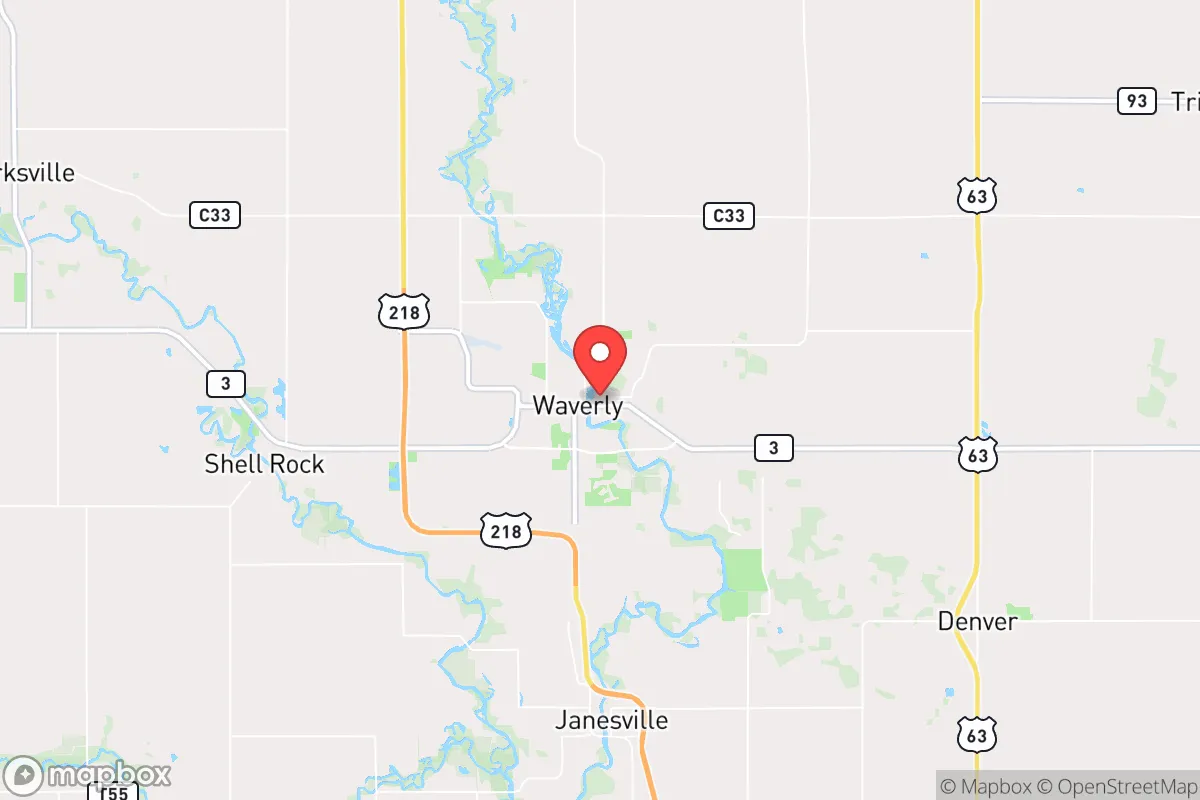

Photo: Wikipedia
Demographics of Waverly, IA
Affluence Level in Waverly, IA
A middle-class area roughly in line with national averages across income, home values, education, and employment.
People of Waverly, IA
Waverly, Iowa, is a predominantly white, college-educated community of 10,446 residents, anchored by Wartburg College and a strong German Lutheran heritage. The city is notably homogeneous, with 89.9% of the population identifying as white and a foreign-born share of just 0.9%, well below state and national averages. Its identity is shaped by a stable, family-oriented character, with a median age of 35.7 and a high proportion of owner-occupied homes in established neighborhoods. For a conservative-leaning relocator, Waverly represents a culturally cohesive, low-diversity small city where civic life revolves around the college, local churches, and the Cedar River corridor.
How the city was settled and grew
Waverly’s population history begins with German Lutheran immigrants who arrived in the 1850s, drawn by cheap land along the Cedar River and the promise of religious freedom. The city was platted in 1854, and the first wave of settlers—primarily farmers and tradesmen from Saxony and Hanover—built the core of what is now the Historic Downtown District, centered on Bremer Avenue. These early residents established St. Paul’s Lutheran Church (1856) and Wartburg College (1852, relocated to Waverly in 1935), which became the twin anchors of the community’s identity. A second wave of German-speaking immigrants arrived in the 1870s and 1880s, settling in the North Waverly neighborhood along the railroad line, where they worked in the newly built grain elevators and the Waverly Brick & Tile Company. By 1900, the population had reached 2,500, and the city’s ethnic character was almost entirely German Lutheran, with small pockets of Irish and Scandinavian families in the South Side near the river. The mid-20th century brought little demographic change; Waverly remained a quiet, white, Protestant town, with growth driven by the expansion of Wartburg College and the opening of the Waverly Municipal Airport in 1948.
Modern era (post-1965)
After the 1965 Hart-Cellar Act, Waverly saw virtually no immigration-driven diversification. The foreign-born population today is 0.9%, and the city’s racial composition has shifted only marginally since 1970. The most notable change has been the growth of the Hispanic population to 3.2%, concentrated in the West Bremer Avenue corridor, where a small number of Mexican-origin families have settled, working in construction and at the Tyson Foods plant in nearby Waterloo. The Black population (2.3%) is largely tied to Wartburg College, with faculty and students living in the College Hill neighborhood surrounding the campus. East/Southeast Asian residents (1.6%) are almost entirely international students and faculty at Wartburg, residing in campus housing or the East Park area near the college’s athletic fields. The Indian subcontinent population (0.1%) is negligible, consisting of a handful of medical professionals at the Waverly Health Center. Domestic in-migration has been modest, with most new residents coming from other parts of Bremer County or the Waterloo-Cedar Falls metro area, drawn by Waverly’s low crime rates and strong school system. The Prairie View subdivision, developed in the 1990s and 2000s on the city’s east side, absorbed most of this growth, attracting young families and retirees seeking newer, larger homes.
The future
Waverly’s population is projected to remain stable or grow slowly, with the 2020 census showing a 2.1% increase from 2010. The city is not homogenizing further—it is already near the ceiling of demographic uniformity for a Midwestern town of its size. The Hispanic share may inch upward to 4-5% over the next decade, driven by natural increase and continued employment in regional agriculture and manufacturing, but the foreign-born share will likely stay below 2%. The East/Southeast Asian population will fluctuate with Wartburg College’s international enrollment, which has declined slightly since 2020. There is no evidence of tribalization into distinct ethnic enclaves; the small minority populations are dispersed across the city, with no single neighborhood exceeding 10% non-white. The most significant demographic trend is aging: the share of residents over 65 rose from 14.2% in 2010 to 18.1% in 2020, and the North Waverly neighborhood, with its older housing stock, is seeing a gradual turnover to younger families as retirees downsize or move to assisted living facilities.
For a conservative-leaning relocator, Waverly is a stable, culturally homogeneous small city where the population is not rapidly changing. The community’s German Lutheran roots remain visible in its churches, college, and civic calendar, and the low foreign-born share means little linguistic or cultural friction. The city is becoming slightly older and slightly more Hispanic, but the pace is slow enough that a newcomer can expect the Waverly of 2035 to look and feel much like the Waverly of today—a safe, orderly, college town with a strong sense of place.

* Values derived from national, state, county, city and local statistics and may differ in a specific area. Last updated: 2026-04-20T06:24:44.000Z
Narrative content on this page is AI-generated and may contain mistakes. Verify any details that matter before acting on them.
ReloMaps may earn a commission from affiliate links at no extra cost to you.

