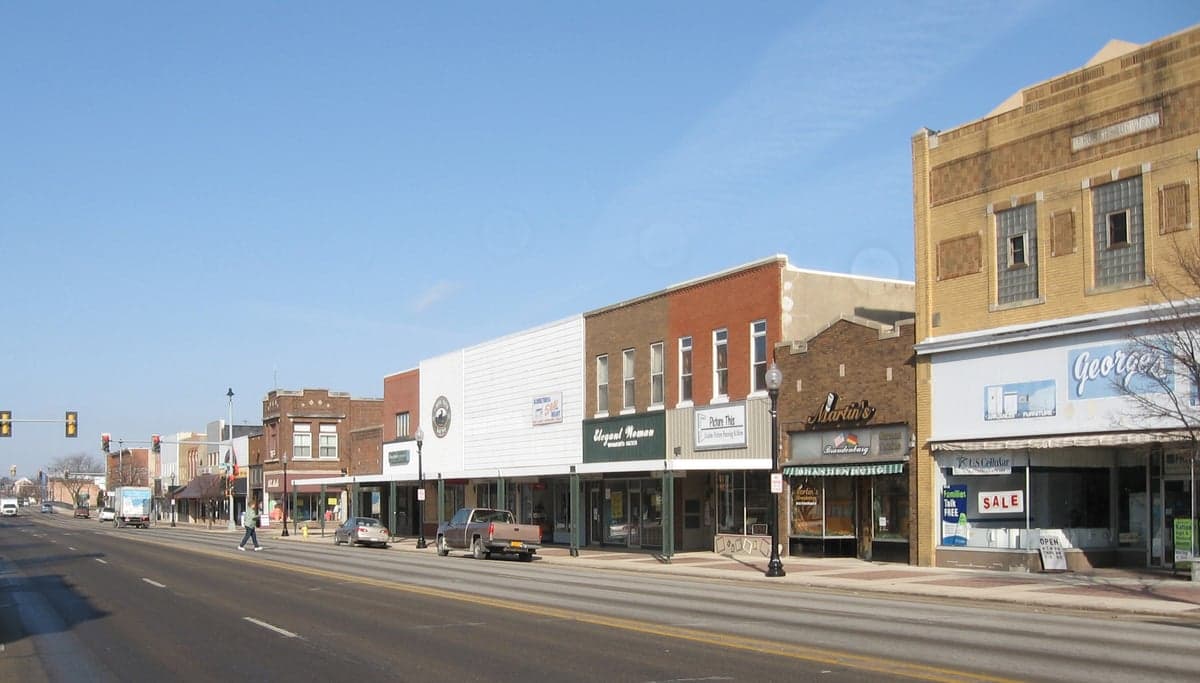
Photo: Wikipedia
Political ClimatePolitical Climate in Waverly, IA
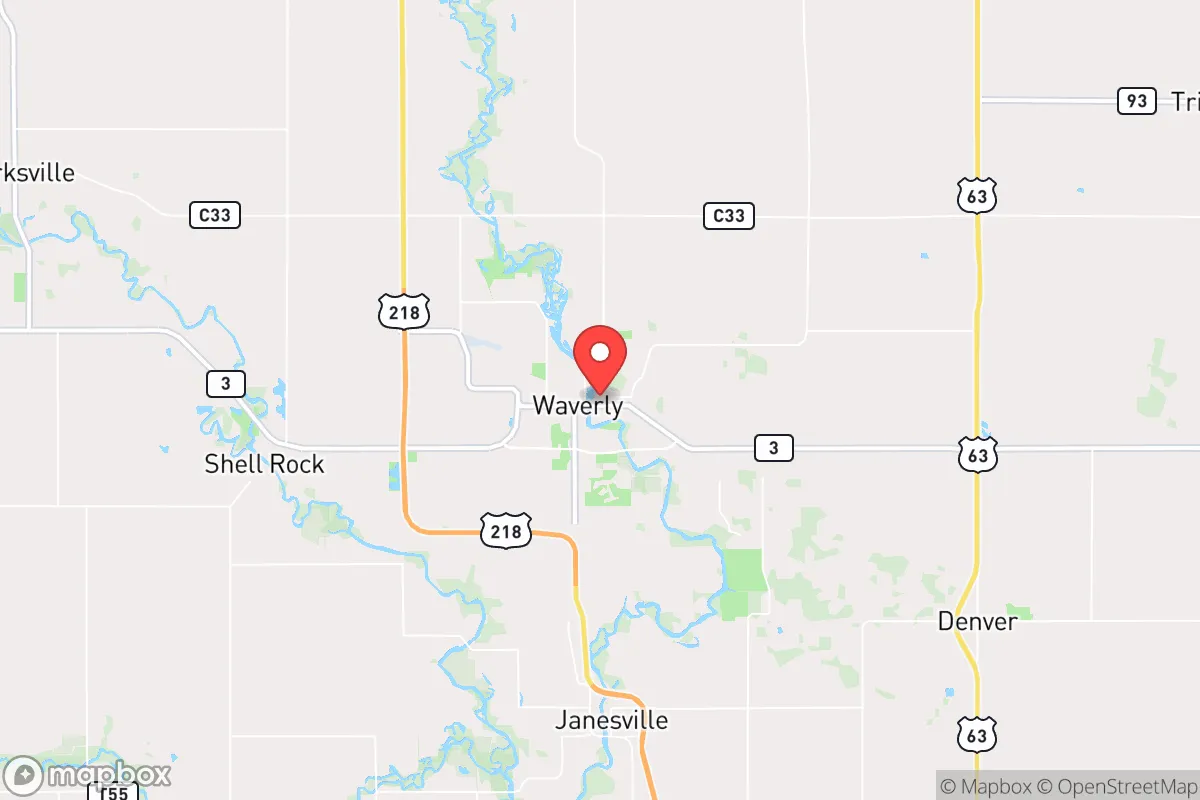
District shown is the primary district for this city’s centroid. Cities may span multiple districts.
Local Political AnalysisPolitical Analysis of Waverly, IA
Waverly, Iowa, sits in a reliably conservative pocket of Bremer County, with a Cook PVI of R+4 that reflects its longstanding Republican lean. For decades, this town has been a place where folks value personal responsibility and limited government, and while the local voting patterns have held steady, there's a growing unease among long-time residents about the direction of things. The 2024 election saw the county go for Trump by a solid margin, but you can feel the subtle shifts in the air—especially as younger families move in from more liberal areas like Waterloo or Cedar Falls, bringing with them a different set of priorities that don't always align with the traditional, freedom-minded values that built this community.
How it compares
Compared to its neighbors, Waverly is a bit of a conservative island in a sea of mixed politics. Head south to Waterloo or Cedar Falls, and you're in Black Hawk County, which leans left—Waterloo's urban core votes reliably Democratic, and the University of Northern Iowa in Cedar Falls pulls that area further blue. Drive west to Tripoli or Sumner, and you'll find even deeper red territory, where the R+4 rating here might actually seem moderate. Waverly's own political identity is shaped by its mix of Wartburg College (a Lutheran institution that tends to be more socially moderate) and a strong agricultural base that prizes independence from government overreach. The contrast is stark: in Waverly, you can still have a conversation about property rights and school choice without getting side-eyed, while in Cedar Falls, those same topics might get you labeled as out of touch. That's the kind of divide that makes you appreciate Waverly's balance, even if you're watching the edges fray a bit.
What this means for residents
For the people who live here, the political climate directly shapes daily life in ways that matter. Property taxes remain relatively low compared to the metro areas, and there's a general resistance to new regulations on small businesses—something that keeps Main Street alive with independent shops rather than chain stores. The school board has held the line on curriculum battles, keeping parental rights front and center, but there's been a push in recent years for more "equity initiatives" that some see as creeping government overreach into classrooms. Local zoning laws are still friendly to landowners, meaning you can build a shed or run a small repair shop without jumping through hoops, but the city council has flirted with stricter codes that would require permits for things that used to be common sense. For residents who value their Second Amendment rights, Waverly remains a safe haven—no local restrictions on carry permits—but the state-level chatter about red flag laws has everyone watching closely. The bottom line: if you want to live where your voice still counts and the government stays out of your business, Waverly is a good bet, but you've got to stay engaged to keep it that way.
Culturally, Waverly still holds onto its small-town character, with the Bremer County Fair and the annual Waverly Heritage Days drawing crowds that feel like family reunions. But there's a noticeable shift in the local discourse—more talk about "sustainability" and "inclusivity" at city meetings, which rubs some the wrong way when it comes with new ordinances that feel like solutions in search of problems. The Wartburg College influence brings a more progressive student body that sometimes clashes with the town's conservative core, especially around issues like housing density and public art displays. If you're a long-time resident, you'll recognize the tension: the same folks who fought to keep the town square from becoming a parking lot are now fighting to keep the town's identity from being washed out by outside trends. It's not a crisis yet, but the trajectory is worth watching—because once you lose the freedom to live your own way, it's hard to get it back.

State Political ClimatePolitical Climate in Iowa
State Political AnalysisPolitical Environment in the State
Iowa has been a reliably Republican state in presidential elections since 2016, but its political identity is more nuanced than a simple red-state label suggests. The state’s overall partisan lean is roughly R+6, with Republicans holding all four U.S. House seats, both U.S. Senate seats, and a trifecta in state government. Over the past 20 years, Iowa has shifted from a classic swing state (voting for Obama in 2008 and 2012) to a solidly conservative one, driven by rural realignment and the exodus of union-aligned Democrats from industrial towns. However, the Des Moines metro and a handful of college towns still punch well above their weight for Democrats, creating a sharp geographic and cultural split that any new resident should understand.
Urban vs. rural divide
The political map of Iowa is a textbook case of the urban-rural chasm. The Des Moines metro (Polk, Dallas, and Warren counties) is the state’s Democratic stronghold, delivering margins of 55-60% for Democrats in recent cycles. Polk County alone cast over 200,000 votes in 2024, and its suburbs like West Des Moines and Ankeny are increasingly competitive, trending left as white-collar professionals move in. On the other hand, rural counties like Plymouth, Sioux, and Lyon in northwest Iowa routinely vote 75-80% Republican. The real battleground is the eastern third of the state, where old industrial cities like Davenport and Bettendorf (Scott County) are trending redder as union membership declines. In 2024, Scott County flipped to Trump after backing Biden in 2020, a shift that mirrors the broader Midwestern realignment of working-class voters away from Democrats. The University of Iowa’s home, Iowa City (Johnson County), remains a deep-blue outlier, voting 70% Democratic, but it’s an island in a sea of red.
Policy environment
Iowa’s policy environment has shifted decisively rightward since 2017, and the results are tangible. The state has a flat income tax rate of 3.8% (phasing down to 3.5% by 2027), no inheritance tax, and a property tax system that caps annual growth for homeowners. Governor Kim Reynolds signed a 6-week abortion ban in 2023 (HF 732), which took effect after a court ruling in 2024, making Iowa one of the most restrictive states in the Midwest on that issue. Education policy is a major draw for conservative families: Iowa’s Education Savings Account (ESA) program, signed in 2023, gives every K-12 student roughly $7,600 in state funds to use for private school tuition, homeschooling, or other approved expenses. This is a universal school choice program with no income cap, making it one of the most expansive in the nation. On healthcare, Iowa did not expand Medicaid under the traditional ACA model, instead using a managed-care waiver system that has kept costs lower than neighboring Illinois but drawn criticism for limited provider networks. Election laws were tightened in 2021 (SF 413), requiring voter ID, reducing early voting days from 29 to 20, and closing polls at 8 p.m. sharp. For a conservative moving in, the policy environment is broadly favorable: low taxes, school choice, and a regulatory posture that favors business over bureaucracy.
Trajectory & freedom
Iowa is clearly trending more free in the areas that matter most to conservative residents. The 2021 permitless carry law (HF 756) allows any legal gun owner to carry a concealed firearm without a permit, and the state preempts all local gun ordinances, meaning cities like Des Moines cannot impose their own restrictions. Parental rights were strengthened in 2023 with HF 604, which requires schools to notify parents of any curriculum involving sexual orientation or gender identity and prohibits instruction on those topics in kindergarten through 6th grade. This law has been a flashpoint, but for families who want transparency in education, it’s a clear win. On the economic freedom front, Iowa became a right-to-work state in 2017, and in 2023 it passed a law (HF 616) banning local governments from requiring project labor agreements on public construction, effectively ending union-friendly contracting in most cities. The one area where freedom has arguably contracted is medical autonomy: the 2023 abortion ban and a 2024 law restricting gender-affirming care for minors (HF 68) represent a significant expansion of state power over medical decisions. For a conservative family, these are likely seen as protecting life and children, not restricting liberty. Overall, the trajectory is toward less government interference in education, guns, and taxes, with more intervention on social issues.
Civil unrest & political movements
Iowa has not seen the large-scale civil unrest of coastal states, but there have been notable flashpoints. In 2020, Des Moines and Iowa City saw several nights of protests following George Floyd’s death, with some property damage and a heavy police response. Since then, organized activism has been more subdued, though the left-leaning group Iowa Citizens for Community Improvement continues to agitate on environmental and housing issues. On the right, the Iowa Firearms Coalition is a well-funded, highly effective lobbying force that has driven the state’s gun-friendly legislation. Immigration politics are relatively quiet compared to border states, but in 2024, Governor Reynolds deployed the Iowa National Guard to Texas as part of Operation Lone Star, a symbolic move that resonated with rural voters. There is no sanctuary city policy anywhere in Iowa; in fact, a 2018 law (SF 481) requires local law enforcement to honor federal immigration detainers. Election integrity controversies have been minimal, though the 2020 audit of Linn County (Cedar Rapids) found no significant irregularities, and the state’s voter ID law has not produced the long lines or disenfranchisement that critics predicted. A new resident would notice that political signs are ubiquitous in rural areas, but actual conflict is rare—most Iowans are polite even when they disagree.
Projection
Over the next 5-10 years, Iowa will likely become more Republican at the state level, but the Des Moines metro will continue to drift left, creating a growing cultural divide within the state. In-migration is modest but steady, with most newcomers coming from Illinois, Minnesota, and California—many of them conservative families seeking lower taxes and school choice. The state’s population is aging and slowly declining in rural areas, but the Ankeny and Waukee suburbs are booming, adding thousands of new homes annually. Demographically, Iowa remains over 85% non-Hispanic white, and that is unlikely to change dramatically, meaning the political dynamics will be driven by internal migration (rural to suburban) rather than ethnic diversification. The biggest wildcard is the future of the state’s agricultural economy: if commodity prices stay high and ethanol demand holds, rural areas will remain stable; a downturn could accelerate the rural-to-urban shift and weaken the GOP’s base. On policy, expect further tax cuts, continued expansion of school choice (possibly including a voucher for homeschoolers), and more restrictions on abortion and transgender medical procedures. The state’s freedom score will likely rise for economic and educational issues, while contracting on social and medical ones.
For a conservative moving to Iowa, the bottom line is this: you are getting a state that is actively governed by your values, with low taxes, school choice, gun rights, and a culture that respects hard work and self-reliance. The trade-off is that you will live in a state where the urban centers are increasingly hostile to those values, and where the state government is willing to use its power to enforce social conservatism. If you want a place where your kids can go to a private school on the state’s dime, where you can carry a gun without a permit, and where your property taxes won’t skyrocket, Iowa is a strong bet. Just be prepared for cold winters and a political landscape that, while friendly to you, is not without its own internal tensions.
* Values derived from national, state, county, city and local statistics and may differ in a specific area. Last updated: 2026-04-20T06:24:44.000Z
Narrative content on this page is AI-generated and may contain mistakes. Verify any details that matter before acting on them.
ReloMaps may earn a commission from affiliate links at no extra cost to you.

