
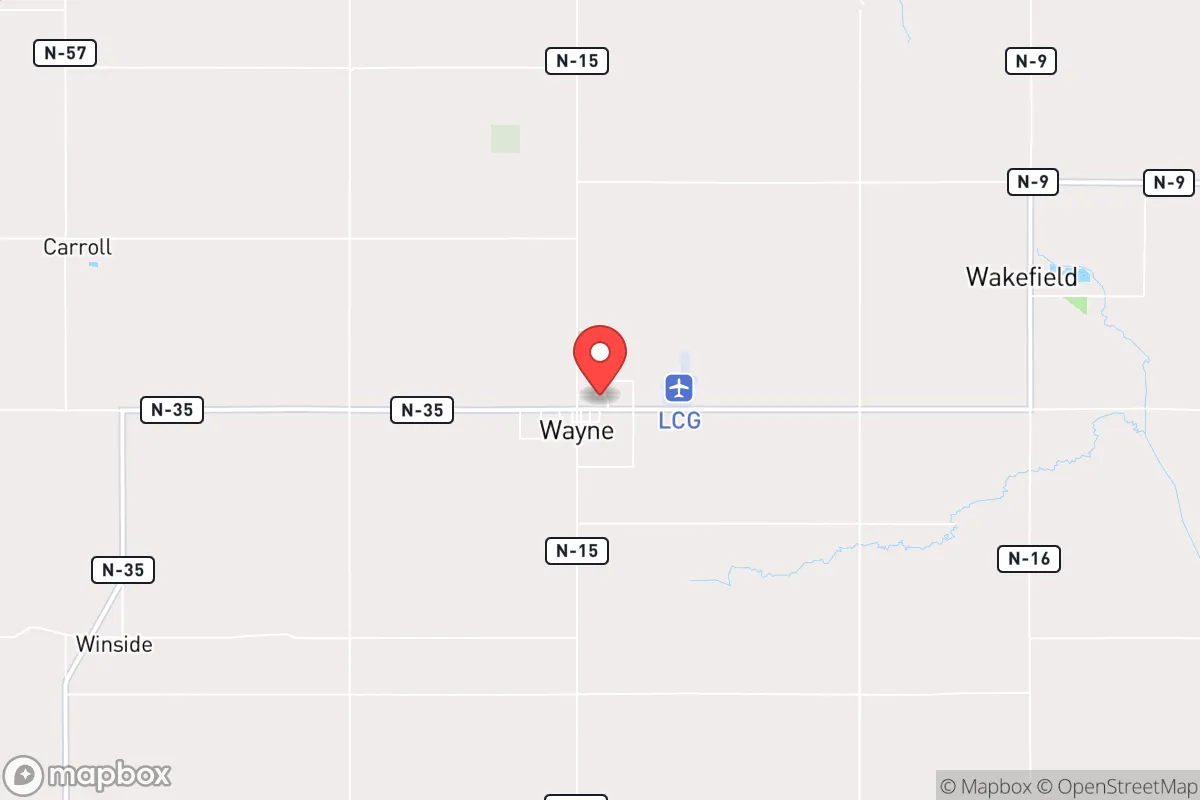
Photo: Wikipedia
Personal Sovereignty in Wayne, NE
Viable for self-reliance. Generally workable, though some barriers may limit total independence.
What does Personal Sovereignty tell us?
Personal Sovereignty measures your capacity for self-reliance and independence with minimal government friction. Higher scores mean fewer barriers between you and the way you want to live... but it assumes you have the space you need and good neighbors.
What does this tell us?
Personal Sovereignty measures your capacity for self-reliance and independence with minimal government friction. Higher scores mean fewer barriers between you and the way you want to live... but it assumes you have the space you need and good neighbors.
State Policy
Energy independence: Importer (35% of energy produced in-state)
Personal Liberty
Homesteading

Personal Liberty Analysis
Wayne, Nebraska, offers a notably high degree of personal sovereignty for those seeking to minimize government overreach in daily life, particularly when compared to coastal or more densely regulated states. The city and surrounding Wayne County operate within a state framework that consistently ranks among the most freedom-oriented in the nation, with low tax burdens, minimal business licensing, and a legal culture that generally presumes individual competence over bureaucratic permission. For the survivalist or prepper mindset, this translates into a practical environment where self-reliance is not just tolerated but structurally supported by state law and local custom.
Tax burden and regulatory posture: what it means for your wallet and plans
Nebraska’s tax structure is a mixed bag, but Wayne benefits from the state’s relatively low property tax rates on agricultural and rural land, which directly supports homesteading and larger lot ownership. The state’s income tax is a flat 3.99% as of 2026, with no city-level income tax in Wayne, keeping more of your earnings in your control. Sales tax in Wayne County is 7%, but essentials like unprepared food and prescription drugs are exempt, which matters for long-term stockpiling. The regulatory posture in Wayne is decidedly hands-off: there are no county-level building codes for most rural parcels, no zoning restrictions on keeping livestock within city limits on lots over one acre, and no state-level permit required for rainwater collection systems. This means you can install a backup well, set up solar panels, or build a root cellar without navigating a permitting maze. The state’s right-to-farm laws further protect agricultural practices from nuisance lawsuits, a critical consideration for anyone planning to raise food or keep bees for self-sufficiency.
Self-defense and gun law specifics: carrying, storing, and using firearms
Nebraska is a constitutional carry state, meaning no permit is required to carry a concealed firearm for anyone legally allowed to possess one. Wayne’s local law enforcement, the Wayne Police Department, is known for a pro-Second Amendment stance and does not enforce any additional local restrictions beyond state law. The state preempts all local firearm ordinances, so you won’t find the patchwork of city-level bans common in states like Colorado or California. Stand-your-ground laws are in effect, with no duty to retreat in any place you are lawfully present. For preppers, this extends to property defense: Nebraska law explicitly allows deadly force to prevent a forcible felony, including burglary of an occupied dwelling. Magazine capacity is unrestricted, and there is no state-level registry for long guns or handguns. The only notable restriction is a 48-hour waiting period for handgun purchases from licensed dealers, but private sales between individuals remain unregulated. For those building a defensive arsenal, Wayne’s proximity to Sioux City, Iowa (about 30 minutes east) provides access to a wider market for firearms and ammunition without the bureaucratic hurdles of coastal states.
Self-reliance and homesteading viability: lot sizes, zoning, and off-grid feasibility
Wayne’s zoning code is remarkably permissive for a town of its size (population ~5,600). Within city limits, lots as small as 7,000 square feet are common, but the city’s extraterritorial jurisdiction allows for acreage parcels just outside town where you can own 1 to 5 acres without county interference. The city allows chickens, goats, and up to two beehives on residential lots over 10,000 square feet, with no permit required. For off-grid living, Nebraska law explicitly protects the right to generate your own electricity via solar or wind, and net metering is available through the local utility, Wayne County Public Power District. Rainwater harvesting is legal and encouraged, with no volume limits. Composting toilets and greywater systems are permitted under the state’s alternative onsite wastewater rules, which require only a simple registration rather than a costly engineered plan. The biggest practical consideration for off-grid feasibility is water: Wayne sits atop the Ogallala Aquifer, meaning well drilling is viable and relatively inexpensive (typically $15–$25 per foot for a domestic well). The city’s climate—hot summers and cold winters—makes passive solar design and wood heat practical, and there are no restrictions on cutting firewood from your own property.
Personal liberties: parental rights, medical autonomy, speech, and property
Nebraska has strong parental rights protections under state law, including a statute that explicitly affirms parents’ fundamental right to direct the upbringing, education, and healthcare of their children. Wayne’s public school system, Wayne Community Schools, is generally responsive to parental concerns, and the district does not enforce mask mandates or vaccine requirements for attendance. Medical autonomy is robust: Nebraska has no state-level vaccine passport system, and the state’s health freedom laws protect the right to refuse any medical treatment, including emergency interventions, for yourself and your minor children. The state also has a religious exemption for all vaccine requirements, and a philosophical exemption for school attendance. Speech protections are strong under Nebraska’s constitution, which has been interpreted by state courts to provide broader free speech protections than the First Amendment in some contexts, particularly regarding political speech and assembly. Property rights are reinforced by Nebraska’s Private Property Protection Act, which requires the government to pay just compensation for any regulatory taking that reduces property value by more than 50%. This means you can build a bunker, install a fence, or clear land without fear of arbitrary government action that destroys your investment.
Overall, Wayne, Nebraska ranks among the top 15% of U.S. micropolitan areas for personal sovereignty, particularly for those prioritizing self-defense, off-grid capability, and minimal government interference in family and medical decisions. The combination of constitutional carry, strong parental rights, permissive zoning for homesteading, and a legal culture that respects property rights creates an environment where a survivalist or prepper can operate with minimal friction. While no location is perfect—Nebraska’s income tax is higher than Texas or Florida, and the state has a sales tax on some preparedness supplies—Wayne’s low cost of land, access to water, and absence of coastal-style overregulation make it a strong candidate for anyone serious about building a self-reliant life outside the reach of federal and state overreach.

* Values derived from national, state, county, city and local statistics and may differ in a specific area. Last updated: 2026-04-22T23:52:15.000Z
Narrative content on this page is AI-generated and may contain mistakes. Verify any details that matter before acting on them.
ReloMaps may earn a commission from affiliate links at no extra cost to you.

