Photo: Wikipedia
Demographics of Welch, WV
Affluence Level in Welch, WV
A low-income area with significant economic hardship. Household wealth and educational attainment are well below national averages.
People of Welch, WV
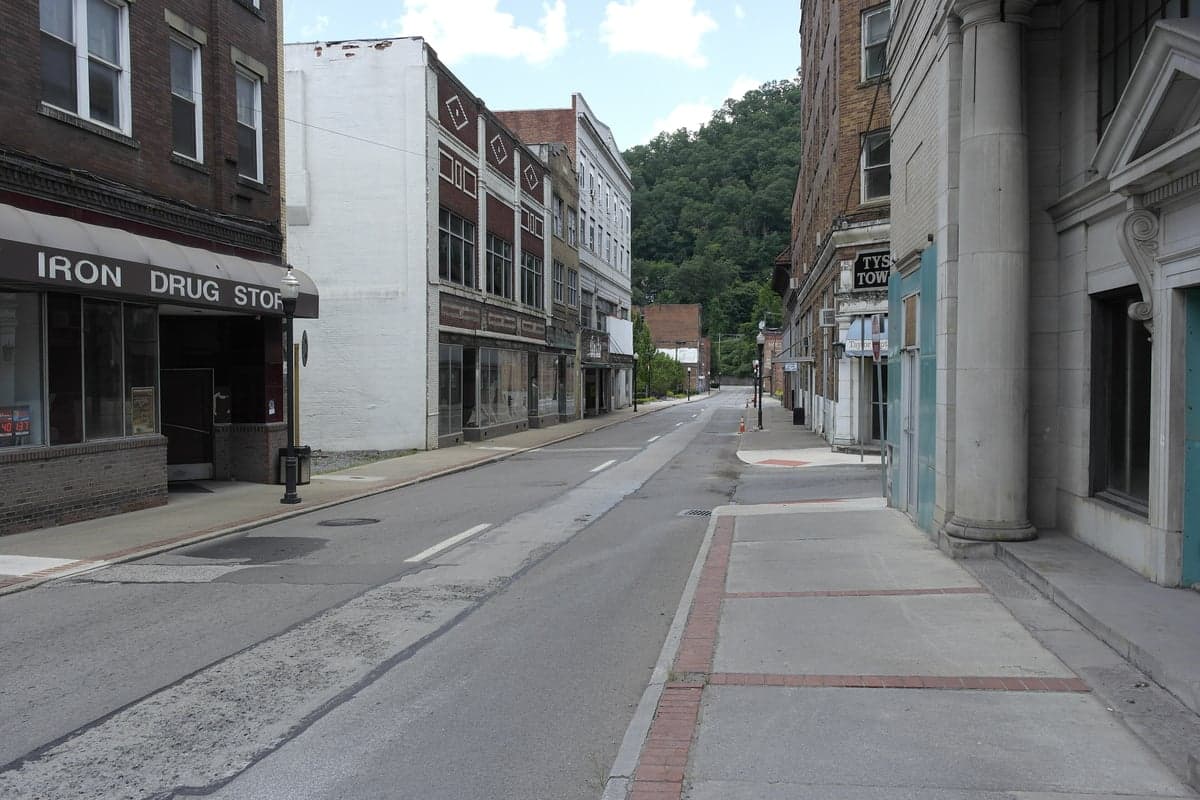
The people of Welch, West Virginia today number 3,492, forming a compact, historically Black and white community in the heart of McDowell County. The city is notably less diverse than the national average, with a population that is 66.3% white, 24.2% Black, and 9.0% Hispanic, while the foreign-born share stands at 6.9%. A distinctive marker of Welch’s character is its low college attainment rate of 6.3%, reflecting a working-class heritage tied to coal mining and a population that has remained remarkably stable in its core demographic composition despite decades of economic decline. The city’s identity is shaped by a deep sense of place, with long-established families and a strong local pride that contrasts with the transient populations seen in many other Appalachian towns.
How the city was settled and grew
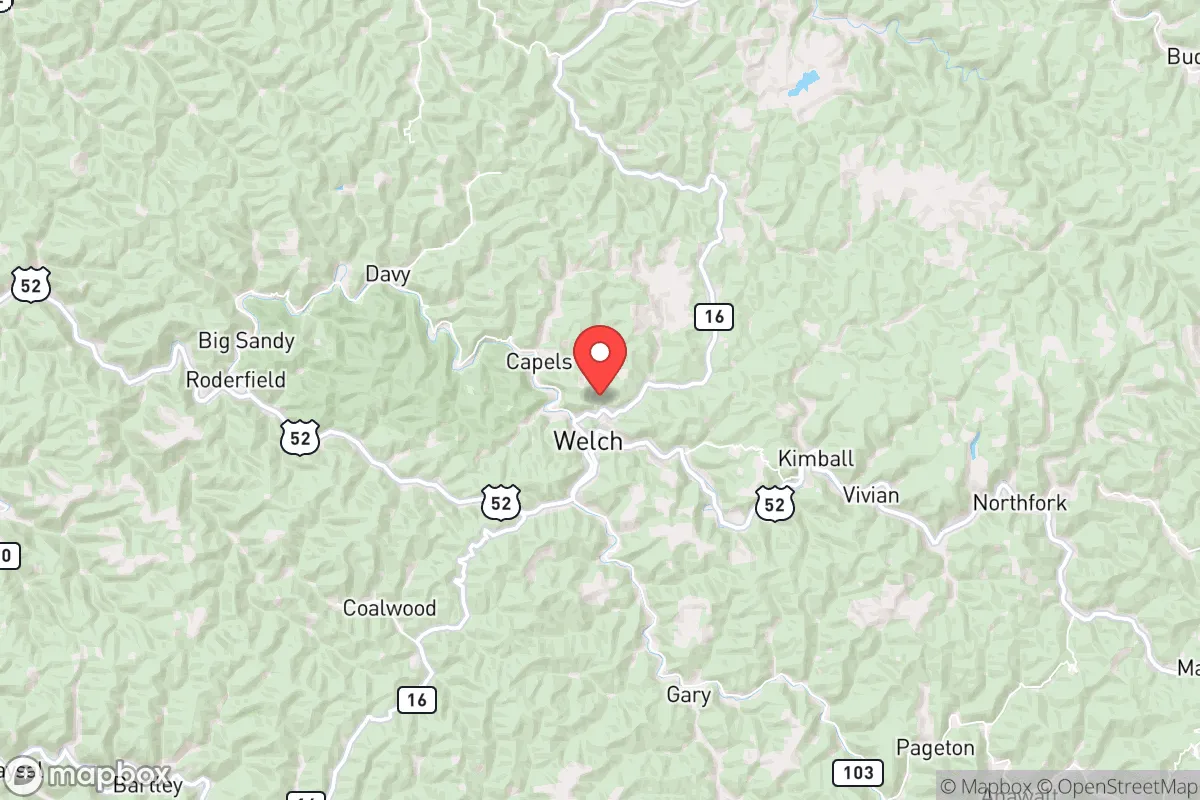
Welch was founded in the 1890s as a railroad and coal mining hub, drawing its first major wave of settlers from the surrounding Appalachian region. The Norfolk & Western Railway’s arrival in 1892 spurred rapid growth, with the town incorporated in 1893. The original population was overwhelmingly white, composed of native-born Americans from nearby counties in West Virginia and Virginia, who built the early neighborhoods like North Welch and South Welch along the Tug Fork River. A second major wave came during the Great Migration (1910–1940), when Black families from the Deep South—primarily from Alabama, Georgia, and the Carolinas—moved to Welch for work in the coal mines. These families settled predominantly in the Kimball area (a neighboring community that functionally merged with Welch’s southern edge) and the Coalwood district, where they formed tight-knit communities centered on the region’s coal camps. By 1950, Welch’s population peaked at over 5,000, with Black residents making up roughly 30% of the total, a proportion that has remained remarkably consistent into the 2020s.
Modern era (post-1965)
The post-1965 era brought significant demographic shifts, though Welch’s core racial composition changed less dramatically than many other U.S. cities. The collapse of the coal industry in the 1970s and 1980s triggered a steady population decline, with the city losing nearly half its residents between 1970 and 2020. The white population shrank faster than the Black population, as many white families left for job opportunities in the Midwest and Southeast. Meanwhile, the Black community, anchored by historic neighborhoods like Kimball and Coalwood, remained more rooted, with many families staying due to strong social networks and lower mobility. A newer, smaller wave arrived in the 1990s and 2000s: Hispanic immigrants, primarily from Mexico and Central America, drawn to the region’s remaining mining and service jobs. These families settled mainly in the North Welch area and along the Route 52 corridor, where they now form a visible 9.0% of the population. The foreign-born share of 6.9% is notably higher than the West Virginia state average of 1.6%, driven almost entirely by this Hispanic influx. East/Southeast Asian residents remain a tiny fraction (0.3%), and Indian-subcontinent residents are statistically zero, reflecting Welch’s lack of the professional-class immigration seen in larger cities.
The future
Welch’s population is likely to continue its slow decline, with the city projected to fall below 3,000 by 2035 if current trends hold. The white population is aging and shrinking, while the Black community is stabilizing at roughly a quarter of the total. The Hispanic population is the only segment showing growth, though it remains small in absolute numbers—likely to reach 12–15% of the city by 2040 if current migration patterns persist. This growth is concentrated in North Welch and the Route 52 corridor, where new Hispanic-owned businesses are beginning to appear, but the community remains largely assimilated into the broader working-class culture. The city is not tribalizing into distinct enclaves; rather, it is homogenizing around a shared economic struggle, with all groups facing similar challenges of poverty, low educational attainment, and limited job opportunities. The Black and white populations continue to live in the same historic neighborhoods, though social networks remain somewhat separate. For someone moving in now, Welch offers a place where community ties are strong and the pace of life is slow, but economic prospects are limited and the population is aging. The city is becoming a quieter, more homogenous version of its former self—a place where the past weighs heavily on the present.
In summary, Welch is a shrinking, historically biracial Appalachian coal town that is slowly diversifying through Hispanic immigration while retaining its core Black and white working-class character. The city’s future is one of continued population loss and economic stagnation, but with a stable social fabric that values continuity over change. For a conservative-leaning individual or family, Welch offers a low-cost, low-crime environment with strong community bonds, but little in the way of new job creation or upward mobility.

* Values derived from national, state, county, city and local statistics and may differ in a specific area. Last updated: 2026-04-24T11:21:39.000Z
Narrative content on this page is AI-generated and may contain mistakes. Verify any details that matter before acting on them.
ReloMaps may earn a commission from affiliate links at no extra cost to you.

