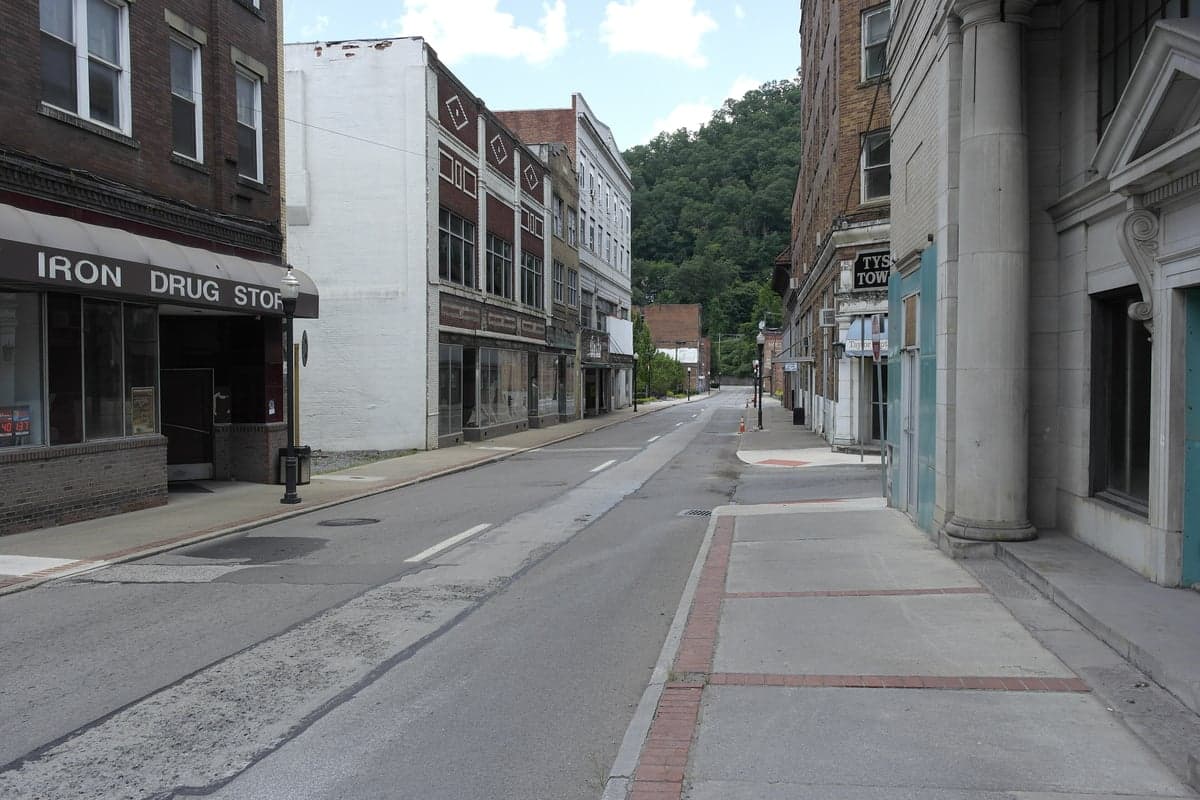
Photo: Wikipedia
Political ClimatePolitical Climate in Welch, WV
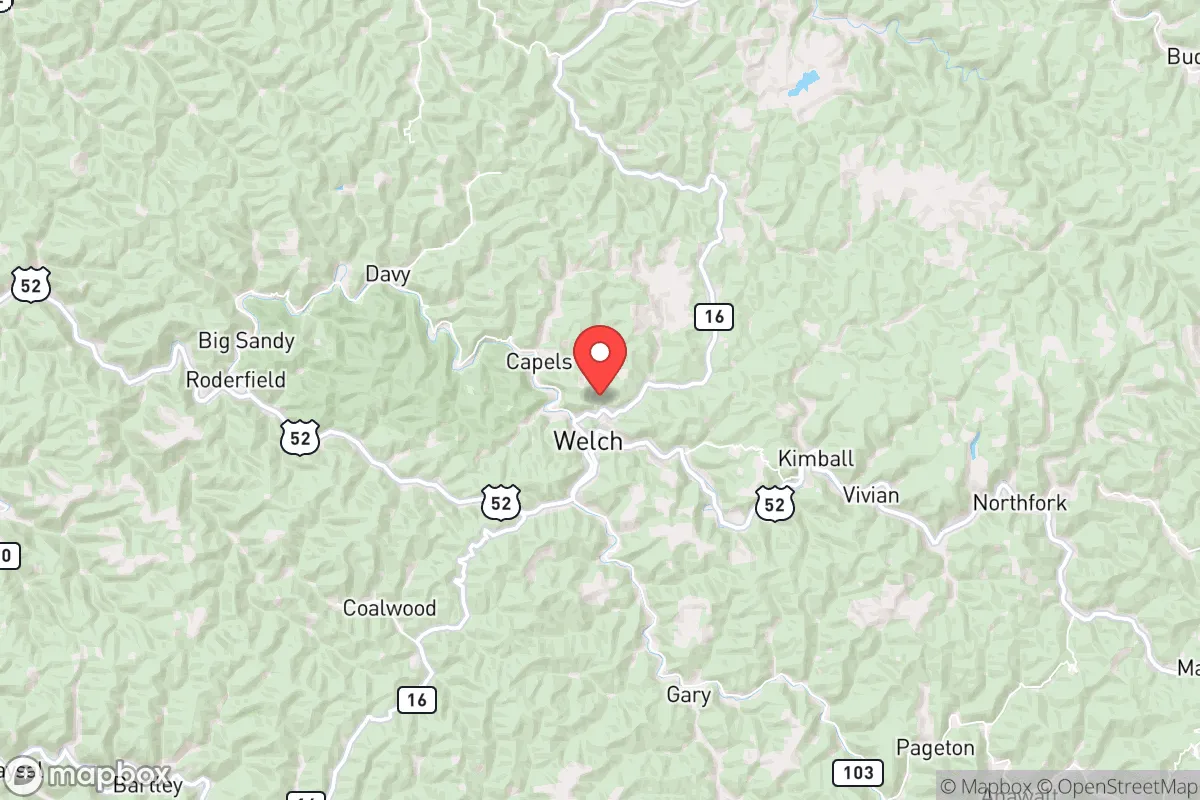
District shown is the primary district for this city’s centroid. Cities may span multiple districts.
Local Political AnalysisPolitical Analysis of Welch, WV
Welch, West Virginia, sits deep in the heart of McDowell County, and politically, it’s about as solidly conservative as you’ll find anywhere in the country. The Cook PVI of R+22 isn’t just a number—it reflects a community that has voted overwhelmingly Republican for decades, and that trend has only hardened in recent years. Back in the 1990s, this area was still reliably Democratic on the local level, but the national party’s shift left on coal, energy, and social issues drove a realignment that’s now complete. Today, you’d be hard-pressed to find a yard sign for a Democrat in the entire county, and the local elections are decided in the GOP primary.
How it compares
Drive 45 minutes north to Bluefield, and you’ll see a similar conservative tilt, though it’s a bit more moderate thanks to a stronger hospital and college presence. Head east to Princeton, and you’ll find a slightly more mixed political scene, with some younger families leaning independent. But the real contrast is with places like Morgantown or Charleston, where progressive policies on energy transition and social issues have taken hold. In Welch, those ideas are seen as a direct threat to the way of life here. The coal mines may not be what they were, but the culture of self-reliance and distrust of government overreach is as strong as ever. People here remember when federal regulations gutted the mining industry, and they’re not eager to repeat that mistake with new mandates on energy or personal freedoms.
What this means for residents
For someone moving to Welch, the political climate means you’ll experience a community that values personal liberty and local control above almost everything else. There’s no appetite for government telling you what you can do with your property, your business, or your family. The local school board and county commission are dominated by folks who prioritize low taxes and minimal interference. You won’t see mask mandates or vaccine passports here—those ideas were met with strong resistance during the pandemic. The downside? Public services are limited, and the tax base is thin, so don’t expect the kind of infrastructure you’d find in a progressive city. But for those who value freedom over convenience, it’s a trade-off most locals are happy to make.
There’s also a cultural distinction that’s worth noting: Welch is a place where the Second Amendment isn’t debated—it’s assumed. Gun ownership is nearly universal, and the local sheriff’s office is known for being pro-community and pro-rights. The shift toward progressive ideology that you see in larger cities is viewed here as a dangerous overreach, and the community has made it clear they’ll resist it. If you’re looking for a place where your voice matters and the government stays out of your business, Welch is about as close as you’ll get in the eastern United States. Just don’t expect it to change anytime soon—the political trajectory here is locked in, and it’s pointing firmly right.

State Political ClimatePolitical Climate in West Virginia
State Political AnalysisPolitical Environment in the State
West Virginia has long been one of the most reliably Republican states in the nation, but that wasn’t always the case. As recently as 2000, it was a swing state that voted for George W. Bush by just 6 points, and before that, it was a Democratic stronghold for generations. The shift has been dramatic: by 2024, Donald Trump carried the state by nearly 40 points, with every single county voting red for the first time in modern history. The dominant coalition today is a mix of rural, working-class voters, coal and natural gas workers, and culturally conservative families who have abandoned the national Democratic Party over gun rights, energy policy, and social issues. The trajectory over the last 20 years has been a steady march rightward, and there’s no sign of that slowing down.
Urban vs. rural divide
The political map of West Virginia is surprisingly simple for such a geographically diverse state. The only real blue holdout in recent cycles was Monongalia County, home to Morgantown and West Virginia University, which voted for Joe Biden in 2020 by about 7 points. But even that flipped in 2024, with Trump carrying it by a narrow margin. Charleston (Kanawha County) and Huntington (Cabell County) are now solidly red, though they tend to be less conservative than the surrounding rural areas. The real engine of the Republican vote is the southern coalfields—places like Logan, Mingo, and McDowell counties, where Trump pulled in 80% or more of the vote. The eastern panhandle, including Martinsburg and Berkeley County, has seen an influx of former D.C. metro residents, and while they lean Republican, they’re more moderate on issues like taxes and development. The rural-urban divide here isn’t about left vs. right—it’s about how deep the shade of red is. Even the “cities” feel small-town, and the cultural conservatism is remarkably uniform across the state.
Policy environment
West Virginia’s policy environment is aggressively conservative by national standards, and it’s been getting more so. The state has no personal income tax on Social Security benefits, and in 2023, the legislature passed a phased elimination of the state income tax on all wages, cutting rates by 21% initially with triggers for further reductions as revenue grows. The corporate tax rate is a flat 6.5%, and there’s no franchise tax. Regulatory posture is business-friendly, especially for energy extraction—permitting for natural gas drilling and coal mining is streamlined, and the state has fought EPA overreach in court repeatedly. On education, the 2021 school choice law created the Hope Scholarship, which gives families roughly $4,400 per child to use for private school, homeschooling, or other educational expenses. The state also passed a Parents’ Bill of Rights in 2022, requiring schools to notify parents about curriculum changes and medical services. Healthcare is a mixed bag: the state expanded Medicaid under the ACA, but there’s no state-run exchange, and abortion is banned after 15 weeks with no exceptions for rape or incest, following the 2022 trigger law. Election laws are solid—voter ID is required, early voting is available but limited to 10 days, and there’s no same-day registration. The state also purged non-voters from rolls aggressively in 2024.
Trajectory & freedom
On the freedom front, West Virginia is moving in a strongly libertarian-conservative direction, but it’s not without its contradictions. The biggest win for personal liberty in recent years was the 2021 repeal of the state’s “blue laws” that had banned Sunday alcohol sales and hunting—a long-overdue rollback of government overreach. Gun rights are about as strong as they get: the state has constitutional carry (no permit needed to carry concealed), preemption laws that block local gun control, and a “Stand Your Ground” law. In 2024, the legislature passed a bill prohibiting the enforcement of federal gun laws that conflict with state law—a direct challenge to federal authority. On medical freedom, the state passed a law in 2023 banning COVID-19 vaccine mandates by private employers and government entities, and it prohibits discrimination based on vaccination status. However, there are areas where the state still overreaches: property taxes are relatively high for a low-cost state, and the state’s heavy reliance on severance taxes from coal and gas means energy policy is deeply intertwined with state revenue. The biggest concern for freedom-minded residents is the state’s drug policy—possession of small amounts of marijuana is decriminalized, but full legalization has stalled, and the state still has some of the harshest penalties for fentanyl trafficking. Overall, the trajectory is toward more personal autonomy, especially on guns, medical choices, and education, but the state’s fiscal dependence on extractive industries creates a tension between economic freedom and environmental regulation.
Civil unrest & political movements
West Virginia has a long history of labor activism, but in recent years, the political energy has shifted to conservative and libertarian movements. The 2018 teachers’ strike was a rare moment of cross-ideological unity, with educators from both parties walking out over pay and benefits. But since then, the dominant grassroots energy has been on the right. The state was an early battleground for the “election integrity” movement, with the legislature passing a 2021 law requiring all ballots to be hand-counted in precincts with fewer than 5,000 voters—a response to 2020 concerns. There’s also a strong Second Amendment sanctuary movement, with over 40 counties passing resolutions vowing not to enforce federal gun laws. On immigration, the state is overwhelmingly opposed to sanctuary policies—there are none, and the legislature passed a law in 2023 requiring local law enforcement to cooperate with ICE. The most visible flashpoint for a new resident would be the ongoing debate over energy transition: coal communities in the southern part of the state feel under siege by federal climate policies, and you’ll see “Trump Won” flags and “Coal Keeps the Lights On” signs everywhere. There’s no secessionist movement to speak of, but there is a strong strain of nullification rhetoric, especially around federal environmental regulations. Protests are rare and usually small, focused on specific issues like pipeline construction or school board decisions.
Projection
Over the next 5-10 years, West Virginia is likely to become even more conservative, but the nature of that conservatism may shift. The biggest demographic trend is out-migration of younger, college-educated residents—the state lost population every year from 2013 to 2023, and the remaining population is older and whiter than the national average. In-migration is small but growing, driven by remote workers from D.C., New York, and California looking for low cost of living and conservative governance. These newcomers tend to settle in the eastern panhandle (Martinsburg, Shepherdstown) and around Morgantown, and they’re more libertarian than traditional—they want low taxes and minimal regulation but are less invested in coal culture. This could create a tension between the old-guard Republican establishment and a newer, more tech-oriented conservative base. The state’s fiscal future is uncertain: as coal declines, the severance tax revenue will shrink, and the income tax cuts will put pressure on services. Expect more fights over school funding and infrastructure. Politically, the state will remain deep red, but the internal battles will be between pragmatic conservatives who want to diversify the economy and populists who want to double down on energy extraction. For a new resident, the bottom line is that you’ll find a state that respects your gun rights, your parental authority, and your paycheck—but you’ll also need to be comfortable with a slower pace of life, limited urban amenities, and a political culture that’s unapologetically conservative.
If you’re moving to West Virginia, you’re choosing a state that has fully embraced the conservative vision of limited government on most fronts—guns, taxes, education, and medical freedom are all moving in the right direction. The trade-offs are real: the economy is still heavily tied to extractive industries, the population is aging, and the infrastructure outside the main corridors can be rough. But for someone who values personal autonomy, low taxes, and a community that shares your values, West Virginia offers a level of political alignment that’s hard to find elsewhere. Just know that the state’s freedom comes with a dose of rugged reality—you’ll need to be self-reliant, because the government isn’t going to hold your hand.
* Values derived from national, state, county, city and local statistics and may differ in a specific area. Last updated: 2026-04-24T11:21:39.000Z
Narrative content on this page is AI-generated and may contain mistakes. Verify any details that matter before acting on them.
ReloMaps may earn a commission from affiliate links at no extra cost to you.

