Photo: Wikipedia
Demographics of Wells River, VT
Affluence Level in Wells River, VT
A below-average socioeconomic profile. Incomes, home values, and educational attainment trail the U.S., with higher poverty and unemployment.
People of Wells River, VT
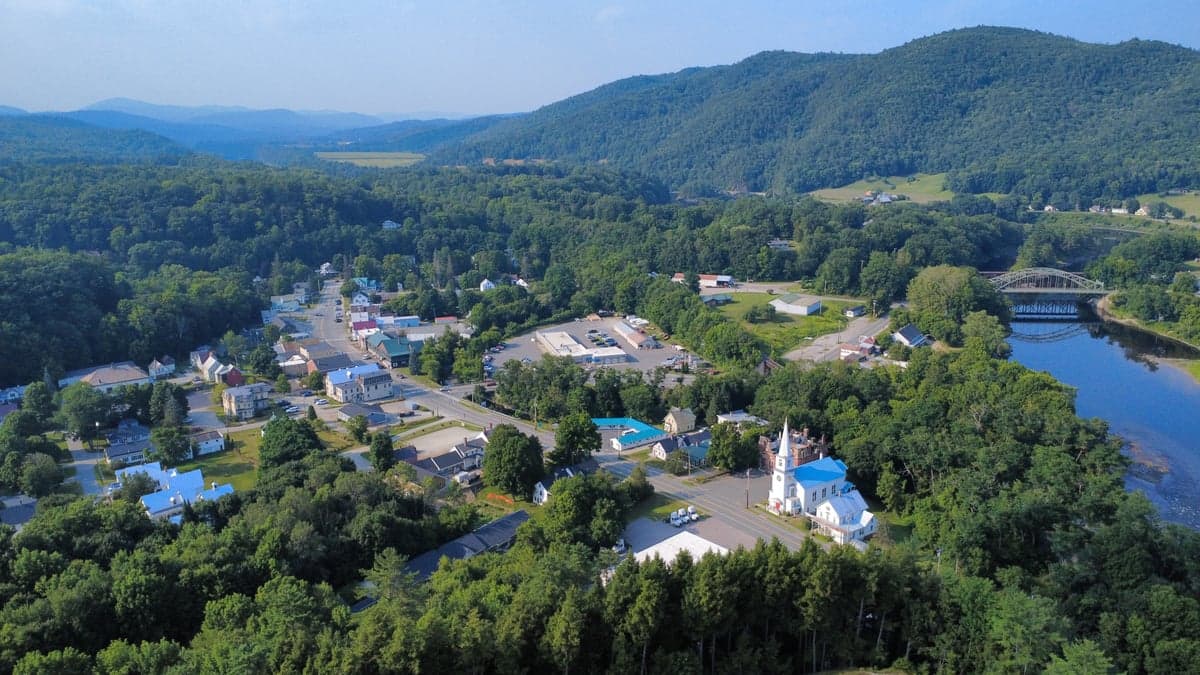
Wells River, Vermont, is a small village of 339 residents with a distinctly rural, working-class character shaped by its history as a railroad and mill town. The population is predominantly white (80.5%) with a notable East/Southeast Asian community (5.9%) and a small Hispanic presence (3.8%), reflecting a modest but real diversity uncommon for a village this size in the Northeast Kingdom. With a college attainment rate of just 15.4%, the population skews toward trades, manufacturing, and service-sector employment, and the village retains a tight-knit, family-oriented identity where generational roots run deep.
How the city was settled and grew
Wells River was originally settled in the late 18th century by Anglo-American farmers from southern New England, drawn by land grants along the Connecticut and Wells Rivers. The village's growth accelerated after 1853 when the Connecticut & Passumpsic Rivers Railroad arrived, making Wells River a critical junction for moving lumber, granite, and agricultural goods. The Depot District around the railroad station became the commercial and industrial core, housing Irish and French Canadian laborers who built the rail lines and worked in the sawmills and granite sheds. By the early 1900s, a small but stable community of French Canadian families had established itself in the Mill Hill neighborhood, living in modest company-built homes near the water-powered mills. The village's population peaked around 500 in the 1920s, then declined as rail traffic diminished and local manufacturing consolidated.
Modern era (post-1965)
After the 1965 Immigration and Nationality Act, Wells River saw limited but notable demographic change. The foreign-born population today stands at 4.1%, a figure driven primarily by a small East/Southeast Asian community—likely families connected to regional manufacturing or service jobs—who settled in the River Road area, a quieter residential stretch along the Connecticut River. The Hispanic population (3.8%) is small and largely consists of individuals working in agriculture or seasonal hospitality, with no concentrated ethnic enclave. The village has not experienced significant Black or Indian subcontinent settlement (both 0.0%). Domestic in-migration has been minimal; most new residents are retirees or remote workers from southern New England seeking lower property costs, often buying older homes in the Main Street Historic District, a cluster of 19th-century buildings near the village green. The overall population has remained stable at around 340 since 2010, with natural decrease offset by modest in-migration.
The future
Wells River's population is likely to remain small and slowly aging, with limited growth potential due to the lack of major employers and housing stock. The East/Southeast Asian community appears stable rather than growing, as younger members often move to larger towns like St. Johnsbury or Barre for education and employment. The Hispanic population may see slight growth if regional dairy and maple operations continue to hire seasonal labor, but permanent settlement is unlikely without affordable rental housing. The village is not tribalizing into distinct enclaves—its size makes that impractical—but there is a subtle divide between long-term families in the Depot District and newer arrivals in the South End, a small subdivision of single-family homes built in the 1990s. The next decade will likely see continued demographic stability, with the village remaining overwhelmingly white and working-class, but with a slightly older median age as younger adults leave for opportunities elsewhere.
For someone moving to Wells River now, the village offers a quiet, affordable, and safe environment with a strong sense of place, but limited economic opportunity and demographic diversity. It is a place where families with deep roots coexist with a small number of newcomers, and where the population is more likely to hold steady than to grow or change significantly. The community's character is best suited to those seeking a low-cost, rural lifestyle with access to outdoor recreation and a close-knit social fabric, rather than career growth or cultural variety.

* Values derived from national, state, county, city and local statistics and may differ in a specific area. Last updated: 2026-04-21T22:54:52.000Z
Narrative content on this page is AI-generated and may contain mistakes. Verify any details that matter before acting on them.
ReloMaps may earn a commission from affiliate links at no extra cost to you.

