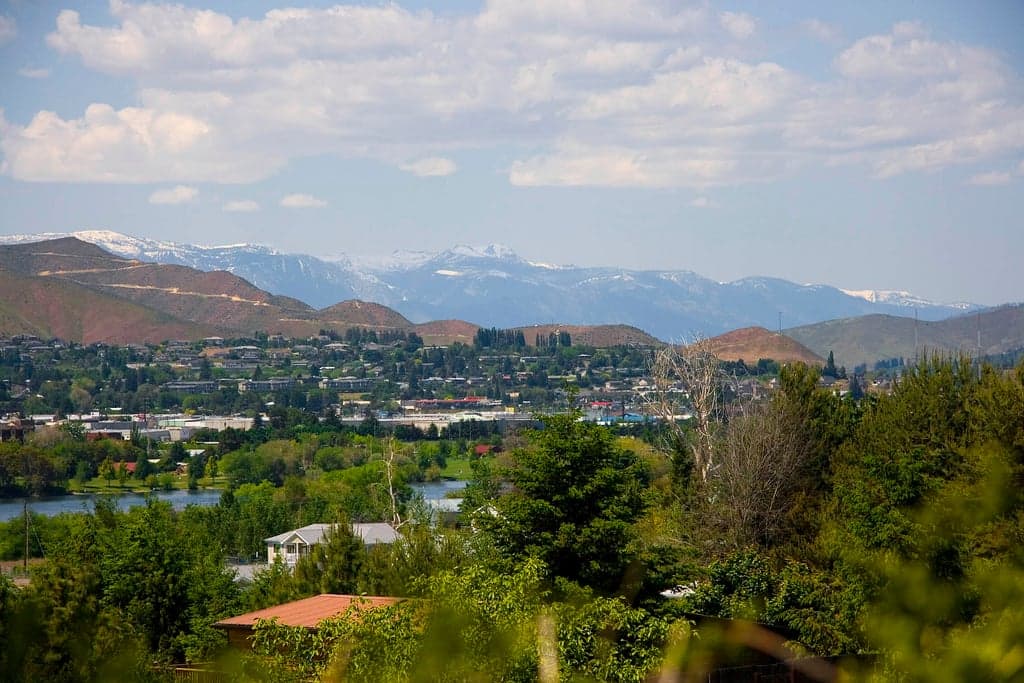
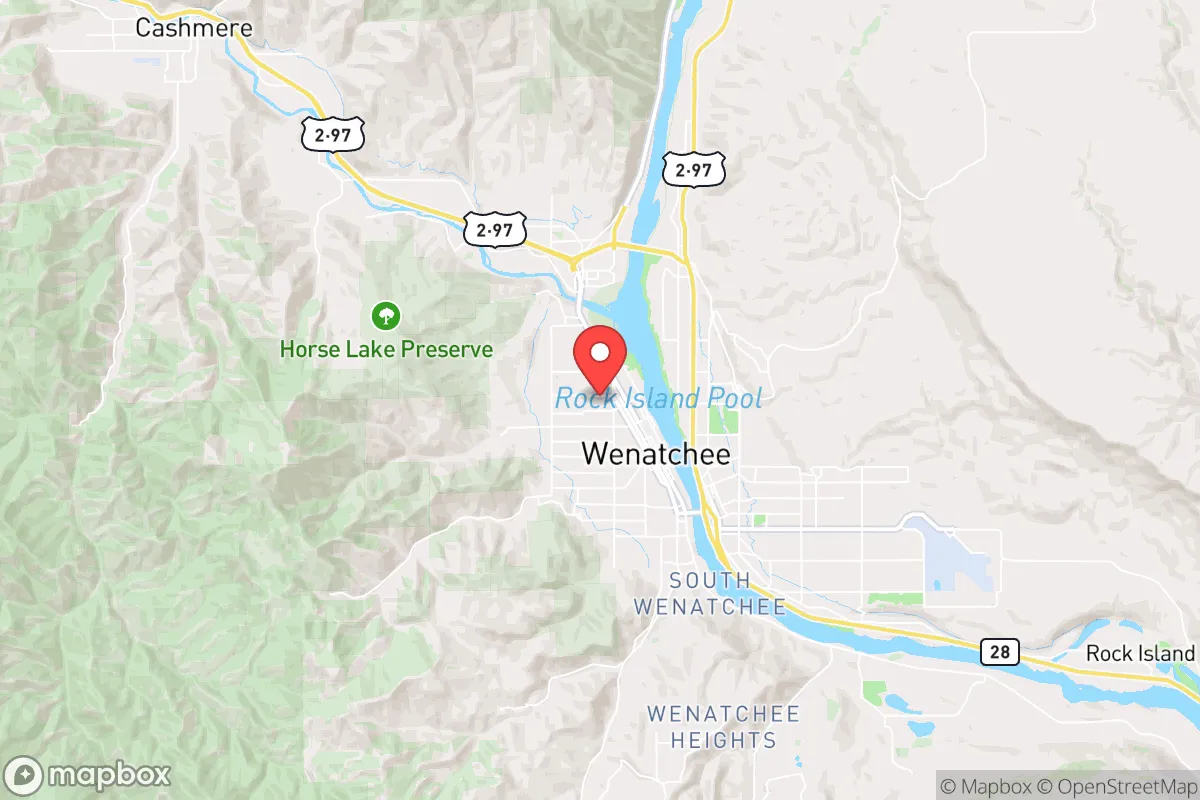
Photo: Wikipedia
Demographics of Wenatchee, WA
Affluence Level in Wenatchee, WA
A middle-class area roughly in line with national averages across income, home values, education, and employment.
People of Wenatchee, WA
The people of Wenatchee, Washington today form a community of roughly 35,500 residents that is notably bicultural, with a white population of 58.6% and a Hispanic population of 35.0%, a proportion far higher than the state average. The city’s identity is rooted in its role as the commercial and agricultural hub of North Central Washington, with a strong sense of local pride, a growing service economy, and a population that is younger than the national median. Foreign-born residents make up 9.7% of the city, a figure that reflects ongoing immigration from Latin America, while the city’s Black (0.9%), East/Southeast Asian (0.6%), and Indian subcontinent (0.2%) populations remain very small. The city’s character is increasingly defined by the interaction between long-established white families and a rapidly growing Hispanic community, with distinct neighborhoods reflecting these different settlement histories.
How the city was settled and grew
Wenatchee’s population history begins not with colonial settlement but with the arrival of the railroad in the 1890s, which transformed a small river crossing into a boomtown. The Great Northern Railway reached the site in 1892, and the city was officially incorporated in 1893. The original white settlers were predominantly of Northern European stock—German, Irish, and Scandinavian—drawn by the promise of irrigated apple orchards. The Wenatchee Valley’s first major irrigation project, the Wenatchee Reclamation District, opened in 1903, turning the arid landscape into one of the nation’s most productive apple-growing regions. These early settlers built their homes in the South Wenatchee neighborhood, near the railroad yards and the Columbia River, and in the Downtown core, where commercial and civic life centered. A second wave of white migrants arrived during the Great Depression and World War II, many from the Dust Bowl and the Great Plains, seeking work in the orchards and at the Alcoa aluminum smelter (opened 1952). These families settled in North Wenatchee, a working-class area that grew rapidly in the 1940s and 1950s. The Hispanic population’s roots in Wenatchee also date to this era: Mexican laborers were recruited as seasonal farmworkers under the Bracero Program (1942–1964), and many stayed, forming the nucleus of what would become a permanent community. These early Hispanic families concentrated in the “West Side” neighborhood, west of the railroad tracks, an area that remains the historic heart of the city’s Latino community.
Modern era (post-1965)
After the 1965 Immigration and Nationality Act, Wenatchee’s Hispanic population grew steadily, shifting from seasonal labor to permanent settlement. By the 1990s, the Hispanic share of the city’s population had risen to roughly 15%, and by 2020 it had reached 35%. This growth has been driven by family reunification and by the expansion of the tree fruit industry, which continues to require a large labor force. The West Side neighborhood remains the most heavily Hispanic area, with many residents owning homes and operating small businesses along Mission Street. A newer concentration has developed in the “Sunnyslope” area on the city’s northern edge, where younger Hispanic families have moved into newer subdivisions. Domestic in-migration during this period has been modest, with most new white residents arriving as retirees or remote workers drawn by the region’s outdoor recreation and lower cost of living compared to Seattle. These newcomers have tended to settle in the “Foothills” neighborhood on the eastern edge of the city, near the Wenatchee Foothills Trail, or in the more affluent “Riverfront” district along the Columbia River. The city’s East/Southeast Asian population (0.6%) is tiny and largely composed of a few families of Japanese and Filipino descent who arrived in the 1970s and 1980s, mostly in professional roles at the local hospital or at the Wenatchee Valley College. The Indian subcontinent population (0.2%) is even smaller, consisting of a handful of medical professionals at Confluence Health. The Black population (0.9%) is similarly small, with most families having arrived in the 1990s and 2000s for work in the service sector.
The future
Wenatchee’s population is heading toward a continued increase in Hispanic share, driven by higher birth rates and ongoing immigration, while the white population is aging and slowly declining in absolute numbers. The city is not homogenizing; rather, it is becoming more distinctly bicultural, with the West Side and Sunnyslope areas becoming more heavily Hispanic and the Foothills and Riverfront areas remaining predominantly white. The small East/Southeast Asian, Indian, and Black populations are likely to remain very small, as the city’s economy does not attract the diverse professional workforce seen in larger Washington metros. The next 10–20 years will likely see the Hispanic share approach 45–50%, making Wenatchee one of the most Latino cities in the Pacific Northwest outside of the Yakima Valley. This demographic shift is already reshaping local politics, schools, and business ownership, with more bilingual signage and Hispanic-owned businesses appearing in the downtown core.
For someone moving to Wenatchee now, the city offers a stable, family-oriented environment with a strong agricultural identity and a growing cultural duality. New residents should expect a community where the white and Hispanic populations coexist with a degree of separation by neighborhood, but with increasing integration in schools and public life. The city’s future is one of gradual demographic change, not rapid disruption, making it a predictable and grounded place for those seeking a slower pace of life in a scenic valley.

* Values derived from national, state, county, city and local statistics and may differ in a specific area. Last updated: 2026-04-21T17:05:28.000Z
Narrative content on this page is AI-generated and may contain mistakes. Verify any details that matter before acting on them.
ReloMaps may earn a commission from affiliate links at no extra cost to you.

