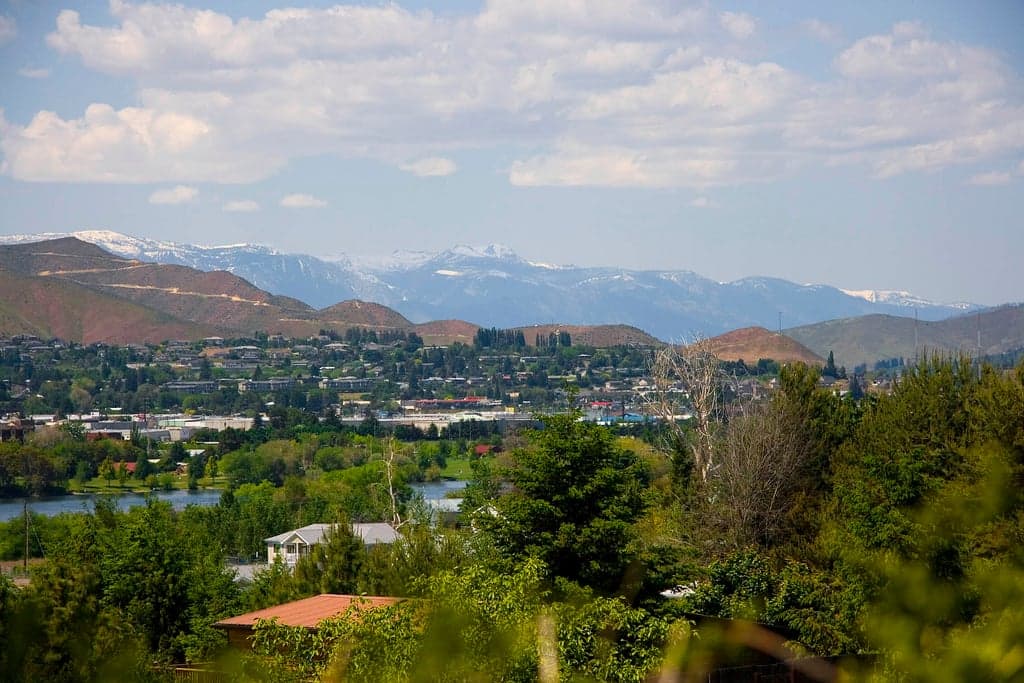
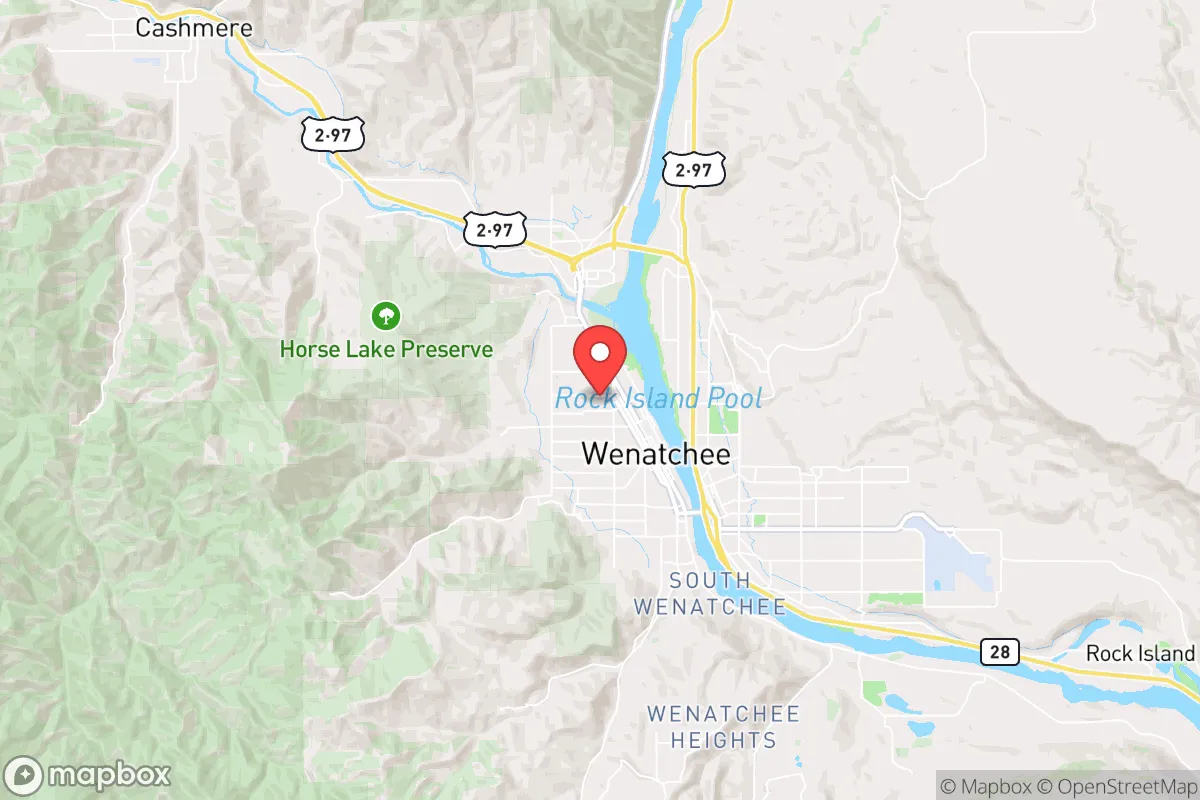
Photo: Wikipedia
Strategic Assessment of Wenatchee, WA
Workable tactical position. Some exposure to population density or targets, but generally defensible in a crisis.
What does the Strategic Assessment tell us?
Our Strategic Assessment grades tactical survivability of an area. Major population centers, military targets, fallout zones, natural disasters, and border exposure all drive risk — lower exposure means a more defensible position in a crisis.
This is heavily inspired by Joel Skousen's Strategic Relocation book. Highly recommended you checkout the book ($)What does this tell us?
Our Strategic Assessment grades tactical survivability of an area. Major population centers, military targets, fallout zones, natural disasters, and border exposure all drive risk — lower exposure means a more defensible position in a crisis.
This is heavily inspired by Joel Skousen's Strategic Relocation book. Highly recommended you checkout the book ($)Strategic Pillars

Key Distances
Regional Safe Places
Below is our recommended "safe zones" in Washington and the surrounding area based on our strategic heuristics. For most people, it's unrealistic to live in a “safe zone” full-time due to work, family or other personal reasons. They tend to be more rural. However, many of these areas are perfect for second homes and retreat properties that double as a vacation home or even a short-term rental.
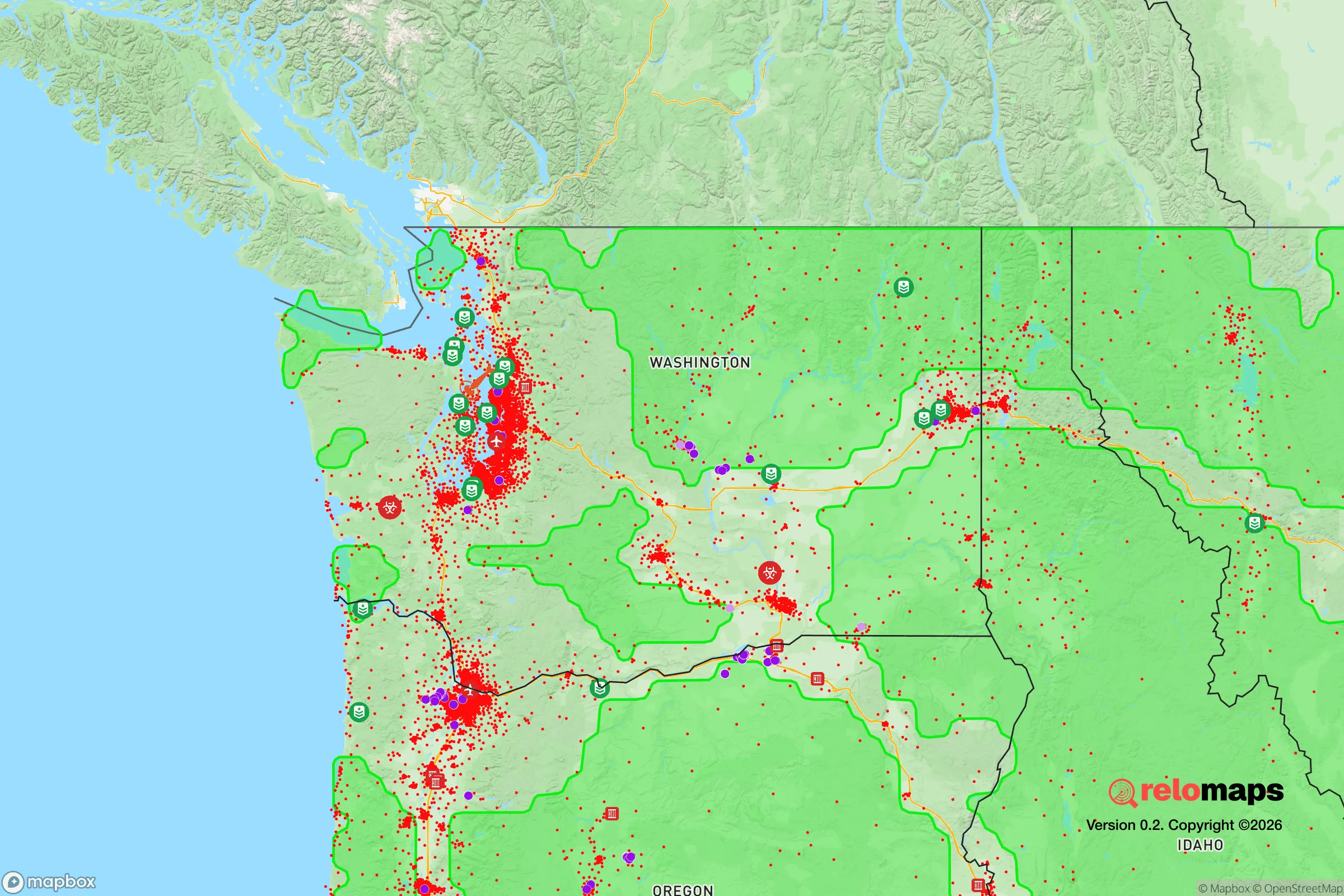
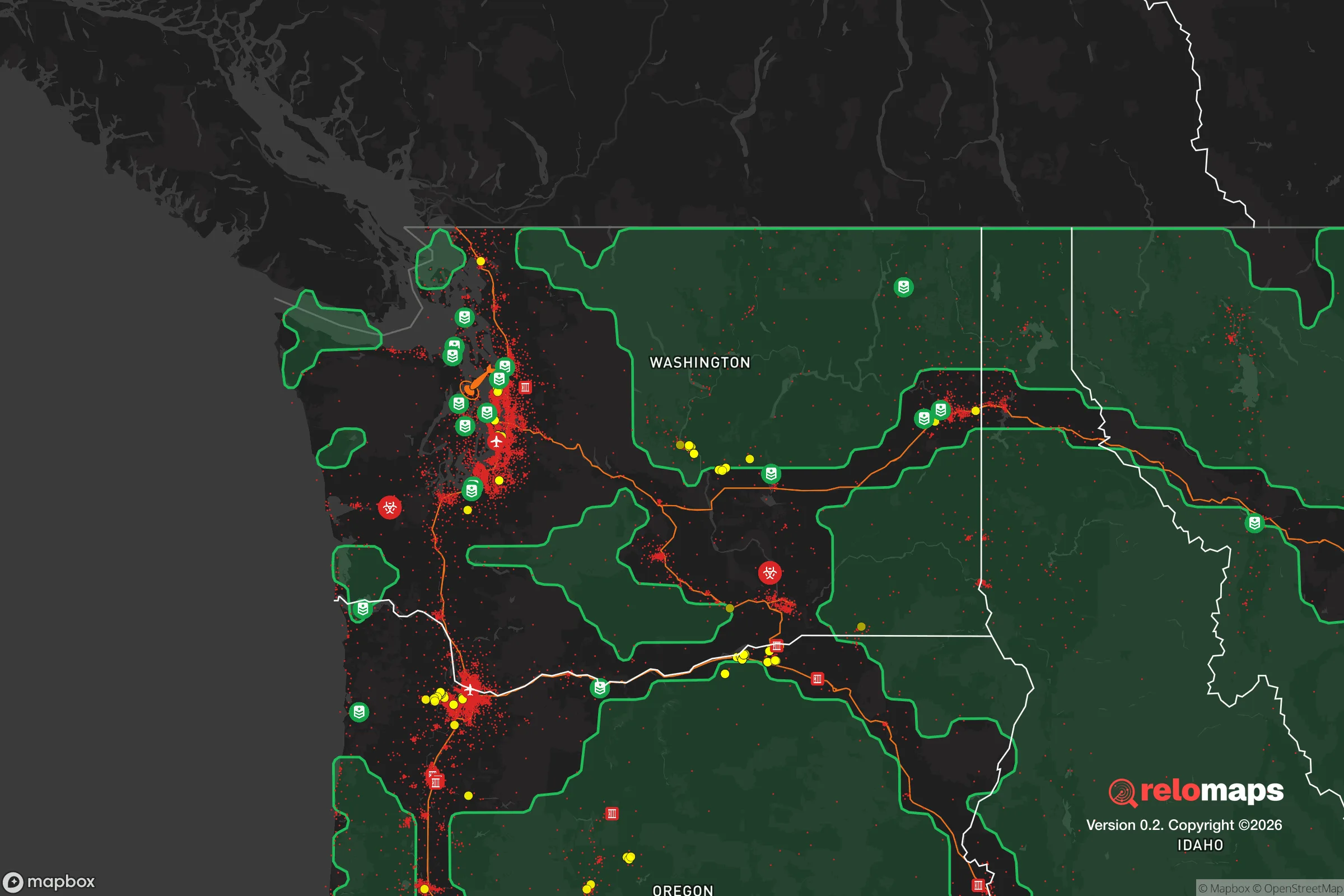


Important Note: For informational purposes only. This does not mean nothing bad ever happens in the green zones. Please use common sense. This is based on public data and modeled with AI. We tried to take a conservative approach but mistakes happen. We update this regularly as new information becomes available.
Solar Generator Recommendations
Backup power matters more here than in safer locations. We've picked three solar generators across budgets and capacity tiers — start with the budget unit if you only need a few essentials, or step up if you want to run a fridge and HVAC for days at a time.

Jackery Portable Power Station Explorer 300
Budget OptionPower on the Go: Weighing only 11 lbs, it's convenient to set up and store with book-sized foldable solar panels

BLUETTI Portable Power Station AC180
Designed for both indoor and outdoor scenarios, AC180 is highly capable as it has a robost capacity and continuous output power.

EF ECOFLOW DELTA Pro Ultra Power Station
Upgraded PickEcoFlow DELTA Pro Ultra is a whole-home energy system designed to grow with your family. Integrated with the Smart Home Panel 2, it scales to meet your evolving energy needs — keeping your home powered, intelligent, and secure through every stage of life.
We earn a commission, at no additional cost to you.
Strategic Assessment Analysis
Wenatchee, Washington, offers a compelling mix of geographic isolation and practical self-sufficiency that makes it a serious candidate for those prioritizing long-term resilience over convenience. Nestled in the rain shadow of the Cascade Range, this central Washington hub sits at the confluence of the Columbia and Wenatchee Rivers, roughly 140 miles east of Seattle—close enough to monitor urban trends, but far enough to avoid the immediate fallout of a major Cascadia event or civil unrest. The area’s agricultural backbone, reliable hydroelectric power, and defensible mountain terrain create a strategic buffer that many coastal or valley locations simply cannot match.
Geographic position and natural advantages for long-term security
Wenatchee’s location is its primary strategic asset. The city lies in a broad valley surrounded by the Cascade foothills, with the Columbia River acting as both a water source and a natural barrier to east-west movement. The region’s rain shadow climate delivers over 300 days of sunshine annually, which is a stark contrast to the wet, gloomy conditions west of the mountains. This dry climate reduces mold, rust, and infrastructure decay—practical concerns for anyone stockpiling supplies or maintaining equipment. The surrounding terrain offers numerous choke points: the only major highways into the area are US-2 over Stevens Pass and US-97 along the Columbia, both of which can be monitored or controlled with minimal effort. For a relocator, this means the area is naturally defensible against large-scale movement from the Puget Sound corridor, which is the most likely source of urban refugees in a crisis. The nearby Wenatchee National Forest provides millions of acres of public land for hunting, foraging, and retreat, though it also requires familiarity with backcountry navigation and seasonal access restrictions.
Risks, exposures, and proximity to fallout-relevant landmarks
No location is without vulnerabilities, and Wenatchee has several that a prepper must weigh. The most immediate risk is wildfire. The same dry climate that makes the area livable also turns the surrounding forests into tinderboxes during late summer. The 2015 Chelan Complex Fire and the 2021 Red Apple Fire both came within miles of residential areas, and smoke events can degrade air quality for weeks. Flooding is a lesser but real concern along the Columbia and Wenatchee Rivers, particularly during rapid snowmelt years. On the human-caused side, Wenatchee sits roughly 80 miles from the Hanford Nuclear Reservation, a decommissioned plutonium production site with massive underground waste tanks. While Hanford is not an active reactor, a catastrophic leak or terrorist event could contaminate the Columbia River downstream—and Wenatchee draws its drinking water from that same river. The city is also within 150 miles of Joint Base Lewis-McChord, a major military installation south of Tacoma. In a national emergency, that base could become a staging area for federal forces or a target for adversaries, potentially drawing attention to the entire central Washington region. Finally, the local economy is heavily tied to agriculture and healthcare, meaning a prolonged economic collapse would hit the service sector hard, though the agricultural base provides a buffer that most urban areas lack.
Practical resilience for a relocator: food, water, energy, and defensibility
For someone serious about self-reliance, Wenatchee scores well on the basics. Water is abundant—the Columbia River is a year-round, high-volume source, though it requires treatment for human consumption. The city’s municipal water system is gravity-fed from the Wenatchee River watershed, which is less vulnerable to power outages than pumped systems. Food production is a major advantage: the Wenatchee Valley is one of the nation’s top apple-growing regions, with orchards, packing houses, and cold storage facilities scattered throughout the area. In a crisis, barter networks could form around fruit, nuts, and livestock, which are already common in the rural outskirts. Energy is reliable thanks to the Columbia River dams—Rocky Reach and Rock Island are both within 20 miles—providing cheap, grid-tied hydroelectricity. Solar potential is excellent due to the high sunshine hours, and many rural properties already have backup generators or off-grid setups. Defensibility is moderate but improvable. The valley floor is open and exposed, but the surrounding hillsides offer numerous retreat properties with long sightlines and limited access roads. The local population is largely conservative, with a strong hunting and firearms culture—Chelan County has one of the highest per-capita gun ownership rates in Washington, which in a prepper context means a community that is likely to be armed and self-reliant rather than dependent on government aid. The downside is that the same terrain that provides defensibility also limits escape routes: if the passes close due to snow or disaster, Wenatchee becomes a cul-de-sac. Stockpiling fuel and having a capable 4x4 vehicle is not optional here—it’s a necessity.
Overall, Wenatchee presents a balanced strategic picture for the conservative relocator. It avoids the worst of the Cascadia Subduction Zone risks that plague the coast, sits far enough from Seattle to avoid the immediate chaos of a major urban collapse, and offers genuine agricultural and water security. The trade-offs are real: wildfire season is stressful, Hanford is a lingering unknown, and the isolation that makes it safe also makes it hard to leave. For a single individual or a family willing to invest in fire mitigation, water filtration, and off-grid energy, Wenatchee provides a solid foundation. It is not a bunker—it is a working town with real vulnerabilities—but for those who want to be part of a resilient, self-sufficient community rather than hiding in a hole, it is one of the better options in the Pacific Northwest.

* Values derived from national, state, county, city and local statistics and may differ in a specific area. Last updated: 2026-04-21T17:05:28.000Z
Narrative content on this page is AI-generated and may contain mistakes. Verify any details that matter before acting on them.
ReloMaps may earn a commission from affiliate links at no extra cost to you.

