Photo: Wikipedia
Demographics of Wentzville, MO
Affluence Level in Wentzville, MO
An upper-middle-class area. Household wealth, education levels, and homeownership run ahead of national benchmarks.
People of Wentzville, MO
The people of Wentzville, Missouri, today number roughly 45,734, forming a predominantly white (86.1%), family-oriented suburban community with a notably low foreign-born population (0.9%). The city’s identity is shaped by rapid post-2000 growth, a strong manufacturing and logistics employment base, and a demographic profile that is less diverse than the St. Louis region as a whole. With nearly 40% of adults holding a college degree, Wentzville attracts upwardly mobile families seeking newer housing, good schools, and a conservative-leaning political environment in western St. Charles County.
How the city was settled and grew
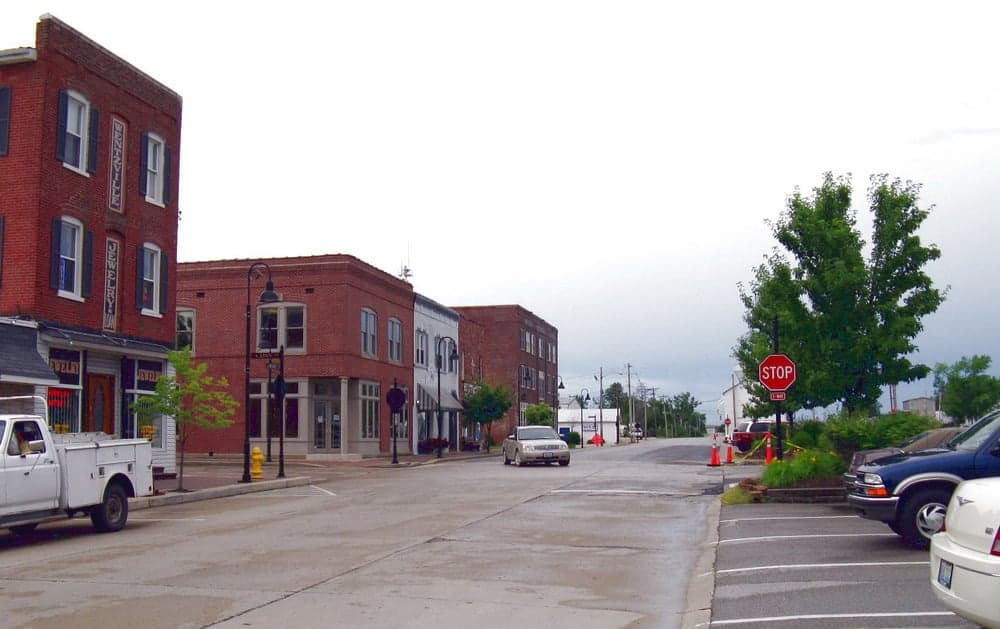
Wentzville’s human history begins not with colonial settlement but with the arrival of German immigrants in the mid-19th century. Founded in 1855 along the North Missouri Railroad (later the Wabash line), the town was named after Erasmus Livingston Wentz, a railroad official. The earliest residents were German farmers and tradesmen drawn by affordable land and the railroad’s promise of market access. These families built the original core around what is now Historic Downtown Wentzville, where the Lutheran and Catholic churches they established still stand. A second wave of German and Irish immigrants arrived in the 1870s-1890s, settling in the South Wentzville area along the rail corridor, working in the town’s early flour mills and brickyards. The population remained small—under 1,000—through the 1950s, as the town served primarily as a farming service center.
Modern era (post-1965)
The modern transformation of Wentzville began after the 1965 Hart-Cellar Act, though its impact was muted here compared to coastal cities. The real driver was domestic in-migration: the completion of Interstate 70 in the 1970s and the 1983 opening of the General Motors Wentzville Assembly Plant. The GM plant, now employing over 4,000 workers, drew a wave of white working- and middle-class families from the St. Louis metro area and rural Missouri. These families settled in new subdivisions like WingHaven (developed from the 1990s onward) and Wilmer Valley, which offered large single-family homes on cul-de-sacs. A smaller but notable influx of Black families, many employed at GM or in logistics, concentrated in the Westwood and Lakeview neighborhoods near the plant. The Hispanic population, at 2.9%, is modest and largely dispersed, with no single ethnic enclave; many work in construction and service industries tied to the city’s rapid housing expansion. The East/Southeast Asian community (1.9%) is primarily employed in engineering and tech roles at GM and regional suppliers, living in newer subdivisions like Meadowbrook Estates. The Indian-subcontinent population (0.3%) remains very small, with no distinct neighborhood concentration.
The future
Wentzville’s population trajectory points toward continued growth—the city added over 10,000 residents between 2010 and 2020—but with a homogenizing rather than diversifying trend. The foreign-born share (0.9%) is among the lowest for a city of this size in the St. Louis region, and there is no evidence of a growing immigrant gateway. The Hispanic and Black shares are rising slowly, but the city remains overwhelmingly white. New housing developments, such as the Dardenne Prairie extension and South Point subdivisions, are marketed to the same demographic: white families from St. Louis County seeking lower taxes and newer schools. The GM plant’s shift toward electric vehicle production may attract a slightly more diverse engineering workforce, but the city’s zoning (primarily large-lot single-family) and school district reputation (Wentzville School District, rated highly) reinforce its current character. Over the next 10-20 years, Wentzville will likely become more populous but not significantly more diverse, remaining a solidly white, middle-class suburb with a conservative political tilt.
For a conservative-leaning individual or family considering relocation, Wentzville offers a predictable, growing environment with strong schools, a robust manufacturing economy, and a population that is culturally and politically homogeneous. The city is not becoming a melting pot; it is becoming a larger, more prosperous version of its current self. New arrivals will find a community where the dominant identity—white, family-focused, and suburban—is reinforced by housing patterns, school choices, and local governance.

* Values derived from national, state, county, city and local statistics and may differ in a specific area. Last updated: 2026-04-22T13:45:13.000Z
Narrative content on this page is AI-generated and may contain mistakes. Verify any details that matter before acting on them.
ReloMaps may earn a commission from affiliate links at no extra cost to you.

