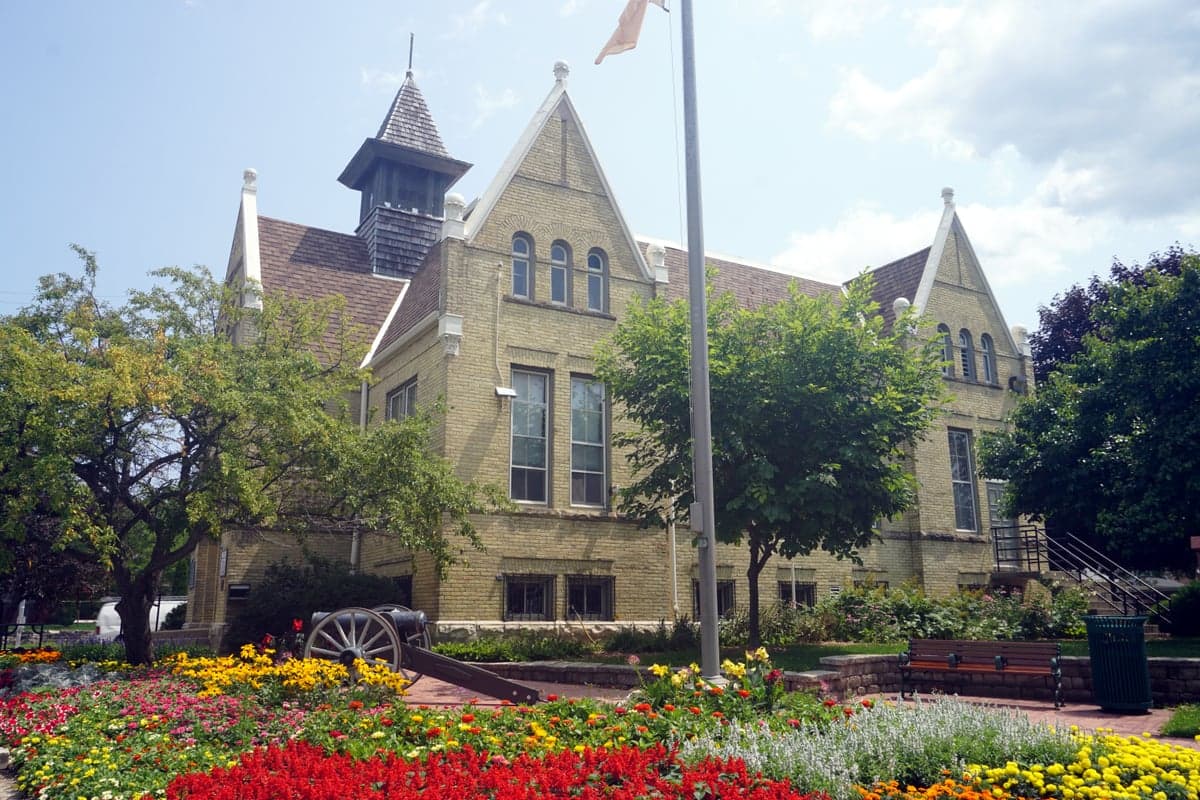
Photo: Wikipedia
Personal Sovereignty in West Allis, WI
Moderate friction. Expect trade-offs in some aspect of personal liberty and independence.
What does Personal Sovereignty tell us?
Personal Sovereignty measures your capacity for self-reliance and independence with minimal government friction. Higher scores mean fewer barriers between you and the way you want to live... but it assumes you have the space you need and good neighbors.
What does this tell us?
Personal Sovereignty measures your capacity for self-reliance and independence with minimal government friction. Higher scores mean fewer barriers between you and the way you want to live... but it assumes you have the space you need and good neighbors.
State Policy
Energy independence: Importer (15% of energy produced in-state)
Personal Liberty
Homesteading

Personal Liberty Analysis
West Allis, Wisconsin, offers a mixed bag for those prioritizing personal sovereignty, leaning heavily on the state-level legal framework while presenting a local environment that requires careful navigation. As a densely developed inner-ring suburb of Milwaukee, its autonomy environment is shaped by a tension between Wisconsin's relatively strong preemption laws and the practical realities of municipal governance in a blue-collar, urbanized setting. For the survivalist or prepper, West Allis is less a bastion of self-reliance and more a strategic location where state-level protections must be actively leveraged against potential local overreach.
Tax burden and regulatory posture in a Milwaukee suburb
Wisconsin's tax climate is a critical factor for anyone seeking to maximize personal financial sovereignty. The state imposes a progressive income tax with rates ranging from 3.54% to 7.65% for the 2025 tax year, which is a significant drag compared to no-income-tax states. Property taxes are a major concern: Wisconsin consistently ranks among the top ten states for effective property tax rates, and West Allis is no exception. The city's mill rate, combined with Milwaukee County levies and school district taxes, means homeowners face a substantial annual burden. For a median-valued home around $200,000, expect to pay roughly $4,500 to $5,500 annually in property taxes. This is a direct hit to personal wealth accumulation and a key consideration for anyone looking to minimize government extraction. On the regulatory front, Wisconsin is generally business-friendly with right-to-work laws and limited state-level red tape, but West Allis itself has a municipal code that can be restrictive. The city enforces zoning and building codes typical of an older suburb, and there is a local occupational tax on businesses. For the prepper, the high property tax is the most immediate sovereignty concern, as it represents a perpetual claim on your land and income.
Self-defense rights and gun law specifics in Wisconsin
Wisconsin is a shall-issue state for concealed carry permits, meaning the county sheriff must issue a license if you meet the statutory requirements. This is a strong point for personal sovereignty. The state also has a preemption law that explicitly prohibits local governments from enacting their own firearm ordinances, which is crucial in a suburb like West Allis where the city council might otherwise be tempted to impose restrictions. Wisconsin law allows open carry without a permit, and concealed carry requires a permit that is issued after a background check and a training course. Stand-your-ground laws are in effect, with no duty to retreat in any place where you have a legal right to be. However, there are limitations: carrying a firearm into a bar or restaurant that serves alcohol is prohibited unless you are not consuming, and there are restrictions on carrying in government buildings, schools, and on private property where the owner has posted signs. For the survivalist, the state-level framework is solid, but the practical reality is that West Allis is a dense urban environment where defensive firearm use is more likely to involve legal scrutiny than in a rural county. The key takeaway: your right to keep and bear arms is legally protected, but the social and legal environment of a Milwaukee suburb means you must be meticulous about compliance and aware of the heightened risk of legal entanglement following a defensive incident.
Self-reliance and homesteading viability in a built-up suburb
West Allis presents significant challenges for anyone seeking self-reliance through homesteading or off-grid living. The city is almost entirely built out with small lots, typically 40 to 60 feet wide, with limited yard space. Zoning regulations are restrictive: keeping chickens is allowed with a permit and specific coop requirements, but larger livestock like goats or pigs is prohibited. Urban agriculture is permitted, but the small lot sizes severely limit the scale of food production. Off-grid feasibility is essentially zero within city limits. The municipal code requires connection to city water and sewer, and any attempt to disconnect from the grid would be a clear code violation. Solar panels are allowed but subject to aesthetic review by the city's plan commission, and battery storage for full independence is not a common or straightforward approval. For the prepper, the lack of land and the density of neighbors mean that self-reliance is limited to stockpiling, gardening in raised beds, and developing skills like food preservation and first aid. The real value of West Allis for a self-reliance mindset is its proximity to rural areas in Waukesha County or Jefferson County, where larger parcels and less restrictive zoning are available. If you are serious about homesteading, West Allis is not the place; it is a location for those who prioritize urban employment and state-level legal protections over land-based autonomy.
Personal liberties: parental rights, medical autonomy, speech, and property
Wisconsin has a mixed record on personal liberties that directly affect the sovereignty-minded individual. Parental rights are relatively strong under state law, with a clear presumption that parents have the fundamental right to direct the upbringing, education, and healthcare of their children. The state has a parental consent law for minors seeking abortion, and there is no state-level mandate for critical race theory or comprehensive sexuality education in public schools, though local school boards have discretion. West Allis public schools, part of the West Allis-West Milwaukee School District, have generally followed state standards without significant local controversy, but parents should remain vigilant about curriculum transparency. Medical autonomy is a point of concern. Wisconsin did not have a broad medical freedom law as of 2025, and during the COVID-19 pandemic, the state saw significant government overreach, including mask mandates and business closures enforced by local health departments. There is no state-level protection for refusing a vaccine on philosophical grounds for employment, though religious exemptions exist. For the prepper, this means medical autonomy is not guaranteed and could be restricted again during a future public health emergency. Free speech is protected under the First Amendment and Wisconsin's state constitution, and there are no notable local ordinances in West Allis that suppress speech beyond standard time, place, and manner restrictions. Property rights are protected by state law, but the high property tax and restrictive zoning in West Allis represent a constant erosion of your ability to use your land as you see fit. Eminent domain is a risk, as the city has used it for redevelopment projects in the past, though with compensation required.
Overall, personal sovereignty in West Allis is a study in trade-offs. The state-level framework provides solid protections for gun rights, parental authority, and speech, and the preemption laws prevent the worst local overreach. However, the high property tax burden, restrictive zoning that kills homesteading potential, and the vulnerability to future medical mandates make it a location that demands constant vigilance. Compared to rural areas in northern Wisconsin or the Driftless Region, West Allis offers less autonomy but more economic opportunity and access to services. For the conservative-leaning survivalist, it is a viable base of operations if you are willing to fight for your rights at the local level and accept that true self-reliance will require a secondary property outside the urban core. It is not a sanctuary, but it is not a police state either—it is a place where personal sovereignty is earned through active participation and legal awareness.

* Values derived from national, state, county, city and local statistics and may differ in a specific area. Last updated: 2026-04-21T10:03:45.000Z
Narrative content on this page is AI-generated and may contain mistakes. Verify any details that matter before acting on them.
ReloMaps may earn a commission from affiliate links at no extra cost to you.

