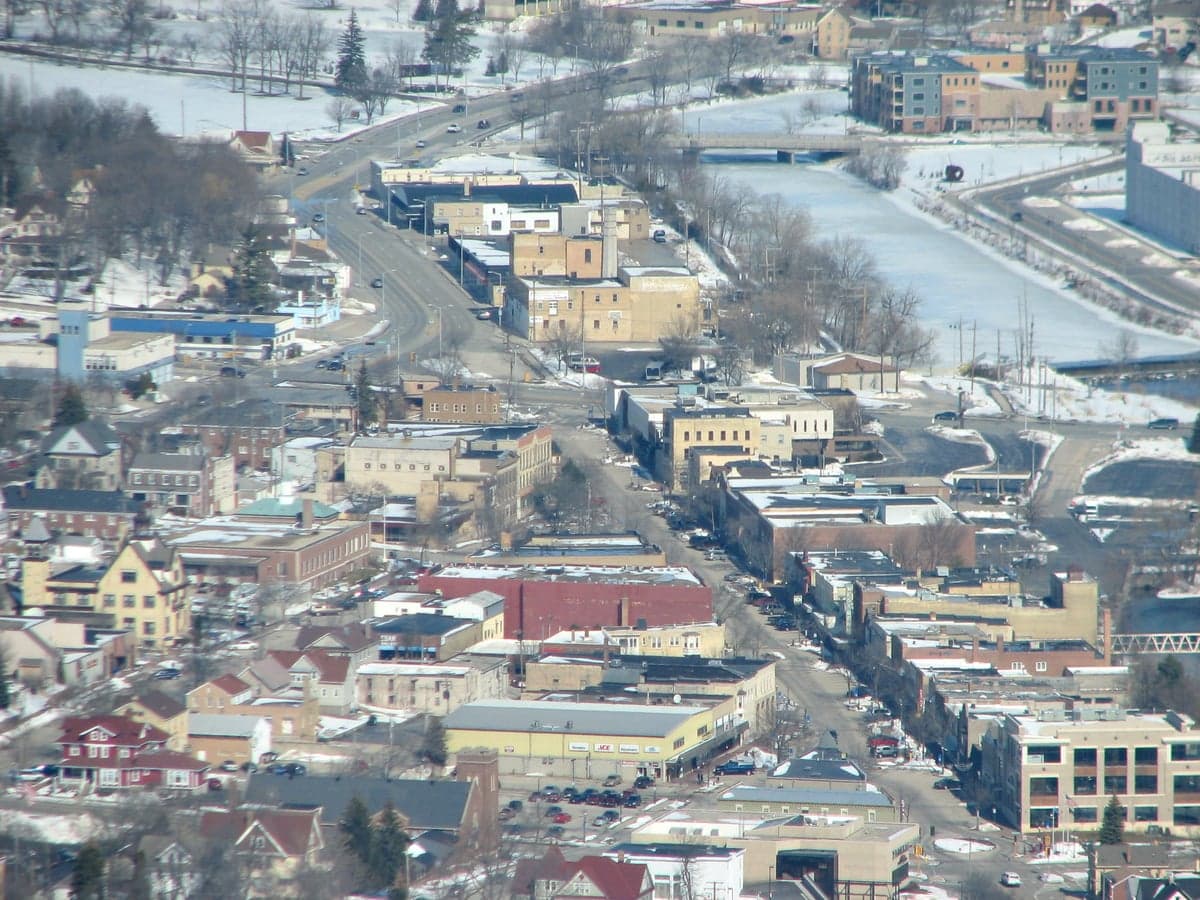
Photo: Wikipedia
Demographics of West Bend, WI
Affluence Level in West Bend, WI
A middle-class area roughly in line with national averages across income, home values, education, and employment.
People of West Bend, WI
The people of West Bend, Wisconsin, today number 31,722 and form a predominantly white, family-oriented community with a distinctly Midwestern character. The city is notably homogeneous, with 89.8% of residents identifying as white, a foreign-born population of just 1.0%, and a median age that reflects a stable, long-settled population. West Bend’s identity is rooted in its manufacturing and small-town heritage, with a strong sense of local pride and a conservative-leaning political culture that shapes daily life.
How the city was settled and grew
West Bend’s human history begins with the Potawatomi and Menominee peoples, who inhabited the area along the Milwaukee River before European-American settlement. The first permanent white settlers arrived in the 1840s, drawn by the region’s fertile land and water power. The city was officially platted in 1845, and its early growth was fueled by German and Irish immigrants who cleared forests, built farms, and established small industries. These groups settled in what is now the Historic Downtown district, where the original gristmills and sawmills operated along the river. By the late 19th century, the arrival of the railroad spurred a second wave of German, Polish, and Czech immigrants, who formed tight-knit ethnic enclaves in neighborhoods like Fairview and Silverbrook, near the rail yards and factories. The city’s industrial base—including the West Bend Company (aluminum cookware) and later Amity Leather Products—drew these workers, and by 1900, West Bend was a thriving manufacturing hub with a population of about 4,000. The early 20th century saw continued growth from German and Scandinavian immigrants, who settled in the North Side neighborhoods around the expanding factory districts.
Modern era (post-1965)
After the 1965 Hart-Cellar Act, West Bend saw minimal immigration from new source countries, reflecting its geographic isolation and lack of major immigrant-receiving industries. The city’s foreign-born share remained below 2% through the late 20th century, and the population grew primarily through domestic in-migration from rural Wisconsin and the Milwaukee suburbs. Suburbanization in the 1970s and 1980s expanded the city outward, with new subdivisions like Rolling Hills and Pleasant Valley attracting white, middle-class families seeking larger homes and lower taxes. These areas remain predominantly white and owner-occupied today. The Hispanic population, now 4.2%, began to grow in the 1990s, largely through labor migration to manufacturing and agricultural jobs in Washington County. Hispanic residents are concentrated in the South Side neighborhoods near industrial parks and along Highway 45. The Black population (2.3%) and East/Southeast Asian population (0.6%) are small and dispersed, with no single ethnic enclave; they are most visible in the Downtown and Fairview areas, where rental housing is more available. The Indian-subcontinent population (0.1%) is negligible, primarily consisting of professionals employed at local hospitals or engineering firms.
The future
West Bend’s population is projected to remain stable or grow slowly, with the city’s demographic trajectory pointing toward continued homogeneity rather than rapid diversification. The white population share has declined only slightly since 2000 (from 95% to 89.8%), while the Hispanic share has grown modestly but is plateauing as immigration from Mexico and Central America slows nationally. The East/Southeast Asian and Black populations are growing at a very low rate, primarily through second-generation families and a trickle of professional migrants. The city is not tribalizing into distinct ethnic enclaves; instead, it is homogenizing further as younger white families move in from Milwaukee County and older residents age in place. The next 10-20 years will likely see a slight increase in Hispanic and Asian shares, but West Bend will remain overwhelmingly white and native-born. The college-educated share (29.4%) is below the national average, and the city’s economic base in manufacturing and healthcare will continue to attract workers with trade skills rather than advanced degrees.
For someone moving in now, West Bend is becoming a stable, culturally conservative community where demographic change is slow and incremental. The city offers a predictable, family-oriented environment with low crime, good schools, and a strong sense of local identity, but it is not a place of rapid diversity or cosmopolitan growth. New residents should expect a population that is overwhelmingly white, native-born, and rooted in Midwestern traditions, with limited exposure to the multicultural dynamics seen in larger cities.

* Values derived from national, state, county, city and local statistics and may differ in a specific area. Last updated: 2026-04-19T07:43:23.000Z
Narrative content on this page is AI-generated and may contain mistakes. Verify any details that matter before acting on them.
ReloMaps may earn a commission from affiliate links at no extra cost to you.

