
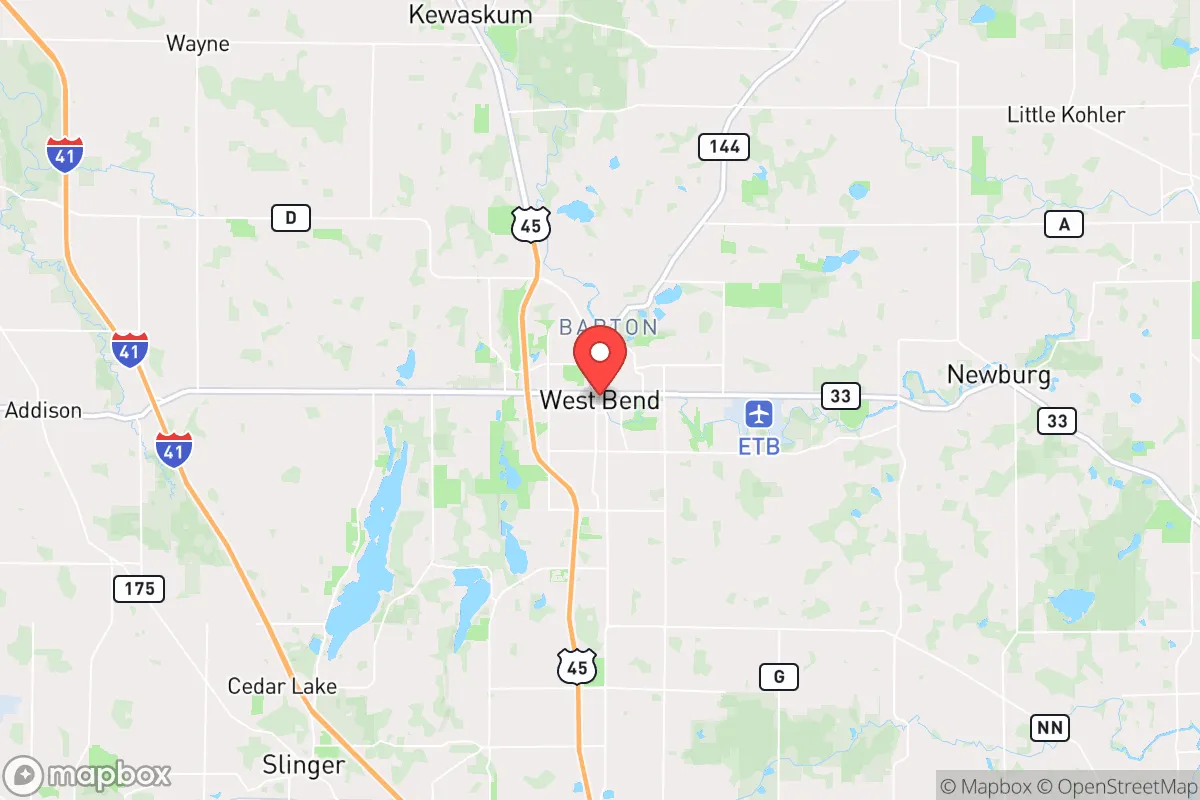
Photo: Wikipedia
Personal Sovereignty in West Bend, WI
Moderate friction. Expect trade-offs in some aspect of personal liberty and independence.
What does Personal Sovereignty tell us?
Personal Sovereignty measures your capacity for self-reliance and independence with minimal government friction. Higher scores mean fewer barriers between you and the way you want to live... but it assumes you have the space you need and good neighbors.
What does this tell us?
Personal Sovereignty measures your capacity for self-reliance and independence with minimal government friction. Higher scores mean fewer barriers between you and the way you want to live... but it assumes you have the space you need and good neighbors.
State Policy
Energy independence: Importer (15% of energy produced in-state)
Personal Liberty
Homesteading

Personal Liberty Analysis
West Bend, Wisconsin offers a notably high degree of personal sovereignty for those prioritizing autonomy, self-reliance, and minimal government interference in daily life. Situated in Washington County, this city of roughly 32,000 sits within a state that has maintained a consistent posture of protecting individual rights, particularly in the areas of firearm ownership, parental authority, and property use. For the strategic relocator—whether a single individual or a parent—West Bend represents a deliberate choice to operate within a legal and cultural framework that values personal responsibility over state control, especially when compared to the regulatory density of nearby Milwaukee or the restrictive environments of the coastal states.
Tax burden and regulatory posture: How West Bend compares to the state and region
Wisconsin's tax structure is a mixed bag, but West Bend's local governance tilts heavily toward fiscal restraint. The state imposes a flat individual income tax rate of 4.4% as of 2025, which is moderate compared to progressive tax states like California or New York. Property taxes in Washington County average around 2.1% of assessed home value, which is higher than the national median but typical for the Midwest. However, the trade-off is tangible: West Bend's city government maintains a lean operational budget, with no local sales tax beyond the state's 5% rate (plus a 0.5% county tax). The regulatory environment is business-friendly, with Washington County consistently ranking among Wisconsin's most economically free areas. Zoning codes are straightforward, and the city's planning department is known for practical, not punitive, enforcement. For a prepper or survivalist, this means fewer bureaucratic hurdles for property improvements, home-based businesses, or alternative energy installations compared to more restrictive municipalities like Madison or Shorewood.
Self-defense and gun law specifics: What West Bend allows that other places don't
Wisconsin is a shall-issue state for concealed carry, and West Bend fully embraces that framework. The state preempts local firearm ordinances, meaning the city cannot impose restrictions stricter than state law. This is a critical advantage: no waiting periods, no magazine capacity bans, and no "assault weapon" prohibitions exist at the local level. Open carry is legal without a permit for anyone 18 or older who can legally possess a firearm. Concealed carry requires a license, but the process is straightforward—a background check and a $50 fee for a five-year permit. Stand-your-ground laws apply statewide, with no duty to retreat in any place where a person is lawfully present. Castle doctrine protections extend to vehicles and workplaces, not just homes. For the survivalist mindset, this legal landscape means you can train, store, and carry without fear of arbitrary local crackdowns. The Washington County Sheriff's Office is known for a pro-Second Amendment stance, and the local gun culture is robust, with multiple ranges and training facilities within a 20-minute drive.
Self-reliance and homesteading viability: Lot sizes, zoning, and off-grid feasibility
West Bend's zoning code is a pragmatic compromise between suburban order and rural freedom. Within city limits, standard residential lots range from 0.15 to 0.5 acres, which limits large-scale homesteading but still allows for substantial vegetable gardens, small livestock like chickens (with a permit), and rainwater collection systems. The real opportunity lies just outside city limits in unincorporated Washington County, where zoning is far more permissive. There, lots of 1 to 5 acres are common, and county regulations explicitly allow for backup power generation, private wells, and septic systems without the bureaucratic gauntlet seen in more urbanized counties. Off-grid feasibility is high: solar panel installations face no HOA-style restrictions in unincorporated areas, and the state's net metering policy is favorable. However, full off-grid living (no utility connection) is technically allowed but requires a county-approved alternative sanitation system, which is a manageable hurdle. For a prepper, the sweet spot is a property just outside the city's extraterritorial zoning jurisdiction—typically a 3-mile ring—where county rules apply and city oversight ends.
Personal liberties: Parental rights, medical autonomy, speech, and property
Wisconsin law provides strong protections for parental rights, and West Bend's school district—the West Bend Joint School District—operates with a conservative board that emphasizes transparency and parental input. The state's Parental Bill of Rights (2013 Wisconsin Act 20) explicitly affirms parents' authority over their children's education, healthcare, and religious upbringing. Medical autonomy is similarly robust: Wisconsin does not have a state-level vaccine mandate for adults, and while school immunization requirements exist, philosophical exemptions are available (though religious exemptions were tightened in 2024). For the survivalist, this means you can make healthcare decisions for your family without state coercion. Free speech protections are strong, with no local hate speech ordinances or content-based restrictions beyond state and federal law. Property rights are reinforced by Wisconsin's eminent domain limitations, which prohibit takings for private economic development—a direct response to the Kelo v. New London decision. This means your land is genuinely yours, not subject to seizure for a developer's project.
In the broader context of American personal sovereignty, West Bend ranks favorably against most of the country. It lacks the extreme libertarian legal frameworks of states like New Hampshire or Alaska, but it also avoids the authoritarian overreach seen in states like California, New York, or Illinois. For the strategic relocator who values firearm freedom, low regulatory friction, and a community that respects individual choice, West Bend offers a solid, middle-ground option that doesn't require sacrificing proximity to urban resources. The city's location—40 minutes from Milwaukee, 90 minutes from Madison—provides access to medical centers and supply chains while maintaining a buffer from the political and social chaos of larger cities. For a prepper or survivalist, this is a defensible, functional base of operations in a state that still remembers what liberty looks like.

* Values derived from national, state, county, city and local statistics and may differ in a specific area. Last updated: 2026-04-19T07:43:23.000Z
Narrative content on this page is AI-generated and may contain mistakes. Verify any details that matter before acting on them.
ReloMaps may earn a commission from affiliate links at no extra cost to you.

