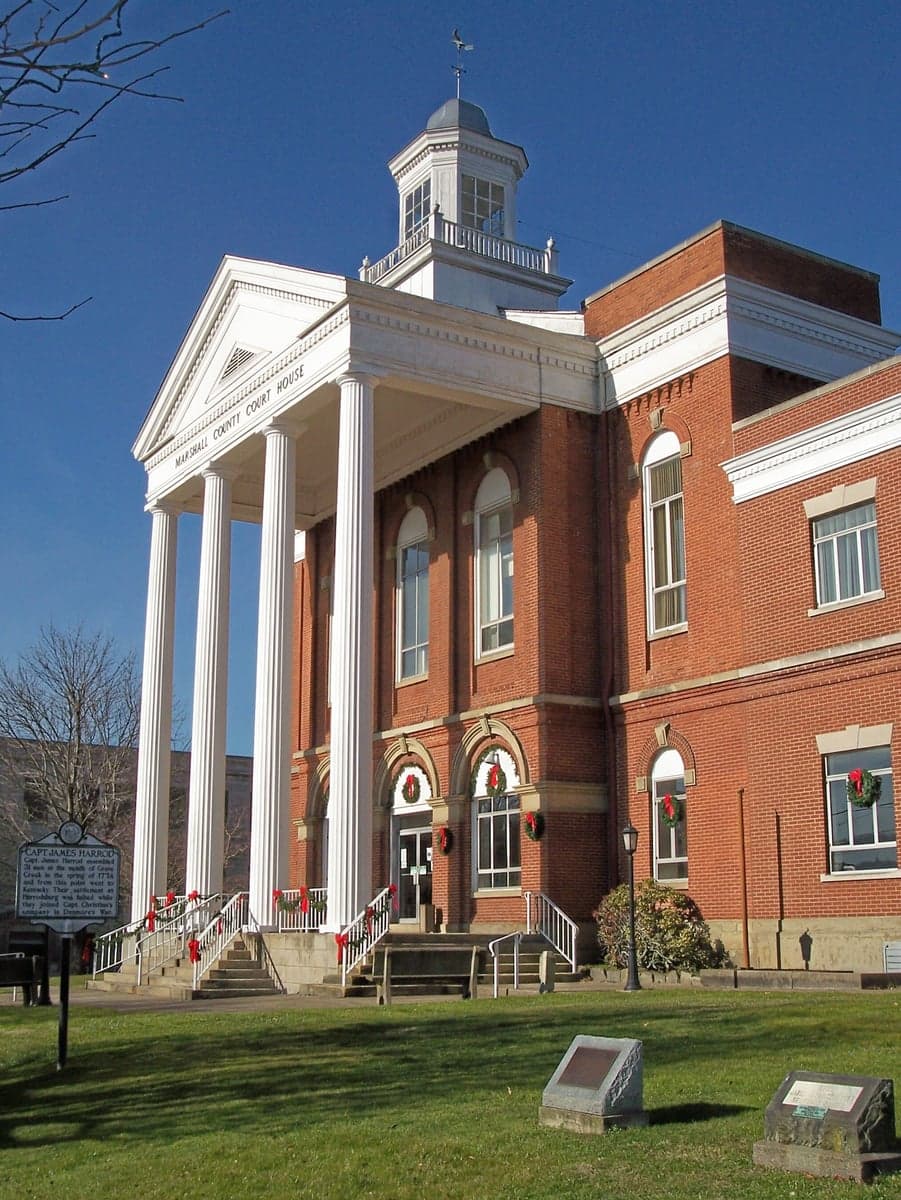
Photo: Wikipedia
Demographics of Marshall County
Affluence Level in Marshall County
A below-average socioeconomic profile. Incomes, home values, and educational attainment trail the U.S., with higher poverty and unemployment.
People of Marshall County
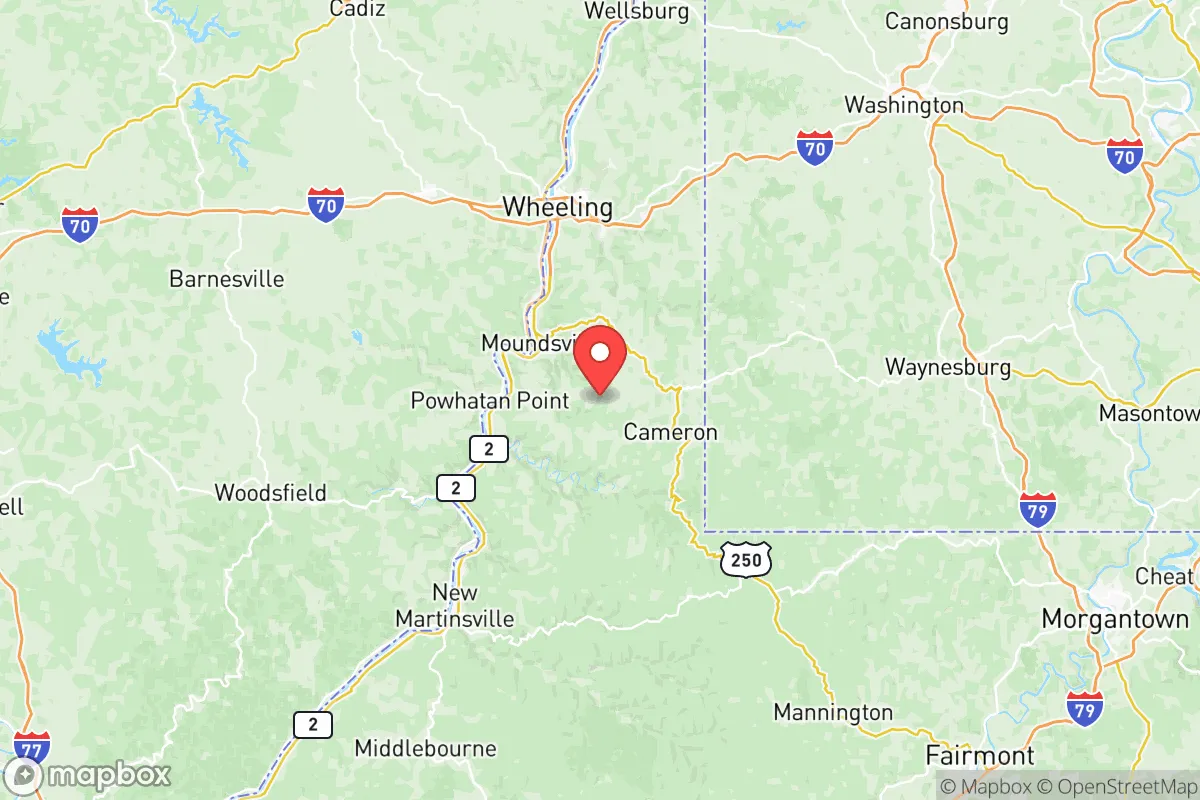
Marshall County, West Virginia, is a deeply rooted, predominantly white Appalachian community of 30,129 residents, characterized by its historic industrial backbone and a strong sense of local identity. With a population that is 93.9% white and a foreign-born share of just 0.2%, it remains one of the most ethnically homogeneous counties in the state, a direct legacy of its 19th- and early 20th-century settlement patterns. The county’s distinctive identity is shaped by its Ohio River border, its history as a coal and steel hub, and a population that is older and less mobile than the national average, with only 19.1% holding a college degree. For a conservative-leaning individual or family, Marshall County represents a place where traditional values, local ties, and a slower pace of life remain the norm.
Settlement & growth (pre-1960)
Long before European settlers arrived, the area now known as Marshall County was part of the hunting and trading grounds of the Shawnee and Iroquois nations, who used the Ohio River as a major travel and trade corridor. The first permanent European settlers were primarily of English, Scots-Irish, and German descent, who began crossing the Appalachian Mountains in the late 18th century. The Virginia General Assembly created Marshall County in 1835 from a portion of Ohio County, naming it after Chief Justice John Marshall. The earliest settlements clustered along the Ohio River and its tributaries, with Moundsville, the county seat, growing around the prehistoric Grave Creek Mound—a significant Native American earthwork that still stands today.
The major population wave came with the industrial boom of the late 19th and early 20th centuries. The discovery of rich coal seams and the expansion of the Baltimore and Ohio Railroad transformed the county. Benwood and McMechen became bustling company towns, drawing thousands of workers from the surrounding Appalachian region and from Southern and Eastern Europe. Italian, Polish, and Hungarian immigrants arrived in significant numbers between 1880 and 1920, settling in the river towns to work in the steel mills, glass factories, and coal mines. Glen Dale and Cameron also grew as agricultural and railroad service centers. This wave created a working-class, Catholic-influenced enclave within the otherwise Protestant Appalachian landscape, a distinction still visible in the county’s church architecture and family names.
The post-World War II period saw a peak in population, with Marshall County reaching over 40,000 residents by 1950. The local economy was dominated by the massive steel plants in Benwood and the coal mines that stretched into the surrounding hills. However, the county’s population began a slow decline after 1960, as automation reduced mining jobs and the steel industry faced increasing competition. The descendants of the early English and Scots-Irish settlers, along with the later Italian and Eastern European immigrants, largely stayed put, creating a stable but aging demographic base that remains the county’s core today.
Modern era (post-1965)
The 1965 Hart-Cellar Act, which reshaped American immigration, had virtually no impact on Marshall County. Unlike the booming Sun Belt or major metropolitan areas, the county did not attract new immigrant populations. The foreign-born share of 0.2% is among the lowest in the nation, and the county’s racial composition has remained essentially static. The small Hispanic population (1.1%) and the tiny Black (0.3%), East/Southeast Asian (0.1%), and Indian (0.3%) communities are largely the result of individual professionals—often doctors or engineers at local hospitals or the West Virginia Penitentiary—rather than any organized migration wave.
The dominant demographic story of the modern era is domestic out-migration. Since the 1970s, Marshall County has lost population steadily, as younger residents left for job opportunities in Pittsburgh, Columbus, and the Carolinas. The county’s population dropped from 37,000 in 1990 to 30,129 today. This “brain drain” has left an older, less mobile population. The remaining residents are overwhelmingly native-born and deeply connected to the area. Suburbanization has been limited; while some new housing has been built around Moundsville and along the Interstate 470 corridor, the county has not experienced the sprawling development seen in West Virginia’s eastern panhandle. The towns of Dallas, Sand Hill, and Lynn Camp remain small, unincorporated communities where families have lived for generations.
The closure of the steel mills in Benwood and the decline of deep-shaft coal mining have forced a shift toward a more service-based economy. Healthcare, education, and corrections (the West Virginia Penitentiary in Moundsville, now a tourist attraction, and the Northern Regional Jail) are now the largest employers. This economic transition has not attracted new ethnic diversity; instead, it has reinforced the county’s character as a place where people stay because of family, land, and a preference for a quiet, rural lifestyle.
The future
Demographic projections for Marshall County point toward continued slow decline and further homogenization. The population is older than the state average, with a median age around 45, and the birth rate is below replacement level. Without significant in-migration, the county will likely shrink to 25,000–27,000 residents by 2040. The small Hispanic and Asian populations may grow slightly as healthcare facilities recruit foreign-trained professionals, but they will remain a tiny fraction of the total. The county is not tribalizing into distinct ethnic enclaves; rather, it is becoming more uniformly white and native-born as younger, more diverse cohorts leave.
The cultural identity of Marshall County is likely to remain stable. New residents who do move in are typically retirees returning to family roots or remote workers seeking low housing costs and a slower pace. These newcomers are generally absorbed into the existing social fabric rather than changing it. The county’s political and social conservatism, rooted in its Appalachian and Rust Belt heritage, shows no signs of shifting. The next 10–20 years will likely see a continuation of the status quo: a shrinking, aging, but stable community where family history and local institutions—churches, volunteer fire departments, high school sports—remain the center of social life.
For someone moving in now, Marshall County offers a predictable, low-diversity environment where community ties are strong and change is slow. It is not a place of demographic transformation or cultural flux, but a place where the past continues to shape the present. The kind of person who will thrive here is one who values rootedness, knows their neighbors, and prefers the quiet rhythms of the Ohio River valley over the dynamism of a growing metropolis.

* Values derived from national, state, county, city and local statistics and may differ in a specific area. Last updated: 2026-05-22T03:43:42.000Z
Narrative content on this page is AI-generated and may contain mistakes. Verify any details that matter before acting on them.
ReloMaps may earn a commission from affiliate links at no extra cost to you.

