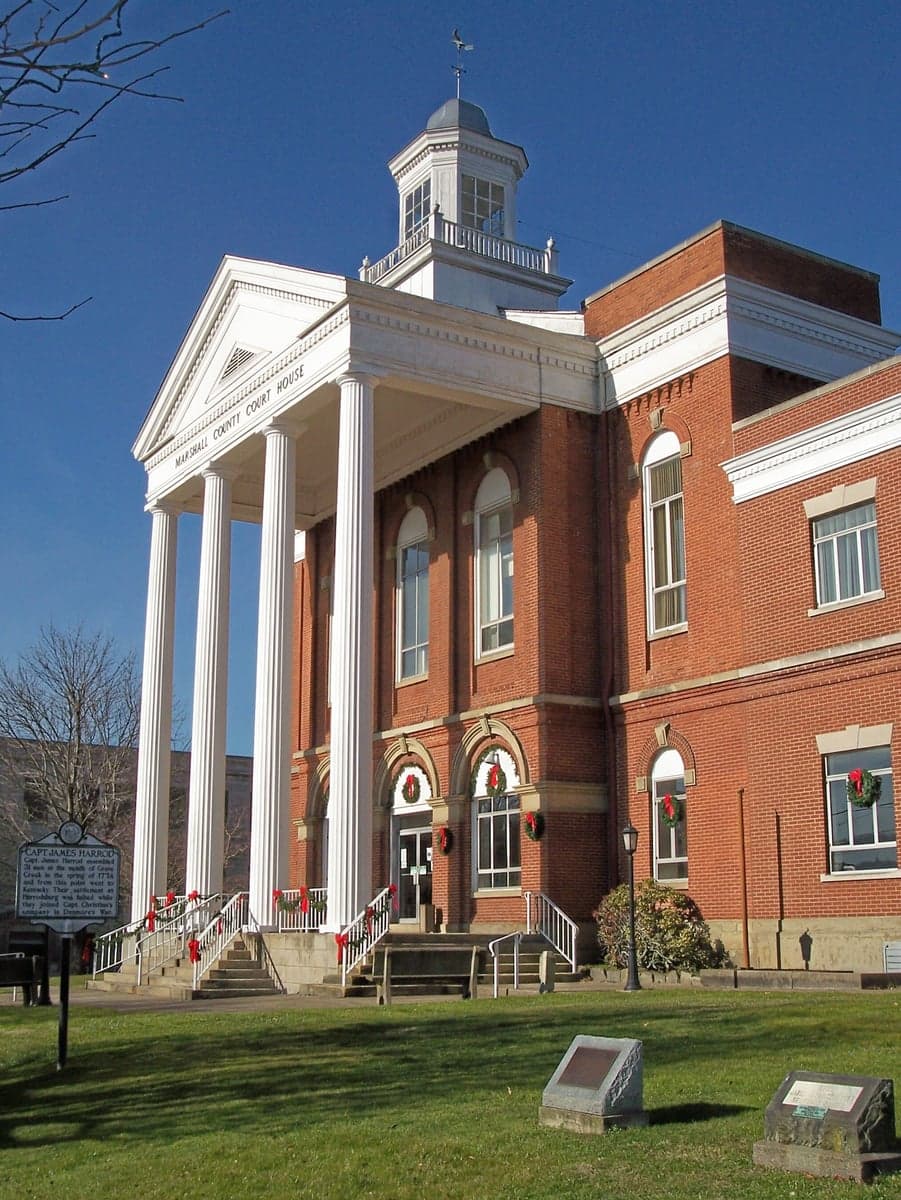
Photo: Wikipedia
Political ClimatePolitical Climate in Marshall County
Showing district-level results — no local-only data available.
Local Political AnalysisPolitical Analysis of Marshall County
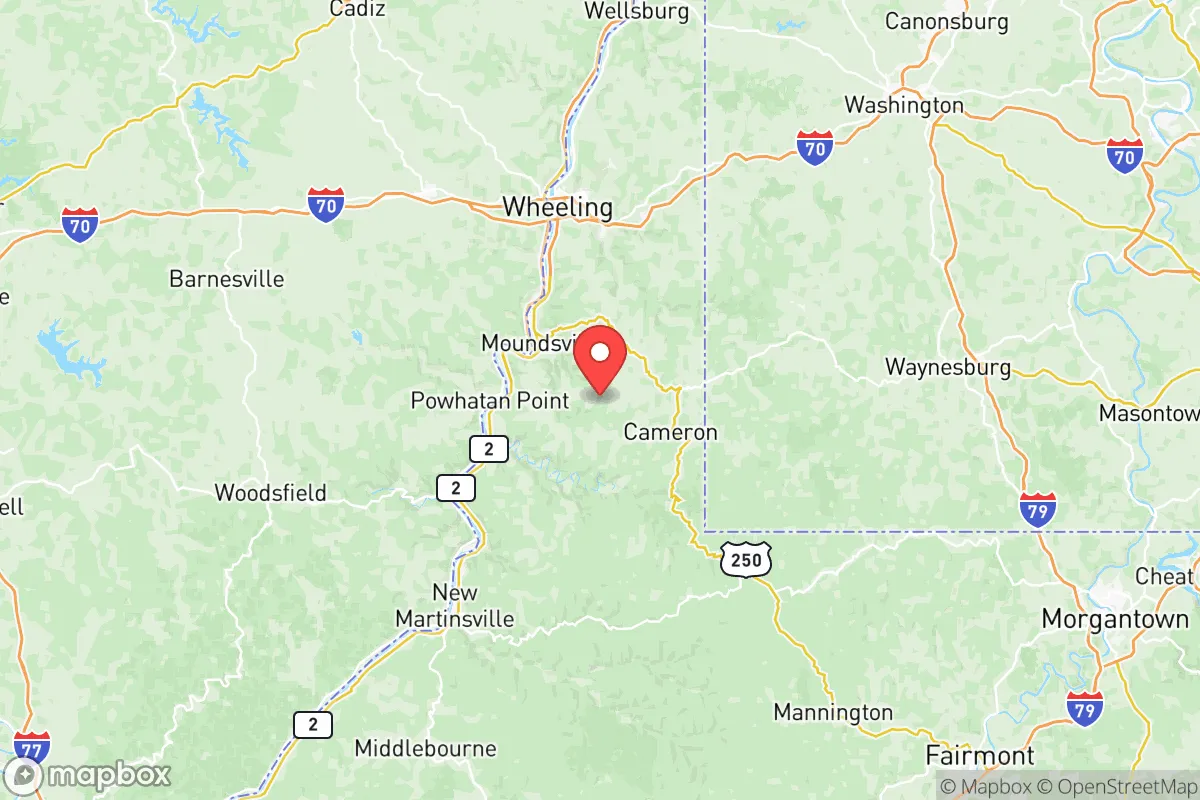
Marshall County is a rock-solid Republican stronghold, carrying a Cook PVI of R+20 that puts it just a hair to the left of the state's R+21 average, but don't let that decimal fool you—this is deep-red country through and through. The county hasn't voted for a Democratic presidential candidate since 1996, and the margins have only widened since then, with Trump pulling in over 70% in 2020 and 2024. That said, there's a real split between the northern end of the county, where towns like Moundsville and Glen Dale have a few more union households and historically Democratic precincts that can swing closer to 60-40, and the southern end around Cameron and Sand Hill, where you're looking at 80-20 or even 85-15 Republican. The swing precincts are mostly in the Moundsville city limits, especially around the old steel and glass plants, where a handful of working-class families still vote straight-ticket Democrat out of habit, but even those are shrinking fast as the national party drifts further from their values.
How it compares to West Virginia as a whole
West Virginia as a state is R+21, so Marshall County is essentially a mirror image of the state's overall political DNA—culturally conservative, economically populist, and deeply skeptical of federal overreach. The big difference is that Marshall County doesn't have the same kind of college-town liberal enclaves you see in Morgantown (Monongalia County) or the Eastern Panhandle's exurban sprawl. There's no WVU campus here, no hipster coffee shops, no progressive activist base to speak of. What you get instead is a more uniform, blue-collar conservatism that's rooted in the coal and natural gas industries, even though those jobs aren't what they used to be. The county's politics are also more consistently Republican than the state's southern coalfields, where you still see a few old-school Democrats hanging on in places like McDowell or Mingo counties. In Marshall County, the shift to the GOP happened faster and more completely, and there's no real sign of it reversing.
What this means for residents
For folks living here, the political climate means you can generally expect local government to stay out of your business on things like gun rights, property taxes, and school curriculum. The county commission and school board are reliably conservative, so you're not going to see the kind of progressive overreach that's popping up in places like Morgantown or Charleston—no mask mandates that drag on forever, no critical race theory nonsense in the classrooms, no push to restrict your Second Amendment rights. The downside is that the county's tax base is shrinking, and the local economy hasn't diversified much, so you're stuck with a trade-off: more personal freedom, but fewer public services and job opportunities. The biggest concern I hear from neighbors is that the state government in Charleston, even with a Republican supermajority, has been too willing to take federal money with strings attached, which could eventually force local schools and health departments to adopt policies that don't fit our values. So far, Marshall County has held the line, but you've got to keep an eye on it.
Culturally, Marshall County is a place where people still wave from their trucks, the VFW hall is the social hub, and the biggest controversy in recent years was over whether to allow a Dollar General on Route 2. There's a strong sense of self-reliance here—people don't like being told what to do by anyone, whether it's the county health department or the EPA. The policy distinction that really sets Marshall County apart from the rest of the state is its approach to natural resource extraction: while southern West Virginia has embraced mountaintop removal and the state has pushed hard for petrochemical development along the Ohio River, Marshall County has been more cautious, with local zoning battles over fracking wells and a general wariness of out-of-state corporations coming in to take what's ours without giving back. It's a conservative skepticism of big business that you don't see as much in the rest of the state, and it's one of the things that makes this place feel like a last bastion of common sense in a country that's losing its mind.

State Political ClimatePolitical Climate in West Virginia
State Political AnalysisPolitical Environment in the State
West Virginia is one of the most reliably Republican states in the nation, carrying a Cook PVI of R+21, meaning it votes about 21 points more Republican than the national average. This wasn’t always the case—as recently as the 1990s, the state was a Democratic stronghold at the local level, but a massive realignment over the last 20 years has flipped it hard red, driven by cultural backlash against national Democratic positions on coal, guns, and abortion. Today, the dominant coalition is a mix of rural conservatives, working-class voters who abandoned the Democratic Party, and a growing number of out-of-state transplants seeking lower taxes and fewer regulations.
Urban vs. rural divide
The political map is starkly divided between a handful of small urban centers and the vast, deeply red rural expanse. Charleston, the capital and largest city, is the only real blue dot—Kanawha County voted for Joe Biden in 2020 by a slim margin, driven by state government workers, healthcare employees, and a small but vocal progressive activist class. Morgantown, home to West Virginia University, leans left among students and faculty, but the surrounding Monongalia County is competitive and often votes Republican in statewide races. Huntington and Wheeling are more purple but trending red, as deindustrialization has soured voters on Democratic economic policies. Meanwhile, counties like Mingo, Logan, and McDowell in the southern coalfields are among the most Republican in the nation, routinely giving GOP candidates 80% or more of the vote. The Eastern Panhandle—including Berkeley and Jefferson counties—has seen an influx of former Washington, D.C., area residents, and while it’s still Republican-leaning, it’s more moderate and less culturally conservative than the rest of the state. If you’re moving here, your political experience will depend heavily on whether you settle in Charleston’s suburbs or a small town like Lewisburg or Fayetteville.
Policy environment
West Virginia’s policy environment is aggressively conservative by design. There is no state income tax on Social Security benefits, and the state has been phasing down its personal income tax—the rate was cut from 6.5% to 3.99% in 2023, with a goal of full elimination. Sales tax is a low 6%, and property taxes are among the lowest in the nation, capped by the state constitution. The regulatory climate is business-friendly, especially for energy extraction, manufacturing, and outdoor recreation. Education policy has shifted rightward: the state passed one of the nation’s broadest school choice laws in 2021, creating Education Savings Accounts (ESAs) that let parents use public funds for private school, homeschooling, or tutoring. On healthcare, the state expanded Medicaid under the Affordable Care Act, but there’s been no push for a state-run public option. Election laws are solid: voter ID is required, early voting is available, and the state has resisted mail-in ballot expansions. Governor Jim Justice, a Republican, has signed pro-life legislation, including a near-total abortion ban with limited exceptions, and the state has a constitutional amendment declaring no right to abortion. For a conservative relocating here, the policy environment is a clear green light—low taxes, school choice, and minimal government interference in daily life.
Trajectory & freedom
West Virginia is becoming more free in several key areas, but there are warning signs. On gun rights, the state enacted constitutional carry in 2016, allowing permitless concealed carry for adults, and has preempted local gun ordinances—a strong protection against city-level restrictions. On parental rights, the 2021 ESA law was a major win, and the state has passed laws requiring schools to notify parents of curriculum changes and allowing them to opt children out of sexually explicit materials. Medical autonomy took a hit with the abortion ban, but the state has not restricted COVID-19 vaccine mandates or mask requirements—in fact, the legislature passed a bill in 2023 banning vaccine mandates for state employees and students. Property rights are generally strong, with no statewide zoning and low property taxes, but the state’s reliance on natural gas extraction has led to friction over mineral rights and surface owner protections. The biggest concern for freedom-minded residents is the state’s heavy reliance on federal funding—over 40% of the state budget comes from Washington, which creates a vulnerability to federal strings attached. Recent legislation like the Second Amendment Preservation Act (which attempts to nullify federal gun laws) shows the legislature is willing to push back, but the state’s economic dependence on federal dollars limits how far that can go.
Civil unrest & political movements
West Virginia has a history of labor militancy, but modern political movements are dominated by conservative activism. The 2021 teachers’ strike was a rare flashpoint, with educators walking out over pay and benefits—but that movement was nonpartisan and didn’t align with progressive causes. The state has seen organized opposition to wind and solar projects in some rural areas, driven by property rights concerns and skepticism of green energy mandates. Immigration politics are muted—the state has a tiny foreign-born population (about 1.5%), so there’s no sanctuary city debate or visible immigration enforcement flashpoints. Election integrity has been a hot topic: the legislature passed a law in 2021 requiring drop boxes to be monitored and limiting who can return absentee ballots, and there’s been no major fraud controversy. The most visible political movement is the “Take Back West Virginia” effort by conservative groups to push the state further right, focusing on school board races and county commissions. You won’t see large protests or civil unrest here—the state is too rural and spread out for that. What you will notice is a deep cultural distrust of federal authority, especially the EPA and the Department of Education, which is a unifying sentiment across the political spectrum.
Projection
Over the next 5-10 years, West Virginia will likely become even more Republican, but with a growing tension between traditional rural conservatives and moderate transplants in the Eastern Panhandle. The state’s population is aging and shrinking—it lost about 3% of its population between 2010 and 2020—but in-migration from Virginia, Maryland, and Pennsylvania is picking up, especially in the Panhandle and around Berkeley Springs and Shepherdstown. These newcomers tend to be more fiscally conservative but socially moderate, which could soften the state’s hardline positions on issues like marijuana legalization (medical use is legal, but recreational is not) and gambling expansion. The income tax phase-out will continue, making the state even more attractive to remote workers and retirees. The biggest wildcard is the energy transition: if coal continues to decline, the southern coalfields will lose political clout, and the state’s economy will shift toward tourism, healthcare, and logistics. For a conservative moving in now, expect a state that remains deeply red but becomes slightly more suburban and less culturally isolated over the decade.
Bottom line for a new resident: West Virginia offers a low-tax, low-regulation environment with strong protections for gun rights, school choice, and parental authority. You’ll find a welcoming community of like-minded conservatives in most areas, but avoid Charleston if you want to escape progressive politics. The state is stable, safe, and unlikely to shift left anytime soon—just be prepared for a slower pace of life and a heavy reliance on federal dollars that could create future friction. If you value personal freedom and want to live somewhere that still feels like the America of 30 years ago, this is one of the best bets in the country.
* Values derived from national, state, county, city and local statistics and may differ in a specific area. Last updated: 2026-05-22T03:43:42.000Z
Narrative content on this page is AI-generated and may contain mistakes. Verify any details that matter before acting on them.
ReloMaps may earn a commission from affiliate links at no extra cost to you.

