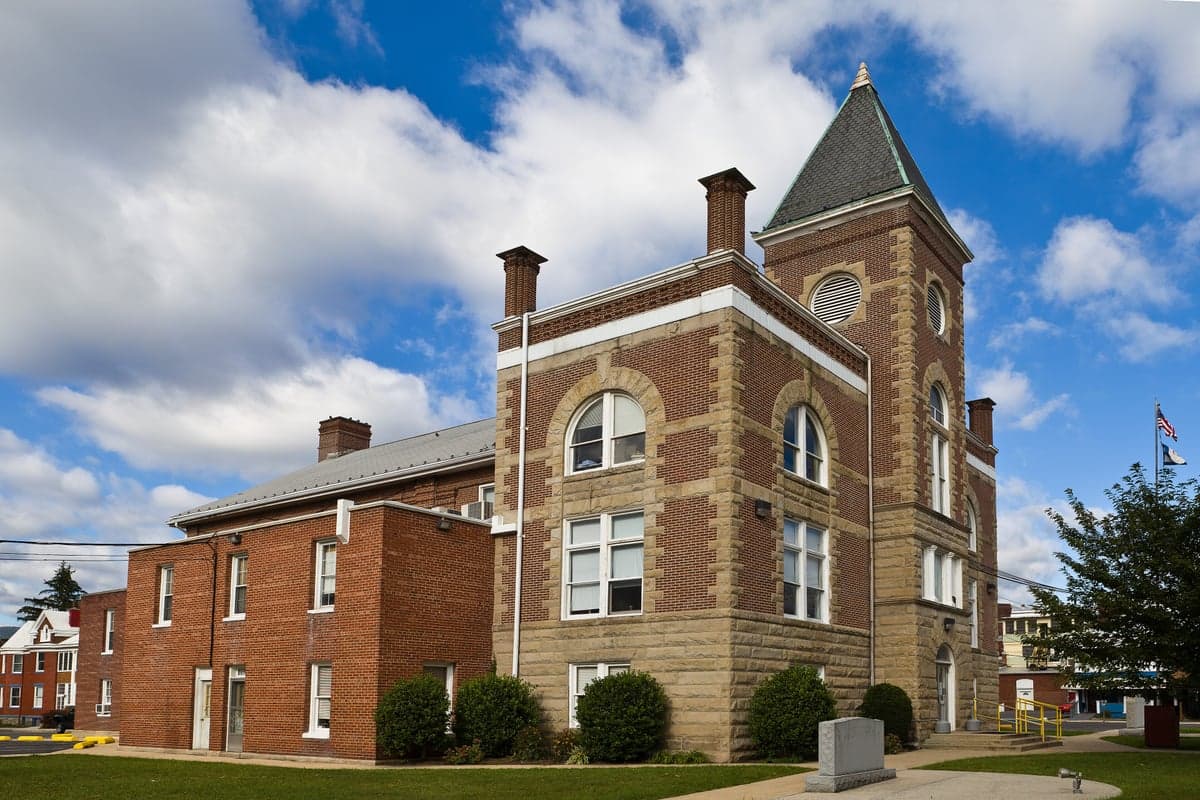
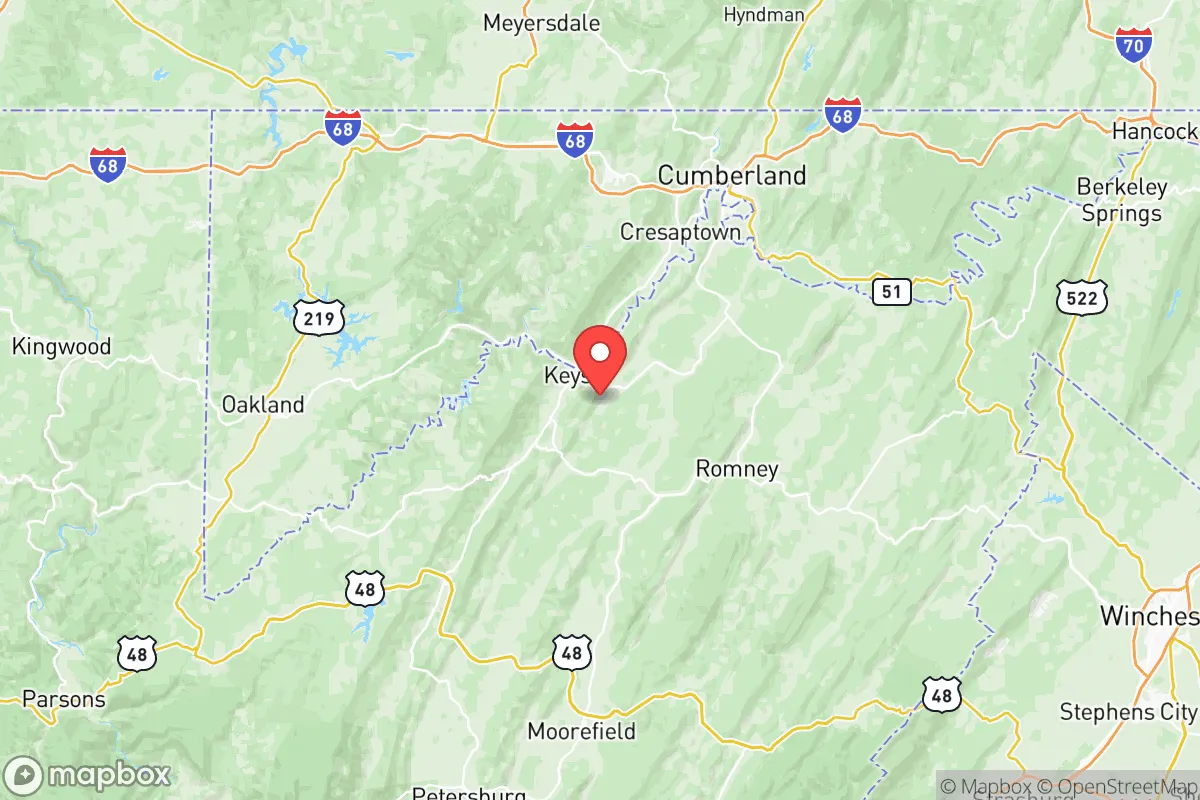
Photo: Wikipedia
Demographics of Mineral County
Affluence Level in Mineral County
A middle-class area roughly in line with national averages across income, home values, education, and employment.
People of Mineral County
The people of Mineral County, West Virginia, number 26,922 and are among the most demographically homogeneous populations in the state, with 92.5% identifying as White and a foreign-born share of just 0.3%. This is a population shaped by nearly three centuries of Appalachian settlement—overwhelmingly of Scots-Irish and German descent—and by the subsequent decline of the coal and railroad industries that once drew workers here. Today, the county carries a distinctive Appalachian cultural identity, marked by low population density, a median age older than the national average, and a strong tradition of family-based land ownership concentrated in the county seat of Keyser and the historic communities of Fort Ashby, Ridgeley, and Piedmont.
Settlement & growth (pre-1960)
Before European settlement, the area now known as Mineral County was part of the homelands of the Shawnee and the Iroquois Confederacy, with the Seneca people using the Potomac River valley for seasonal hunting and travel. French and British fur traders passed through the region in the 17th and early 18th centuries, but no permanent European settlement occurred until after the French and Indian War, when the 1768 Treaty of Fort Stanwix opened the land south of the Ohio River to colonial expansion.
The first major wave of settlement arrived in the decades after the American Revolution, beginning around 1780. Scots-Irish and German families moved south from Pennsylvania along the Great Wagon Road, taking up small farmsteads in the fertile valleys of the Potomac and its tributaries. These early settlers founded what is now Fort Ashby—originally a frontier outpost built in 1755—and the present-day site of Keyser, then known as Paddytown after an early Irish trader. By 1800, the population was almost entirely of British and German stock, living in dispersed farmsteads with a handful of mill towns.
The second wave came with the construction of the Baltimore and Ohio Railroad in the 1840s and 1850s. Irish and German immigrants arrived to build the tracks and tunnels, settling in the towns that grew around the rail depots: Piedmont, Ridgeley, and Keyser. Piedmont became a company town for the railroad, with a workforce that included a small number of African American laborers—the first non-White presence in the county—who worked as porters and track layers. By the 1870 Census, the county's population had reached roughly 5,000, overwhelmingly native-born White but with growing pockets of Irish and German Catholics in the railroad towns.
The third wave, spanning roughly 1880 to 1920, was driven by the coal boom. Mining camps and company towns sprouted in New Creek, Elk Garden, and Antioch, attracting native-born White workers from surrounding counties as well as a modest influx of Eastern European immigrants—primarily Poles and Hungarians—who labored in the mines and coke ovens. The county's population peaked around 1930 at roughly 28,000, then stabilized as the coal industry mechanized and railroad employment declined. By 1960, the population was about 26,000, overwhelmingly White and native-born, with a strong Scots-Irish cultural identity and a deep attachment to local churches, family farms, and mining traditions.
Modern era (post-1965)
The 1965 Hart-Cellar Act, which fundamentally reshaped U.S. immigration by abolishing national-origin quotas, had almost no effect on Mineral County. The county's foreign-born population today stands at just 0.3%, far below the national average of roughly 14%, and the White share remains at 92.5%—an extremely high figure even for rural West Virginia. No significant new immigrant groups arrived in the post-1965 period. The county's demographic stability is not due to immigration but to the absence of it.
Instead, the modern era has been defined by domestic out-migration. Since the 1970s, the decline of coal and the contraction of the railroad industry have driven younger adults to leave for job centers in Baltimore, Washington, D.C., and the broader Mid-Atlantic, while the county has attracted minimal relocation from other states. The population has hovered between

* Values derived from national, state, county, city and local statistics and may differ in a specific area. Last updated: 2026-05-27T20:49:02.000Z
Narrative content on this page is AI-generated and may contain mistakes. Verify any details that matter before acting on them.
ReloMaps may earn a commission from affiliate links at no extra cost to you.

