
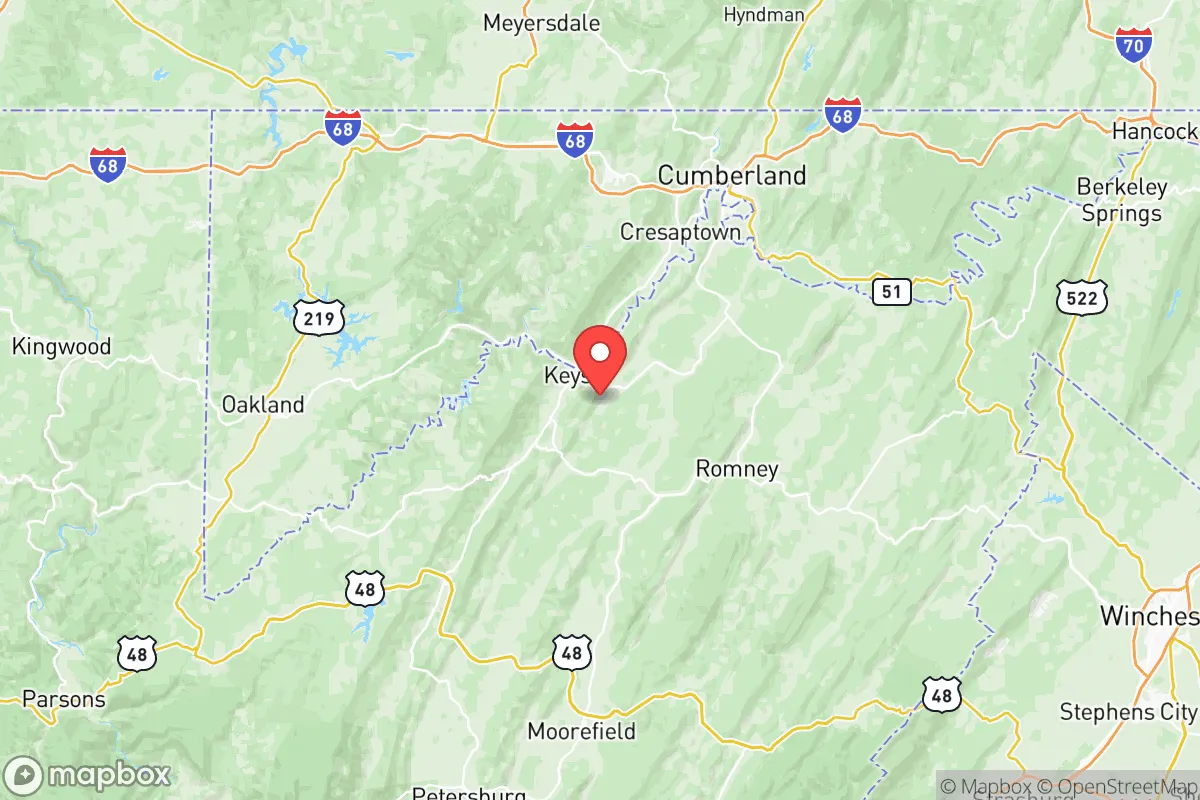
Photo: Wikipedia
Personal Sovereignty in Mineral County
Strong independent fundamentals that actively favor personal liberty and low regulation.
What does Personal Sovereignty tell us?
Personal Sovereignty measures your capacity for self-reliance and independence with minimal government friction. Higher scores mean fewer barriers between you and the way you want to live... but it assumes you have the space you need and good neighbors.
What does this tell us?
Personal Sovereignty measures your capacity for self-reliance and independence with minimal government friction. Higher scores mean fewer barriers between you and the way you want to live... but it assumes you have the space you need and good neighbors.
State Policy
Energy independence: Net exporter (200% of energy produced in-state)
Personal Liberty
Homesteading

Personal Liberty Analysis
Mineral County, West Virginia, offers a level of personal sovereignty that is increasingly rare in the modern United States, making it a serious consideration for those prioritizing autonomy over convenience. The county’s rural character, combined with West Virginia’s generally light-touch governance, creates an environment where individuals can live with minimal interference from state or local authorities. For those concerned with government overreach, the area presents a viable alternative to the densely regulated corridors of the Northeast and Mid-Atlantic, though the trade-offs in economic opportunity and access to services are real and must be weighed carefully.
Tax burden and regulatory posture for individuals and small operations
West Virginia’s tax structure is a net positive for those seeking to keep more of their earnings. The state imposes a progressive income tax with rates from 2.36% to 4.82% as of 2026, but Mineral County’s local tax burden is low. Property taxes are among the lowest in the nation, with effective rates typically under 0.6% of assessed value. A home valued at $150,000 in Keyser or Fort Ashby might carry an annual tax bill of roughly $900. There is no state-level sales tax on groceries, and the combined state and local sales tax rate is 7%, which is moderate. The regulatory posture in Mineral County is decidedly hands-off. Zoning is minimal or nonexistent in unincorporated areas, meaning that in places like Ridgeley and Wiley Ford, residents can operate home-based businesses, keep livestock, or build structures without the permitting headaches common in more urbanized counties. The state’s right-to-work law and lack of burdensome occupational licensing for many trades further reduce the friction of starting a small operation. For a prepper or survivalist, this means less bureaucratic overhead when establishing a self-sufficient homestead or a side business.
Self-defense rights and specific gun law environment
West Virginia is a constitutional carry state, meaning no permit is required to carry a concealed firearm for anyone legally allowed to possess one. This is a foundational liberty for those who view self-defense as a non-negotiable right. Mineral County’s culture aligns strongly with this posture. Gun ownership is widespread, and there is no social stigma attached to carrying openly or concealed. The state preempts local firearm ordinances, so municipalities like Keyser and Piedmont cannot enact their own restrictions on magazine capacity, firearm types, or storage requirements. Stand-your-ground laws are in effect, with no duty to retreat in any place where a person is lawfully present. For those concerned about federal overreach, West Virginia has passed a Second Amendment Sanctuary resolution, signaling local resistance to any future federal firearm restrictions. The practical reality in Mineral County is that you can train, carry, and store firearms without fear of running afoul of local ordinances, and the sheriff’s office is generally supportive of gun rights.
Self-reliance and homesteading viability across the county
Mineral County is well-suited for those pursuing a self-reliant lifestyle, but the feasibility varies by location. Unincorporated areas and smaller towns like Burlington and Elk Garden offer large parcels of land at affordable prices—often $3,000 to $6,000 per acre for raw land. Lot sizes of 5 to 20 acres are common, providing ample space for gardens, orchards, and small livestock. Zoning is virtually absent outside of Keyser’s town limits, meaning you can build a pole barn, install a rainwater catchment system, or set up a solar array without permits. Off-grid living is legally feasible, though you must comply with state health department regulations for septic systems. The county’s water table is generally good for wells, and solar insolation is adequate for year-round power generation. However, in the more developed areas around Keyser and Fort Ashby, homeowners associations (HOAs) may impose restrictions on livestock, outbuildings, or external solar panels. Buyers should verify HOA covenants before purchasing. For the serious prepper, the western and northern parts of the county offer the most freedom, with fewer neighbors and less oversight.
Personal liberties: parental rights, medical autonomy, speech, and property
West Virginia has a mixed record on parental rights and medical autonomy, but Mineral County’s local culture leans heavily toward individual choice. The state does not have a broad religious exemption for vaccine mandates, and school vaccine requirements are standard. However, the county’s school board has shown resistance to federal overreach in curriculum and health policies, and many families opt for homeschooling or private religious education. The state’s homeschool laws are relatively permissive, requiring only a notice of intent and basic assessment options. Medical freedom is a live issue; while the state has not passed a comprehensive medical freedom law, local practitioners who offer alternative or holistic care operate with little interference. Speech and assembly rights are robust, with no local ordinances restricting political expression. Property rights are strong, with eminent domain rarely used for private development. For those concerned about government tracking or data collection, Mineral County’s low population density and limited surveillance infrastructure provide a degree of anonymity that is hard to find in suburban or urban areas. The sheriff’s office is generally focused on serious crime rather than enforcing minor regulatory infractions, which aligns with a live-and-let-live ethos.
Overall, Mineral County ranks as one of the more sovereign areas in the eastern United States for those willing to accept its economic limitations and rural isolation. Compared to neighboring counties in Maryland or Virginia, where taxes are higher, gun laws are stricter, and zoning is more intrusive, Mineral County offers a tangible escape from the creeping regulatory state. For the prepper, the survivalist, or the conservative individual seeking a place where personal responsibility is still the norm, this county provides a solid foundation. The key is to choose your specific location wisely—avoiding HOA-controlled subdivisions and focusing on unincorporated land—and to understand that sovereignty comes with the burden of self-reliance. There are no safety nets here, but for many, that is precisely the point.

* Values derived from national, state, county, city and local statistics and may differ in a specific area. Last updated: 2026-05-27T20:49:02.000Z
Narrative content on this page is AI-generated and may contain mistakes. Verify any details that matter before acting on them.
ReloMaps may earn a commission from affiliate links at no extra cost to you.

