Photo: Wikipedia
Demographics of Westbrook, ME
Affluence Level in Westbrook, ME
A middle-class area roughly in line with national averages across income, home values, education, and employment.
People of Westbrook, ME
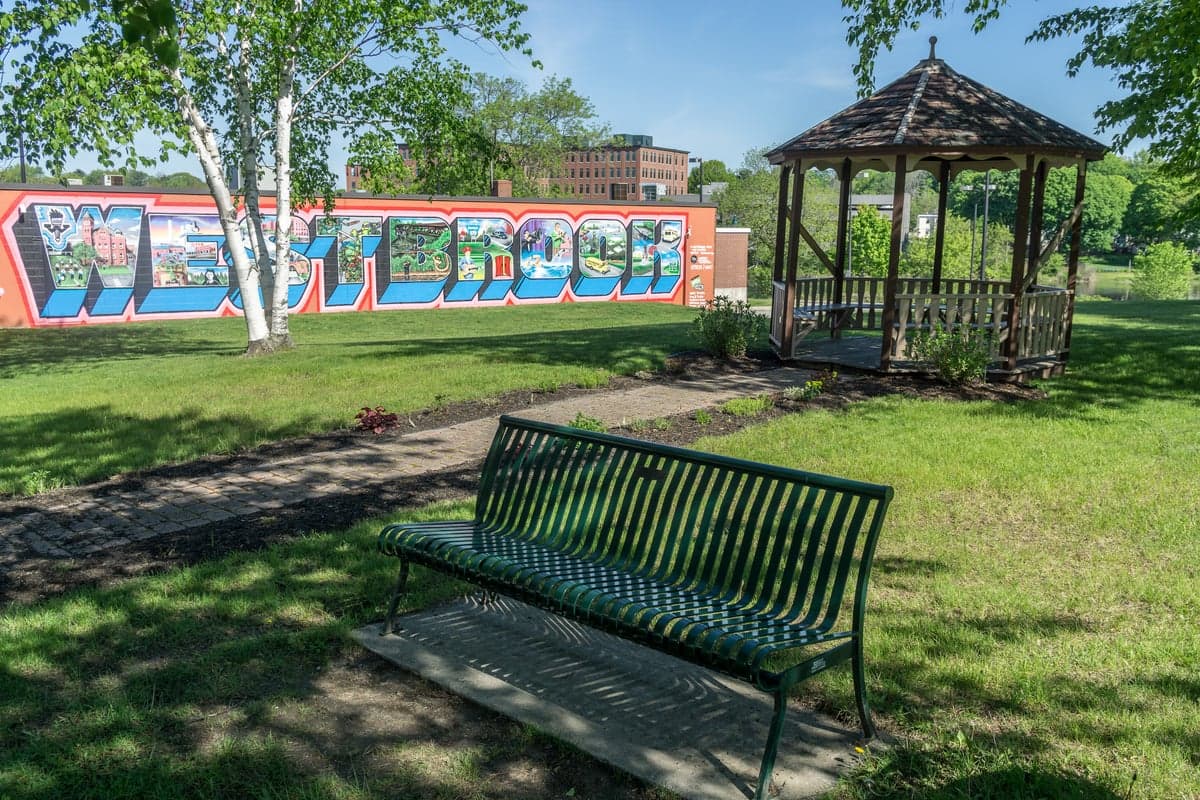
The people of Westbrook, Maine, today number 20,484, forming a compact, historically rooted community that is notably less diverse than the national average. The city is predominantly white (81.3%) with a small foreign-born population of just 3.5%, and it carries a distinct blue-collar heritage now overlain with a growing professional class—nearly 40% of adults hold a college degree. Westbrook’s identity is shaped by its role as a former mill town that has steadily suburbanized, attracting families and workers seeking affordable housing within commuting distance of Portland while retaining a tight-knit, locally oriented character.
How the city was settled and grew
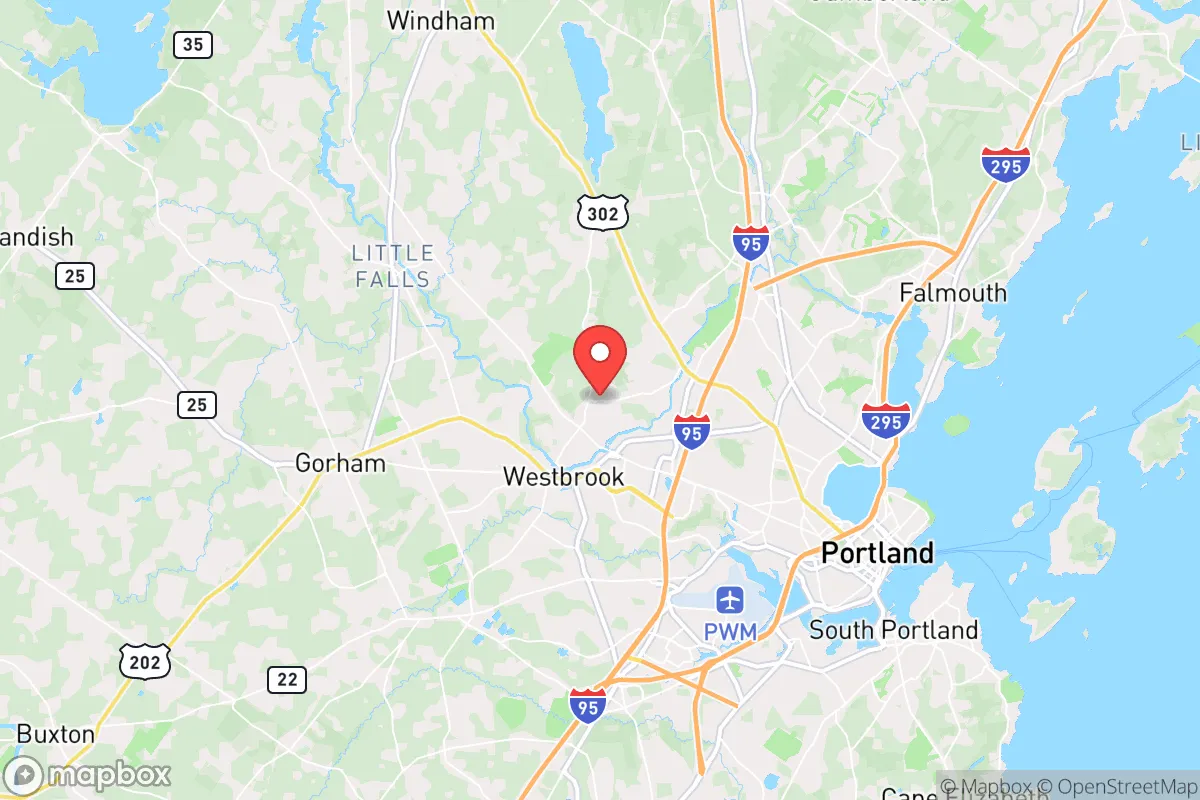
Westbrook’s population history begins with the region’s original inhabitants, the Wabanaki Confederacy, who used the Presumpscot River for fishing and travel. European settlement began in the early 18th century, with the town incorporated in 1814. The defining draw was water power: the Presumpscot River’s falls powered sawmills, gristmills, and later textile mills. The first major wave of settlers were English-descended farmers and millwrights from coastal Massachusetts and southern Maine. By the mid-19th century, the S.D. Warren paper mill (later Sappi) became the dominant employer, drawing a second wave: Irish immigrants fleeing the Great Famine, who settled in the Frenchtown neighborhood along the river’s west bank, building St. Hyacinth’s Church as their anchor. A third wave arrived between 1880 and 1920: French-Canadian families from Quebec, recruited for mill labor, who concentrated in the Millbrook and Riverbank districts near the factory gates. These groups created a Catholic, working-class social fabric that persisted for generations. Smaller numbers of Italian and Polish immigrants arrived in the early 1900s, settling in the Prides Corner area, but the city remained overwhelmingly of French-Canadian and Irish stock through the mid-20th century.
Modern era (post-1965)
The post-1965 period brought gradual demographic change rather than a sudden transformation. The 1965 Immigration and Nationality Act had a muted effect on Westbrook because the city lacked the industrial draw of larger metros. Instead, the major shift was domestic: suburbanization from Portland. From the 1970s onward, middle-class families—many of them white, college-educated professionals—moved into new subdivisions in North Westbrook and the Spring Street corridor, drawn by lower taxes and larger lots. This in-migration diluted the old Franco-American dominance and raised the educational attainment level. The foreign-born population remained small (3.5% today) but shifted in composition. The largest non-white group is Black residents at 5.3%, many of whom are African-born (Somali, Congolese) or African American, with a visible cluster in the Westbrook Heights apartment complex near the Maine Turnpike. East/Southeast Asian residents (3.1%) include Vietnamese and Chinese families, some connected to Portland’s larger Asian community, scattered across the city rather than forming a single enclave. The Indian-subcontinent population is tiny (0.4%), and the Hispanic share (2.1%) is similarly modest, concentrated among younger renters in the Westbrook Village area. Notably, the city has not experienced the rapid diversification seen in Portland or Lewiston; its racial composition has shifted slowly, with the white share declining from roughly 95% in 1990 to 81% today, driven mainly by Black and Asian in-migration.
The future
Westbrook’s population is heading toward modest diversification, but the pace is slow. The city is not tribalizing into distinct ethnic enclaves; instead, newer non-white residents are dispersing across existing neighborhoods, particularly in the apartment-heavy zones near the turnpike and along Main Street. The immigrant communities—especially the Black African population—are growing but from a small base, and there is no sign of a rapid acceleration. The larger demographic trend is aging: the median age has risen to 40.5, and the school-age population has been flat for a decade. New housing construction, concentrated in the Riverfront District (a former mill site redeveloped into mixed-use lofts and townhomes), is attracting younger professionals and empty-nesters, not large families. Over the next 10–20 years, Westbrook will likely become slightly more diverse—perhaps reaching 75–78% white—but will remain a predominantly white, middle-class suburb. The city’s growth will be driven by infill development and Portland spillover, not by immigration waves.
For someone moving in now, Westbrook is becoming a stable, moderately diverse suburb with a strong sense of local history and a practical, no-frills character. It offers a lower-cost alternative to Portland with good schools and a safe environment, but it is not a hub of rapid demographic change or cultural pluralism. The city’s future is one of gradual, managed growth—a place where the old mill-town identity is slowly giving way to a commuter-suburb ethos, without dramatic upheaval.

* Values derived from national, state, county, city and local statistics and may differ in a specific area. Last updated: 2026-05-01T18:10:16.000Z
Narrative content on this page is AI-generated and may contain mistakes. Verify any details that matter before acting on them.
ReloMaps may earn a commission from affiliate links at no extra cost to you.

