Photo: Wikipedia
Demographics of Westminster, MD
Affluence Level in Westminster, MD
A middle-class area roughly in line with national averages across income, home values, education, and employment.
People of Westminster, MD
The people of Westminster, MD today form a predominantly white (77.8%), college-educated (35.4%) community of 20,257 that blends small-town Maryland tradition with a growing professional and service-sector base. The city is notably less diverse than Carroll County as a whole, with a foreign-born population of just 4.7%, and its character remains rooted in the agricultural and institutional history that drew the original settlers. Distinctive markers include a strong civic identity centered on McDaniel College and the downtown historic district, a visible but modest Hispanic presence (7.8%) concentrated in the southwestern neighborhoods, and a small but established Black community (7.5%) whose roots trace back to the post-Civil War era.
How the city was settled and grew
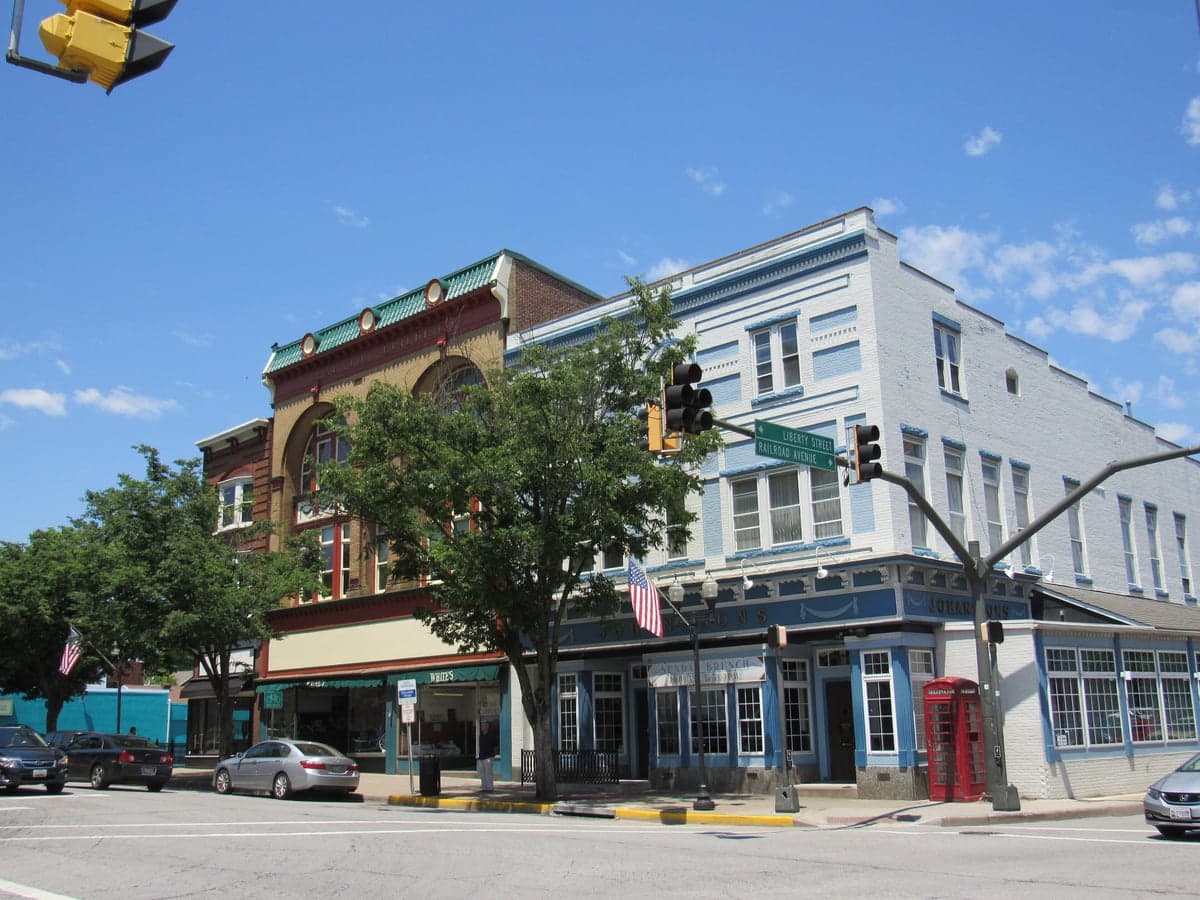
Westminster was founded in 1764 as a crossroads settlement on the "Westminster Path," a Native American trail later used by European settlers moving west from the Chesapeake Bay. The original population was almost entirely English and German Protestant farmers drawn by the fertile limestone soil of the Piedmont region and land grants from the Calvert family. The town's early growth centered on the Historic Downtown District, where German stonemasons built the iconic brick and limestone structures that still line Main Street. By the mid-19th century, the arrival of the Western Maryland Railroad in 1861 spurred a second wave: Irish and German laborers who built the rail line and settled in what is now the Uniontown Road corridor, a working-class area south of downtown. The founding of Western Maryland College (now McDaniel College) in 1867 brought a third wave—faculty, administrators, and their families—who established the College Hill neighborhood north of the campus, a district of Victorian homes that remains the city's most affluent enclave. African Americans, many formerly enslaved, arrived after the Civil War and formed a small community centered on Washington Road and Bond Street, where churches and a segregated school anchored daily life through the Jim Crow era.
Modern era (post-1965)
The post-1965 period brought modest demographic change to Westminster, driven less by international immigration than by domestic in-migration from the Baltimore and Washington, D.C. suburbs. The 1970s and 1980s saw the construction of Carrolltowne, a planned subdivision on the city's western edge, which attracted white-collar commuters seeking larger lots and lower taxes than in Baltimore County. This wave reinforced the city's white majority and raised the college-educated share from roughly 15% in 1970 to 35% today. Hispanic growth began in the 1990s, primarily Mexican and Central American immigrants drawn to construction and poultry processing jobs in the broader county; they concentrated in the South Center Street area and the Westminster Mobile Home Park off Route 97. The Asian population (1.5%, East/Southeast Asian) and Indian population (1.5%, subcontinent) are both small and dispersed, with no single ethnic enclave; these groups are largely professionals employed at McDaniel College, Carroll Hospital, or the county government. The Black population has remained stable at roughly 7.5% since 2000, with most families living in the Washington Road and Bond Street historic corridor, though younger Black professionals have begun moving into newer subdivisions like Wakefield Valley on the city's east side.
The future
Westminster's population is projected to grow slowly—perhaps 5-8% over the next decade—driven by continued spillover from the Baltimore metro area rather than international migration. The foreign-born share (4.7%) is likely to remain low, as Carroll County's restrictive zoning and higher housing costs limit the affordable rental stock that typically attracts new immigrants. The Hispanic population, while growing, is plateauing as second-generation families assimilate and move to larger cities or outer suburbs; the South Center Street corridor may see gradual gentrification as downtown redevelopment pushes east. The white majority will likely shrink slightly—from 77.8% to perhaps 73-75% by 2035—as the city's college-educated professional base diversifies modestly. The most notable trend is tribalization by income and lifestyle: College Hill and Wakefield Valley are becoming more affluent and homogeneous, while Washington Road and the Westminster Mobile Home Park remain working-class and more diverse. The city is not homogenizing; it is slowly sorting into distinct enclaves by class and race, with the historic downtown serving as a shared civic space.
For someone moving in now, Westminster offers a stable, safe, and increasingly professional community with a strong sense of place—but one where the demographic trends are toward gradual, income-driven stratification rather than rapid diversification. The city's future is one of slow, managed growth, with the downtown and college anchoring a white-collar majority while working-class and minority neighborhoods persist on the periphery. It is a good fit for those who value small-town Maryland tradition, low crime, and access to Baltimore without the urban pace, but less suited to those seeking a rapidly diversifying or immigrant-rich environment.

* Values derived from national, state, county, city and local statistics and may differ in a specific area. Last updated: 2026-04-22T04:15:27.000Z
Narrative content on this page is AI-generated and may contain mistakes. Verify any details that matter before acting on them.
ReloMaps may earn a commission from affiliate links at no extra cost to you.

