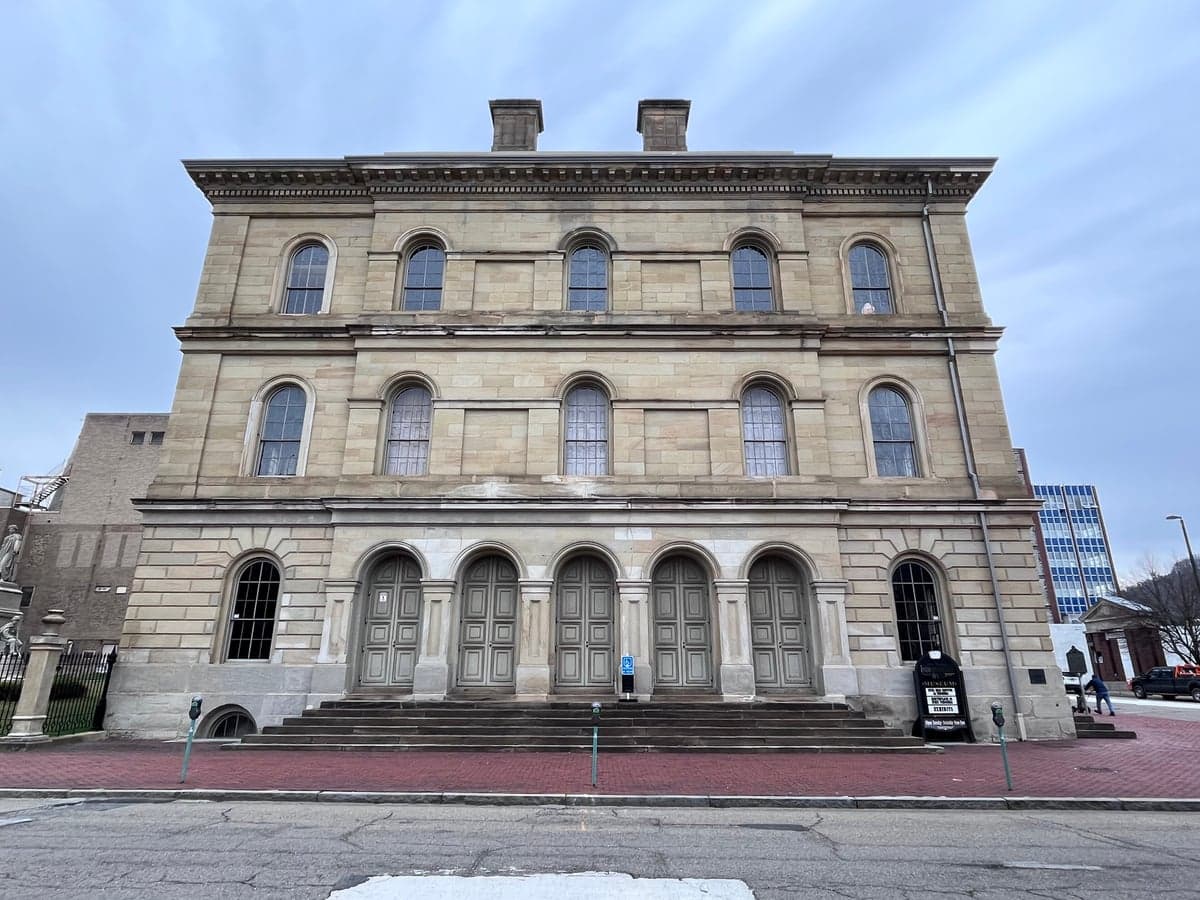
Photo: Wikipedia
Demographics of Wheeling, WV
Affluence Level in Wheeling, WV
A below-average socioeconomic profile. Incomes, home values, and educational attainment trail the U.S., with higher poverty and unemployment.
People of Wheeling, WV
The people of Wheeling, West Virginia today number 26,670, forming a predominantly white (88.6%) and older population with a distinct Appalachian and industrial heritage. The city is notably less diverse than the national average, with a foreign-born share of just 1.2% and a college attainment rate of 32.4% that sits slightly below the U.S. median. Wheeling’s identity is shaped by its steep hillside neighborhoods, a shrinking but stable population, and a strong sense of local history rooted in 19th-century immigration waves that have since largely assimilated.
How the city was settled and grew
Wheeling’s founding population was overwhelmingly of English, Scots-Irish, and German stock, drawn by the city’s strategic position on the Ohio River and the National Road. Incorporated in 1806, it became a major manufacturing and transportation hub by the 1850s, with the Wheeling Suspension Bridge (1849) and the Baltimore & Ohio Railroad fueling growth. The first major wave of immigrants arrived between 1840 and 1890: German Catholics and Lutherans settled in South Wheeling and East Wheeling, building churches and breweries, while Irish laborers dug the railroad tunnels and canals, clustering in Wheeling Island and the Warwood district. By 1900, the city’s population had surged past 38,000, fueled by steel, glass, and tobacco industries. A second wave brought Eastern European immigrants—Poles, Slovaks, and Hungarians—who worked in the mills and settled in North Wheeling and Fulton, where ethnic parishes and fraternal halls defined daily life. These groups largely assimilated by the mid-20th century, leaving only faint cultural markers in neighborhood architecture and church names.
Modern era (post-1965)
After the 1965 Hart-Cellar Act, Wheeling saw almost no new international immigration. The foreign-born share has remained below 2% for decades, and the city’s demographic story since 1970 is one of domestic out-migration and suburbanization. White flight to Ohio County suburbs like Triadelphia and Valley Grove hollowed out older neighborhoods such as East Wheeling and South Wheeling, which lost population and saw housing stock age. The Black population, which peaked at roughly 8% in the 1950s, has declined to 4.4% today, concentrated in the Wheeling Island and downtown areas. The Hispanic share (1.5%) and East/Southeast Asian share (0.2%) are negligible, with no distinct ethnic enclaves forming. The Indian subcontinent population (0.1%) is limited to a handful of professionals, mostly tied to Wheeling Hospital and West Virginia Northern Community College. Wheeling’s modern character is one of demographic stasis—the city has not absorbed any significant new immigrant group since the 1920s, and its population has fallen from a peak of 61,000 in 1930 to its current 26,670.
The future
Wheeling’s population is projected to continue a slow decline, with the 2020-2030 period likely seeing another 5-10% drop as the remaining industrial-era generation ages out. The city is homogenizing rather than tribalizing: the white share is stable at 88-90%, and no immigrant community is growing fast enough to alter the demographic profile. The small Hispanic and Asian populations are plateauing, with most new arrivals being domestic retirees or remote workers drawn by low housing costs. The Centre Market and downtown districts have seen modest reinvestment and a slight uptick in younger residents, but this is a thin countercurrent against overall aging. The next 10-20 years will likely see Wheeling become older, whiter, and smaller, with population concentrated in the flatter, more accessible neighborhoods like Woodsdale and Elm Grove, while steep hillside areas like East Wheeling continue to depopulate.
For someone moving in now, Wheeling offers a low-cost, low-crime environment with a strong sense of place, but it is not a destination for those seeking ethnic diversity or a growing job market. The city is becoming a quiet, stable, and culturally homogeneous small town—a place where the past is more visible than the future, and where new residents will find a welcoming but unchanging community.

* Values derived from national, state, county, city and local statistics and may differ in a specific area. Last updated: 2026-05-02T09:36:10.000Z
Narrative content on this page is AI-generated and may contain mistakes. Verify any details that matter before acting on them.
ReloMaps may earn a commission from affiliate links at no extra cost to you.

