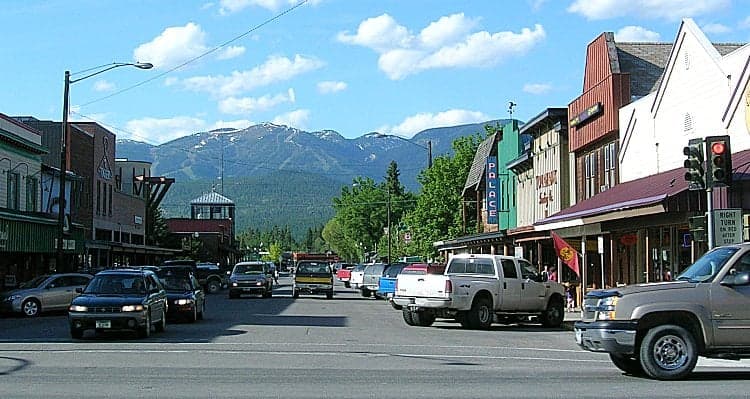
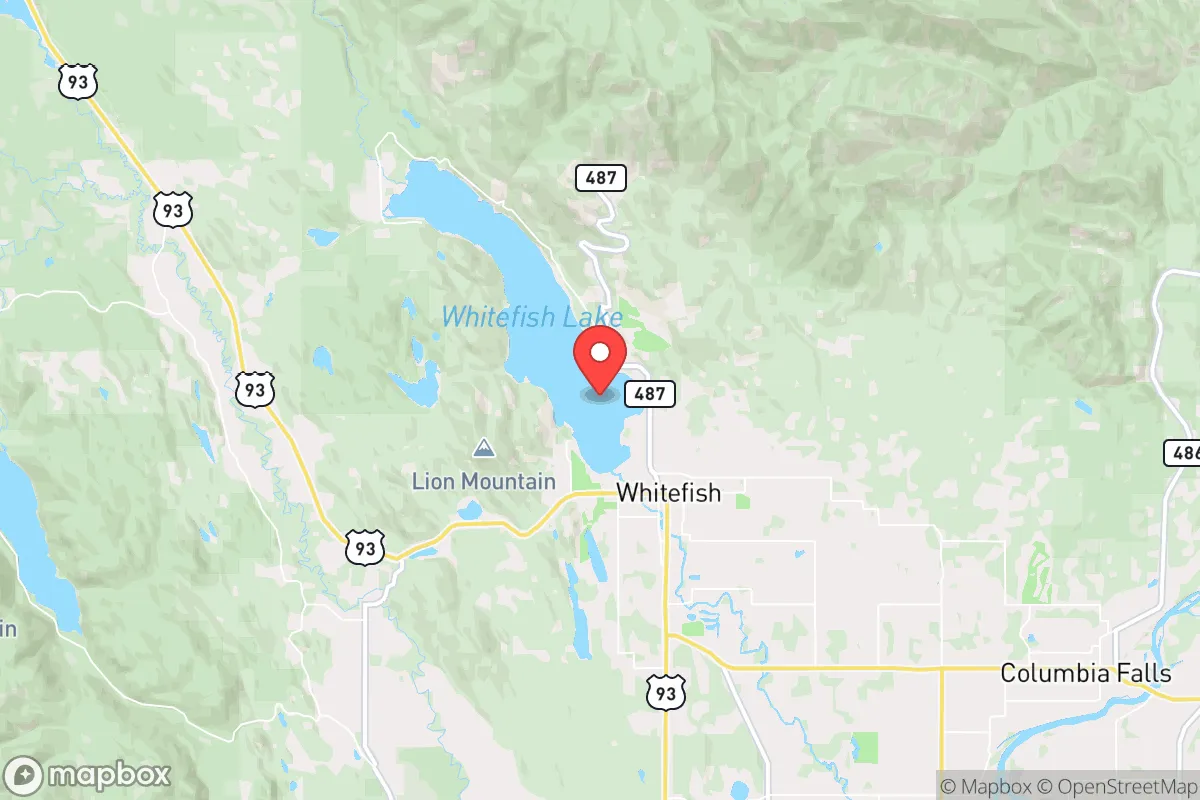
Photo: Wikipedia
Demographics of Whitefish, MT
Affluence Level in Whitefish, MT
An upper-middle-class area. Household wealth, education levels, and homeownership run ahead of national benchmarks.
People of Whitefish, MT
Whitefish, Montana, is a predominantly white, highly educated mountain town of 8,422 residents, where 95.4% of the population identifies as white and 56.5% hold a college degree. The city’s character is defined by its blend of longtime ranching and railroad families, second-home owners from out of state, and a growing cohort of remote workers drawn to the outdoor lifestyle. With a foreign-born population of just 1.9% and negligible racial diversity—0.0% Black, 0.0% East/Southeast Asian, 0.0% Indian subcontinent, and 1.0% Hispanic—Whitefish remains one of Montana’s most homogeneous communities, shaped by a century of selective in-migration.
How the city was settled and grew
Whitefish was founded in the early 1900s as a railroad town, with the Great Northern Railway establishing a division point here in 1904. The original population was almost entirely white, drawn from the Midwest and Northern Plains by railroad jobs and the promise of homestead land. The Railroad District, centered on Central Avenue and Depot Park, was built by Irish, German, and Scandinavian workers who laid track and maintained the rail yards. By the 1920s, a small logging and ranching economy supplemented the railroad, with families settling in the Blanchard Lake area and along the Whitefish River. The city’s population remained under 3,000 through the 1950s, with virtually no non-white residents—the 1960 census recorded a 99.8% white population. The Mountain Trails subdivision, platted in the 1940s, housed many of the post-war railroad families and remains a working-class enclave today.
Modern era (post-1965)
After the 1965 Hart-Cellar Act, Whitefish saw no significant immigration from Asia, Latin America, or Africa—the foreign-born share has never exceeded 2.5%. Instead, the city’s modern growth came from domestic in-migration: wealthy retirees, second-home buyers, and, after 2010, remote tech workers from California, Washington, and Colorado. The Whitefish Mountain Resort area, developed in the 1970s and 1980s, attracted a seasonal workforce that was overwhelmingly white and transient. The Skyles Lake neighborhood, platted in the 1990s, became a hub for out-of-state newcomers building custom homes. By 2020, the city’s Hispanic population had ticked up to 1.0%, concentrated in service-industry rentals near Baker Avenue, but no distinct ethnic enclave formed. The Black and Asian populations remain at 0.0%, reflecting both the city’s high cost of living (median home price over $1 million) and its lack of industrial or agricultural jobs that typically attract immigrant labor.
The future
Whitefish is likely to become more, not less, homogeneous in the next 10–20 years. The city’s population is projected to grow slowly—perhaps to 9,500 by 2040—driven entirely by white domestic migrants with high incomes. The foreign-born share is expected to remain below 2%, as no major employer or refugee resettlement program operates in the area. The Karrow Avenue corridor, currently home to a few Hispanic service workers, may see slight growth in that demographic if affordable housing is built, but the city’s zoning and price point strongly favor wealthy buyers. The Swift Creek area, where new luxury subdivisions are planned, will likely absorb most future growth, reinforcing the city’s character as a white, affluent, recreation-oriented community. No tribalization into distinct ethnic enclaves is occurring or expected—Whitefish is homogenizing around a single demographic profile.
For a conservative-leaning mover, Whitefish offers a stable, safe, and culturally cohesive environment with minimal demographic change. The city is becoming more expensive and more oriented toward out-of-state wealth, but its population remains overwhelmingly white, native-born, and politically conservative. If you value low crime, strong schools, and a community where nearly everyone shares a similar background and values, Whitefish is a reliable choice—but it is not a place of growing diversity or demographic dynamism.

* Values derived from national, state, county, city and local statistics and may differ in a specific area. Last updated: 2026-04-29T21:12:37.000Z
Narrative content on this page is AI-generated and may contain mistakes. Verify any details that matter before acting on them.
ReloMaps may earn a commission from affiliate links at no extra cost to you.

