Photo: Wikipedia
Demographics of Williamsport, PA
Affluence Level in Williamsport, PA
A low-income area with significant economic hardship. Household wealth and educational attainment are well below national averages.
People of Williamsport, PA
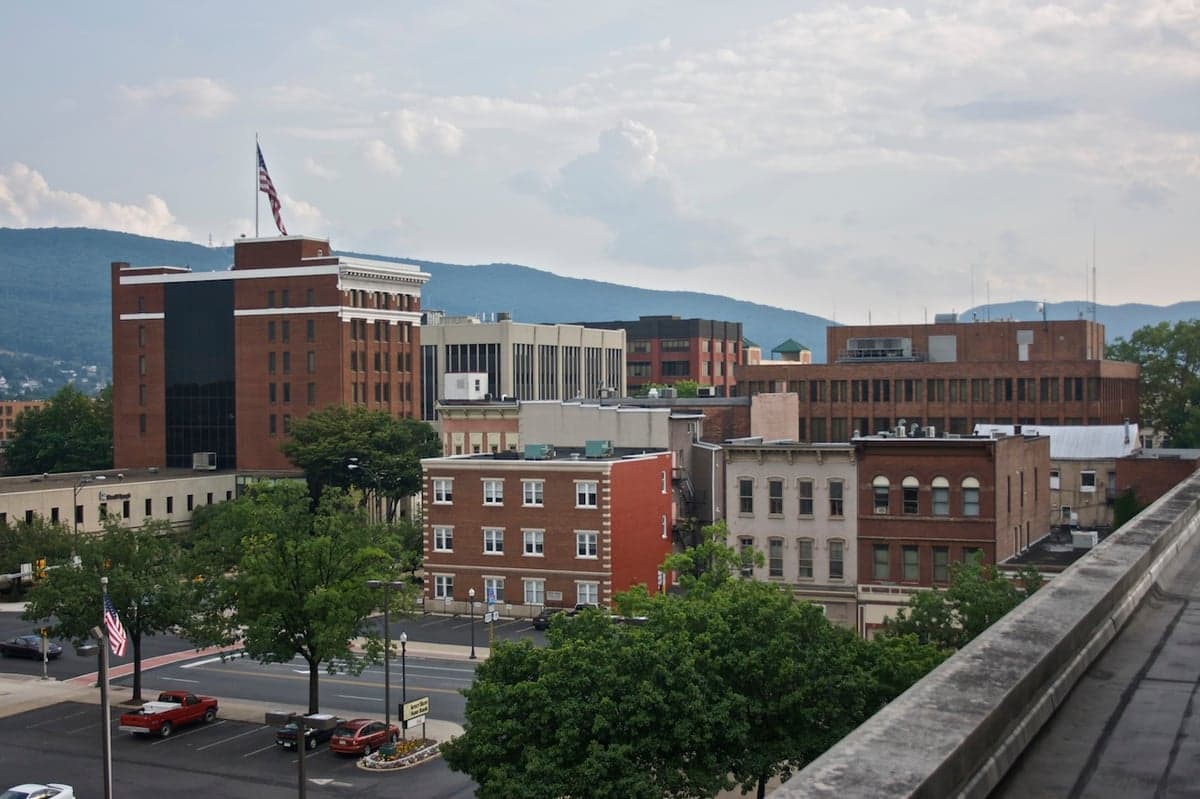
Williamsport, Pennsylvania, is a small city of 27,629 residents with a distinctly working-class character, shaped by its industrial past and a population that is 75.4% White, 12.8% Black, and 3.5% Hispanic. The city is denser than the surrounding Lycoming County, with a tight grid of historic neighborhoods that reflect the waves of European immigration that built the lumber and manufacturing economy. Today, Williamsport is older and less diverse than the national average, with a foreign-born population of just 1.2%, and its identity is closely tied to the Little League World Series and a slow, steady population decline from its mid-20th-century peak.
How the city was settled and grew
Williamsport’s original population arrived in the late 18th and early 19th centuries, drawn by the Susquehanna River’s water power and the vast timber of the surrounding mountains. The city’s founding as a lumber hub in the 1840s triggered the first major wave: English, German, and Scots-Irish settlers who built the early mills and frame houses in Newberry, the oldest neighborhood west of the river, and along the waterfront in Dock Street. By the 1870s, Williamsport was the world’s leading lumber producer, and the boom attracted a second wave of Irish immigrants fleeing the famine, who settled in Vallamont and the working-class blocks near the mills. A third wave of Italian and Eastern European immigrants—Poles, Slovaks, and Ukrainians—arrived between 1890 and 1910 to work in the diversified factories (textiles, wire, and later aviation parts). They concentrated in East End, a dense neighborhood of row homes and corner churches that remains the city’s most ethnically distinct area. By 1920, Williamsport’s population peaked at roughly 36,000, with a heavily European-immigrant character and a small Black community (under 3%) that lived primarily in the Hepburn Street corridor near the railroad tracks.
Modern era (post-1965)
After the 1965 Hart-Cellar Act, Williamsport saw only a modest increase in non-European immigration, unlike larger Pennsylvania cities. The foreign-born share remained below 2% through the 1970s and 1980s, and the city’s demographic shifts were driven instead by domestic migration. The collapse of manufacturing in the 1970s and 1980s triggered a white flight to the suburbs—particularly to Loyalsock and South Williamsport townships—leaving a smaller, poorer, and more Black-concentrated core. The Black population grew from roughly 8% in 1970 to 12.8% today, with most Black residents living in the central Old City district and the public housing along West Third Street. The Hispanic population, now 3.5%, began growing in the 1990s, driven by Puerto Rican migration into the East End and Newberry, where they joined the aging Italian and Polish communities. The East/Southeast Asian population (1.0%) is small and concentrated near the Lycoming College campus, while the Indian-subcontinent population (0.2%) is negligible. The college-educated share is 26.4%, below the national average, reflecting a workforce that remains heavily blue-collar and tied to the region’s remaining manufacturing, healthcare, and logistics employers.
The future
Williamsport’s population is slowly homogenizing as its White, non-Hispanic majority ages and younger residents leave for larger metros. The city lost roughly 8% of its population between 2010 and 2020, and projections suggest continued decline to around 25,000 by 2035. The Hispanic population is the only growing segment, but it is doing so slowly—likely reaching 5-6% by 2030—and is concentrated in the East End and Newberry, creating distinct enclaves rather than broad integration. The Black population is stable but aging, with little new in-migration. The foreign-born share is unlikely to rise significantly, as Williamsport lacks the job base or immigrant networks of larger cities. The city is not tribalizing into sharply divided ethnic blocks, but it is becoming more economically stratified: the Vallamont and Hillside neighborhoods are increasingly White and middle-class, while the Old City and East End are poorer and more diverse. For a new resident, this means a small, stable, and aging community where most growth is in the Hispanic enclaves and most opportunity lies in the suburban townships rather than the city itself.
For someone moving to Williamsport now, the city offers a low-cost, low-crime environment compared to larger Pennsylvania cities, but with limited demographic dynamism. The population is becoming slightly more Hispanic and slightly less White, but the overall trend is one of slow decline and concentration of poverty in the historic core. The most stable, family-oriented areas are the suburban townships and the Vallamont neighborhood, while the East End and Newberry offer more diversity and lower home prices. Williamsport is not a place of rapid change or new immigrant waves—it is a place where the past still shapes the present, and where the population is quietly shrinking into a smaller, older, and more locally rooted community.

* Values derived from national, state, county, city and local statistics and may differ in a specific area. Last updated: 2026-04-24T12:07:30.000Z
Narrative content on this page is AI-generated and may contain mistakes. Verify any details that matter before acting on them.
ReloMaps may earn a commission from affiliate links at no extra cost to you.

