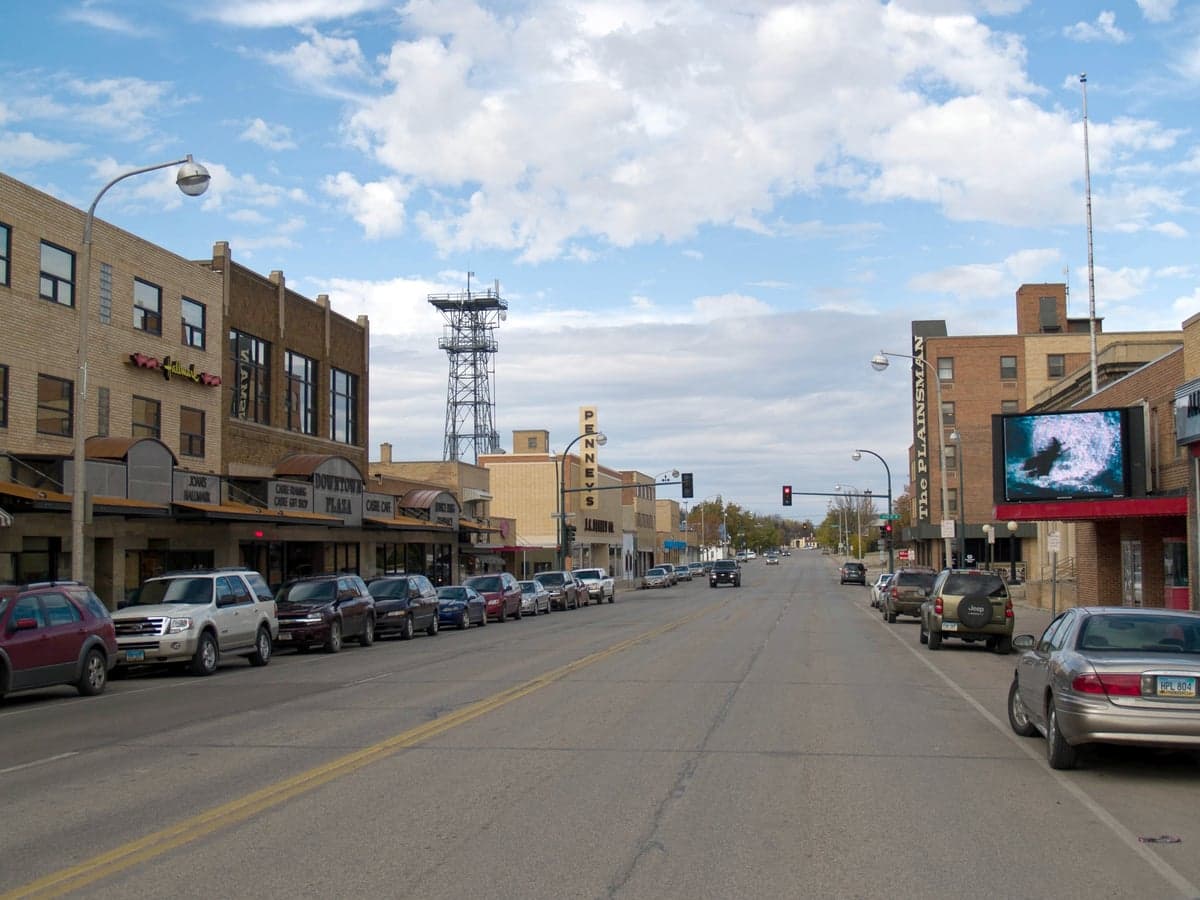
Photo: Wikipedia
Demographics of Williston, ND
Affluence Level in Williston, ND
A middle-class area roughly in line with national averages across income, home values, education, and employment.
People of Williston, ND
The people of Williston, North Dakota today number 27,964, forming a predominantly white (74.9%) workforce-oriented city with a notable Hispanic minority (9.9%) and a growing Black community (7.1%). The city’s character is defined by its boom-and-bust oil economy, which has created a transient, male-skewed population with a median age of 31.4 and a relatively low college attainment rate of 25.7%. Distinctive identity markers include a strong ranching and energy-industry work ethic, a visible presence of out-of-state license plates, and a social landscape split between long-established locals and newer arrivals living in temporary housing or new subdivisions.
How the city was settled and grew
Williston was founded in 1887 as a railroad town on the Great Northern Railway line, drawing its first wave of settlers—primarily Scandinavian and German immigrants—who built the original downtown core around Main Street and the historic Old Town district. These homesteaders were attracted by the promise of free land under the Homestead Act and the railroad’s need for station agents, section crews, and merchants. By the early 1900s, a second wave of Norwegian and Russian-German farmers filled the surrounding prairie, establishing the Westside neighborhood near the rail yards and the Eastside along the Missouri River bluffs. The discovery of oil in the Williston Basin in 1951 triggered a modest population surge, but the city remained a quiet agricultural and oil-service hub of roughly 11,000 people through the 1970s. The North Hill area, developed in the 1950s and 1960s, became the preferred residential zone for oil company managers and professionals, while working-class families clustered in the Southside near the refinery and rail lines.
Modern era (post-1965)
The post-1965 immigration reforms had little immediate effect on Williston, as the city remained overwhelmingly white and native-born through the 1990s. The transformative event was the Bakken oil boom beginning around 2008, which drew a massive domestic in-migration of workers from Texas, Oklahoma, Louisiana, and the Upper Midwest. This wave was overwhelmingly male and transient, with many living in man camps and RV parks on the city’s periphery. The Hispanic population grew from negligible to 9.9% as construction and service workers arrived from Texas and the Southwest, settling in the Westside and newer apartment complexes along 2nd Avenue West. The Black population rose to 7.1% as African American workers came from the Gulf Coast and Rust Belt, concentrating in the Southside and the Bakken Avenue corridor near the airport. East/Southeast Asian communities (1.5%) arrived primarily as restaurant and retail workers, with a small enclave forming near the Downtown business district. The Indian subcontinent population (0.1%) remains minimal, mostly professionals in healthcare and engineering. The city’s foreign-born share (5.8%) is modest by national standards but represents a dramatic shift from near-zero in 2000.
The future
Williston’s population is likely to plateau or decline slightly as the Bakken boom matures and automation reduces drilling labor needs. The city is not homogenizing but rather tribalizing into distinct enclaves: long-established white families in North Hill and Old Town, Hispanic workers in Westside apartments, and Black workers in Southside rentals. Immigrant communities are growing slowly but face high transience—many workers leave after a few years for more stable economies. The Hispanic population may continue to rise as family reunification occurs, while the Black population could stabilize or decline if oil prices fall. The next decade will likely see a demographic consolidation, with the white share remaining dominant but the Hispanic and Black shares holding steady or growing slightly. The city’s low college attainment rate (25.7%) suggests limited attraction for knowledge-economy migrants, reinforcing its identity as a blue-collar energy hub.
For someone moving in now, Williston is becoming a more diverse but still heavily white, working-class city with a transient population and a clear geographic divide between established homeowners and newer renters. The oil economy drives everything, meaning demographic stability depends on global energy prices. New arrivals should expect a community where social networks are often tied to employer and neighborhood, and where the transient workforce creates a less rooted, more pragmatic social atmosphere than in traditional small towns.

* Values derived from national, state, county, city and local statistics and may differ in a specific area. Last updated: 2026-04-19T06:51:42.000Z
Narrative content on this page is AI-generated and may contain mistakes. Verify any details that matter before acting on them.
ReloMaps may earn a commission from affiliate links at no extra cost to you.

