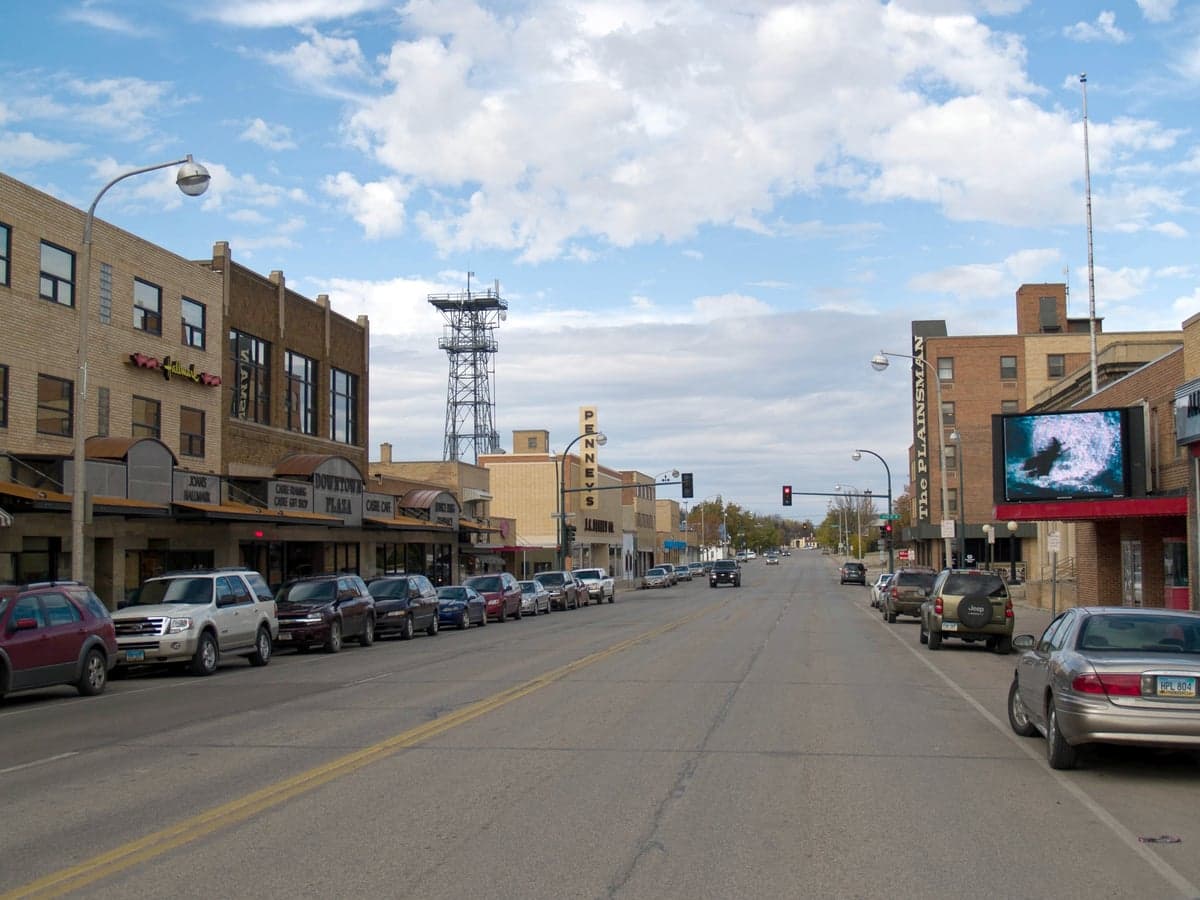
Photo: Wikipedia
Political ClimatePolitical Climate in Williston, ND
District shown is the primary district for this city’s centroid. Cities may span multiple districts.
Inherited from parent state — no local data available.
Local Political AnalysisPolitical Analysis of Williston, ND
Williston, North Dakota, is about as solidly conservative as it gets, and that’s not changing anytime soon. The Cook PVI of R+18 tells you the math, but the real story is the culture: this is a place where people still believe in minding your own business and keeping the government out of your life. The oil boom brought a lot of folks in, but it didn’t dilute the local politics—if anything, it reinforced the idea that hard work, not handouts, builds a community. You won’t find much appetite for progressive experiments here, and the trajectory is clear: Williston is staying red, and the surrounding Williams County votes the same way.
How it compares
Drive an hour east to Minot, and you’ll find a similar conservative vibe, though Minot has a slightly more moderate streak thanks to the Air Force base and a bigger university presence. Head south to Dickinson, and it’s the same story—R+18 territory all the way. The real contrast is if you go west to Montana’s border towns like Sidney, which are also conservative but have a more libertarian, “leave me alone” edge. Williston sits right in the middle of that: it’s conservative, but not in a preachy, big-government way. The local politics here are practical—people care about property rights, energy independence, and keeping taxes low. You won’t see the kind of progressive drift you might catch in Fargo or Grand Forks, where the college crowd and out-of-state transplants are pushing things left. That’s a relief for most folks here, because the last thing anyone wants is the kind of overreach you see in places like Minneapolis or Seattle.
What this means for residents
For the people who live here, the political climate means you can pretty much live your life without a bureaucrat looking over your shoulder. Zoning is minimal, gun laws are common-sense (no waiting periods, no magazine bans), and the local government isn’t trying to micromanage how you run your business or raise your kids. The oil industry is the backbone, and the county commission and city council are full of folks who understand that regulations can kill a boom faster than a bust. That said, there’s been a little pressure from outside groups trying to push “green” energy mandates or diversity quotas, but those efforts have mostly fizzled. Residents here are wary of any shift toward progressive ideology—they’ve seen how it plays out in other states, with higher crime, worse schools, and less freedom. The long-term concern is that if the state government in Bismarck ever gets too cozy with federal money or woke policies, Williston will push back hard. For now, it’s a place where your vote actually counts for something, and the local leaders still answer to the people, not the party bosses.
One thing that sets Williston apart is the no-nonsense attitude toward personal responsibility. You don’t see the kind of victimhood culture that’s taken root in bigger cities. People here expect you to pull your own weight, and the local policies reflect that—low property taxes, no state income tax, and a general distrust of any program that sounds like a handout. The cultural distinction is that Williston is still a frontier town at heart: rough around the edges, but honest. If you’re looking for a place where the government stays out of your wallet and your home, this is it. Just don’t expect any sympathy for the kind of progressive overreach that’s ruining other parts of the country. That’s not how we do things here.

State Political ClimatePolitical Climate in North Dakota
State Political AnalysisPolitical Environment in the State
North Dakota is a deeply conservative state, with a Republican trifecta that has held the governorship and both legislative chambers for over a decade, and a presidential voting record that hasn't gone blue since 1964. The state’s political DNA is rooted in a mix of agrarian populism and modern libertarian-leaning conservatism, but the last 15 years have seen a sharp rightward shift, driven largely by the oil boom in the Bakken region and a growing distrust of federal overreach. While the state has always been red, the flavor has changed—from a more pragmatic, farm-bill conservatism to a harder-edged, freedom-first posture that now defines the legislative agenda.
Urban vs. rural divide
The political map of North Dakota is less about a classic urban-rural split and more about a metro-versus-everything-else dynamic, with a few notable exceptions. Fargo, the largest city, is the state's only real blue dot, consistently voting Democratic in presidential races and sending a few Democrats to the legislature. But even Fargo is shifting right; in 2024, Cass County (Fargo) voted for Trump by a smaller margin than in 2020, but still comfortably red. Bismarck and Mandan are reliably conservative, with Burleigh County often delivering 65-70% Republican votes. The real action is in the oil patch: Williston, Watford City, and Dickinson have become conservative strongholds, fueled by an influx of workers from other red states who brought a more aggressive, anti-regulation ethos. Grand Forks, home to the University of North Dakota, is a mixed bag—the university community leans left, but the surrounding county is solidly red. Minot and the surrounding Ward County are reliably conservative, driven by the Air Force base and agricultural economy. The rural counties, especially in the west and north, are among the most Republican in the nation, often voting 80%+ for GOP candidates. The divide isn't really about geography—it's about which parts of the state have been touched by the oil economy and which haven't, with the oil counties being the most aggressively conservative.
Policy environment
North Dakota's policy environment is a textbook example of a low-tax, low-regulation state that prioritizes individual liberty over collective action. There is no state income tax on individuals (the state has a corporate income tax, but it's being phased down), and property taxes are relatively low compared to the national average, though they vary by county. The regulatory posture is aggressively business-friendly, especially in energy and agriculture—permitting for oil and gas drilling is streamlined, and the state has fought federal EPA overreach on everything from water quality to methane emissions. Education policy is a mixed bag: the state has a robust school choice movement, with a new Education Savings Account (ESA) program passed in 2023 that allows parents to use state funds for private or homeschool expenses. Higher education is dominated by the University of North Dakota and North Dakota State University, both of which have seen budget cuts and a push toward more vocational and STEM programs. Healthcare is a point of tension: the state expanded Medicaid under the Affordable Care Act in 2014, a decision that still rankles many conservatives, but the legislature has since passed laws to restrict abortion (a near-total ban with exceptions for rape, incest, and life of the mother) and to protect medical conscience rights. Election laws are among the most secure in the nation—voter ID is required, and the state has a voter-verified paper ballot system. There is no early voting by mail except for absentee ballots with an excuse, and same-day registration is not allowed. The state has also passed laws to restrict ballot initiatives after a series of progressive measures (like medical marijuana and Medicaid expansion) were passed by voters, which the legislature saw as an end-run around representative government.
Trajectory & freedom
North Dakota is becoming more free, at least by the standards of personal liberty and limited government. The last five years have seen a flurry of legislation that expands individual rights and pushes back against federal overreach. In 2021, the state passed a constitutional carry law, allowing any law-abiding adult to carry a concealed firearm without a permit. In 2023, the legislature passed a Parents' Bill of Rights, which requires schools to notify parents about curriculum changes and medical services, and gives parents the right to opt their children out of any instruction they find objectionable. The same session saw the passage of a medical freedom bill that prohibits employers and government entities from mandating COVID-19 vaccines or requiring vaccine passports. Property rights were strengthened with a law that limits the use of eminent domain for carbon pipeline projects, a direct response to the Summit Carbon Solutions pipeline controversy. On the tax front, the state has been cutting income taxes and is on a path to eliminate the corporate income tax entirely by 2027. However, there are warning signs: the state has a growing reliance on federal oil and gas revenue, which creates a vulnerability if the federal government shifts its energy policy. And the legislature has been slow to address the rising cost of property taxes, which is a growing concern for homeowners. Overall, the trajectory is toward more personal freedom, but the state's dependence on energy markets and federal dollars means that freedom is not entirely self-sustaining.
Civil unrest & political movements
North Dakota has seen its share of political flashpoints, but they are more about resource conflicts than cultural wars. The most visible was the Standing Rock protests in 2016-2017, where thousands of activists from across the country descended on the state to oppose the Dakota Access Pipeline. The protests were a major flashpoint, with clashes between protesters and law enforcement, and they left a lasting scar on the state's politics. Many North Dakotans saw the protests as an invasion by outside agitators, and the state responded by passing laws to criminalize trespassing and to limit the ability of out-of-state activists to disrupt infrastructure projects. More recently, the Summit Carbon Solutions pipeline has become a new battleground, with landowners in the eastern part of the state fighting against eminent domain for a carbon capture pipeline. This has created an unusual alliance between conservative property rights activists and environmentalists, and it has exposed a growing distrust of corporate power even among the state's Republican base. There is also a small but vocal libertarian movement, centered around the state's gun rights and medical freedom communities, that pushes for even less government involvement. Immigration politics are relatively quiet—the state has a small immigrant population, mostly in the oil fields and in Fargo's growing refugee community, and there has been little controversy. Election integrity is a non-issue here; the state's system is widely trusted, and there have been no significant controversies. A new resident would notice that political activism is low-key and mostly focused on local issues like property taxes, school funding, and energy policy, rather than the national culture wars that dominate other states.
Projection
Over the next 5-10 years, North Dakota is likely to remain a deeply conservative state, but the nature of that conservatism will shift. The oil boom is maturing, and production is plateauing, which means the state's economy will need to diversify. In-migration is slowing, and the state's population is aging, with many young people leaving for warmer climates or bigger cities. This demographic pressure could push the state toward more pragmatic, pro-growth policies, including potentially expanding Medicaid further or investing in renewable energy to attract new industries. The libertarian wing of the Republican Party is growing, and you can expect more legislation on medical freedom, school choice, and tax cuts. However, there is a risk that the state's reliance on federal oil revenue could create a fiscal crisis if the federal government shifts its energy policy, which could force the state to either raise taxes or cut services. The cultural wars will likely intensify around education and parental rights, especially as the state's small but growing urban centers (Fargo and Grand Forks) become more diverse. A new resident moving in now should expect a state that is fiercely independent, with a government that is generally on their side when it comes to personal liberty, but one that is also facing the same demographic and economic headwinds as the rest of the rural Midwest. The freedom is real, but it comes with a trade-off: you'll have to be self-reliant, because the state's safety net is thin and its economy is volatile.
For a conservative-leaning individual or family, North Dakota offers a rare combination of low taxes, strong gun rights, parental control over education, and a government that is generally hostile to federal overreach. The trade-offs are real: harsh winters, a limited job market outside of energy and agriculture, and a social scene that can feel isolated if you're not from a small town. But if you value personal liberty over convenience, and you're willing to trade mild weather for a state that still believes in self-governance, North Dakota is one of the last places in the country where you can actually live that way. Just be prepared to drive a long way to the nearest Costco.
* Values derived from national, state, county, city and local statistics and may differ in a specific area. Last updated: 2026-04-19T06:51:42.000Z
Narrative content on this page is AI-generated and may contain mistakes. Verify any details that matter before acting on them.
ReloMaps may earn a commission from affiliate links at no extra cost to you.

