Strategic Assessment of Willow Park, TX
Meaningful friction. Expect exposure to either population pressure, blast zones, or natural disaster risk. Consider buying a retreat property.
What does the Strategic Assessment tell us?
Our Strategic Assessment grades tactical survivability of an area. Major population centers, military targets, fallout zones, natural disasters, and border exposure all drive risk — lower exposure means a more defensible position in a crisis.
This is heavily inspired by Joel Skousen's Strategic Relocation book. Highly recommended you checkout the book ($)What does this tell us?
Our Strategic Assessment grades tactical survivability of an area. Major population centers, military targets, fallout zones, natural disasters, and border exposure all drive risk — lower exposure means a more defensible position in a crisis.
This is heavily inspired by Joel Skousen's Strategic Relocation book. Highly recommended you checkout the book ($)Strategic Pillars

Key Distances
Regional Safe Places
Below is our recommended "safe zones" in Texas and the surrounding area based on our strategic heuristics. For most people, it's unrealistic to live in a “safe zone” full-time due to work, family or other personal reasons. They tend to be more rural. However, many of these areas are perfect for second homes and retreat properties that double as a vacation home or even a short-term rental.

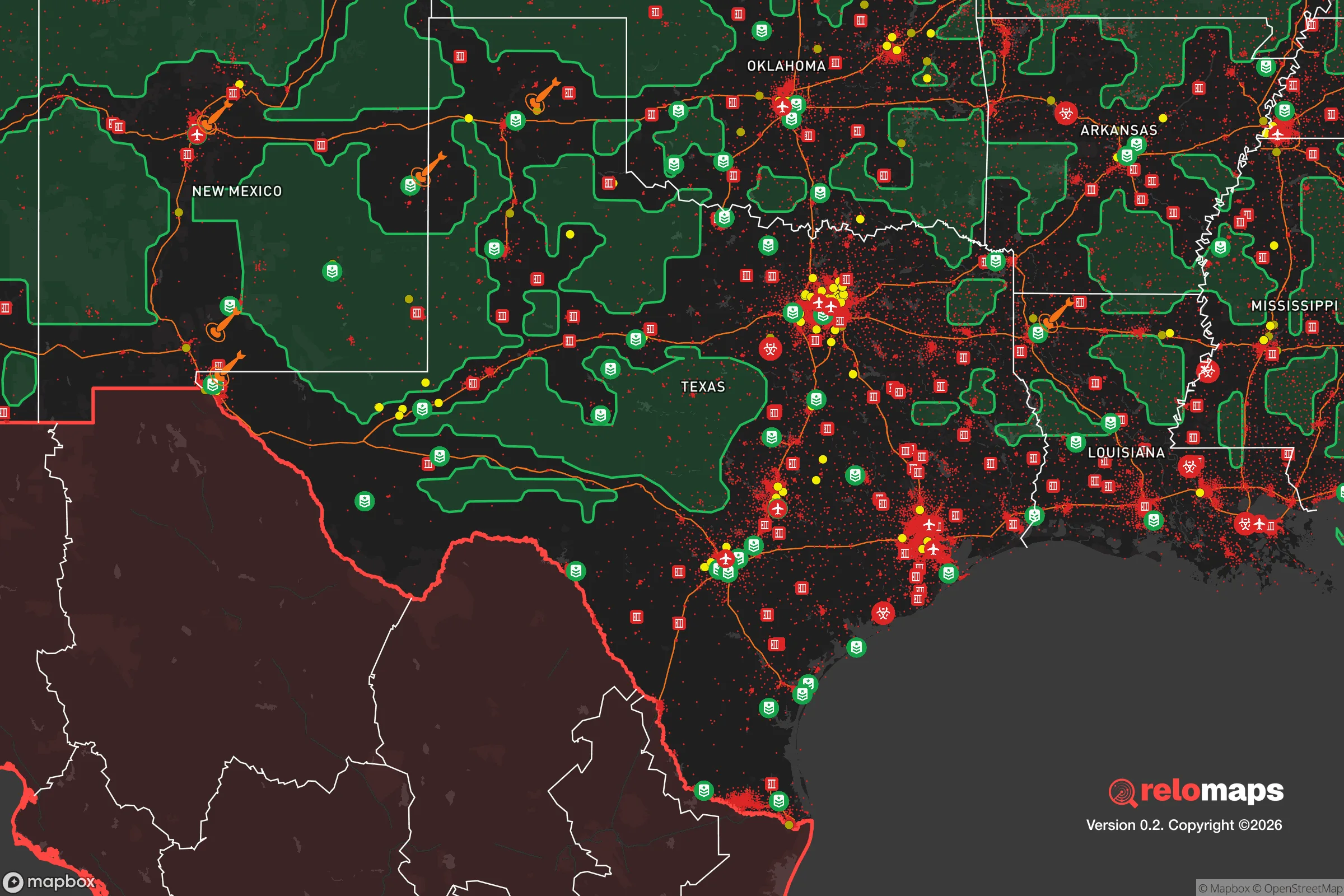


Important Note: For informational purposes only. This does not mean nothing bad ever happens in the green zones. Please use common sense. This is based on public data and modeled with AI. We tried to take a conservative approach but mistakes happen. We update this regularly as new information becomes available.
Solar Generator Recommendations
Backup power matters more here than in safer locations. We've picked three solar generators across budgets and capacity tiers — start with the budget unit if you only need a few essentials, or step up if you want to run a fridge and HVAC for days at a time.

Jackery Portable Power Station Explorer 300
Budget OptionPower on the Go: Weighing only 11 lbs, it's convenient to set up and store with book-sized foldable solar panels

BLUETTI Portable Power Station AC180
Designed for both indoor and outdoor scenarios, AC180 is highly capable as it has a robost capacity and continuous output power.

EF ECOFLOW DELTA Pro Ultra Power Station
Upgraded PickEcoFlow DELTA Pro Ultra is a whole-home energy system designed to grow with your family. Integrated with the Smart Home Panel 2, it scales to meet your evolving energy needs — keeping your home powered, intelligent, and secure through every stage of life.
We earn a commission, at no additional cost to you.
Strategic Assessment Analysis
Willow Park, Texas, sits in a strategic pocket of Parker County that offers genuine resilience advantages for those thinking long-term about security and self-sufficiency. Its position roughly 20 miles west of Fort Worth places it far enough from major metro fallout zones to avoid the worst of civil unrest or disaster ripple effects, yet close enough to access critical supplies and medical infrastructure if needed. The area’s low population density, conservative governance, and distance from high-value targets like DFW Airport or major military installations make it a solid base for a prepared relocator. For single individuals or parents prioritizing stability in an uncertain national landscape, Willow Park provides a defensible, resource-accessible foothold without the isolation that complicates daily life.
Geographic position and natural advantages for long-term security
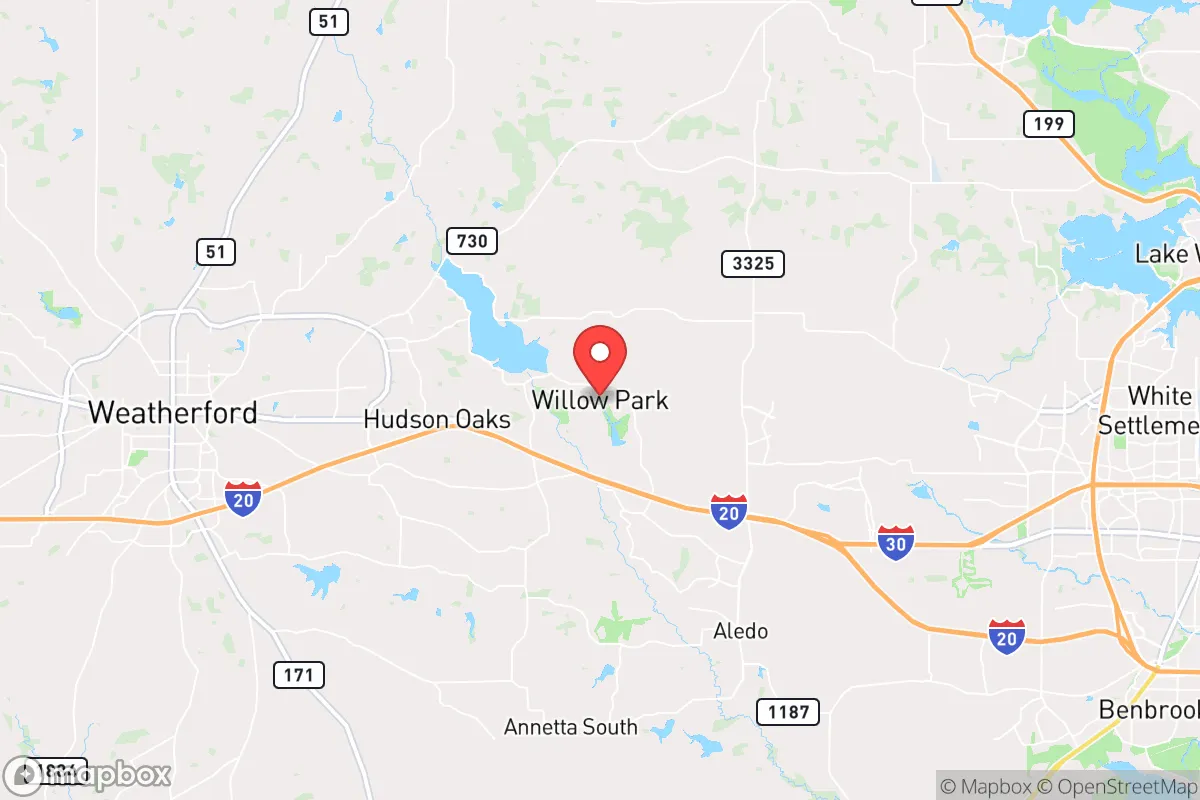
Willow Park’s location along the I-20 corridor is a double-edged sword, but for the prepper, the benefits outweigh the risks. The town sits on the western edge of the Dallas-Fort Worth metroplex, placing it outside the likely blast radius or immediate civil chaos of a major urban event. The surrounding Parker County terrain is rolling hills with mixed oak and mesquite, offering natural cover and multiple egress routes via state highways 1187 and 730. Unlike the flat, exposed expanses of West Texas, this area provides enough topographic variation to make defensive positioning viable. The Brazos River runs roughly 10 miles to the west, offering a reliable water source for filtration or catchment, while the region’s average 35 inches of annual rainfall supports rain barrels and small-scale agriculture. For a family, the ability to retreat to a rural property within 15 minutes of town—while still having access to a grocery store, hardware store, and a Level IV trauma center in Fort Worth—is a rare balance. The area’s lack of major dams, nuclear plants, or chemical facilities within a 30-mile radius reduces the risk of secondary disasters like flooding or toxic releases.
Risks, exposures, and proximity to fallout-relevant landmarks
No location is immune, and Willow Park has specific vulnerabilities that a strategic relocator must account for. The most immediate concern is its proximity to the DFW metroplex—a population center of over 7 million people that would become a humanitarian crisis zone in any major event. A coordinated attack on the region’s infrastructure—targeting the natural gas pipelines that run through Parker County, the electrical grid’s ERCOT interconnections, or the major rail lines near Aledo—could trigger cascading failures that ripple into Willow Park within hours. The town itself sits within 25 miles of Naval Air Station Joint Reserve Base Fort Worth, a potential military target, and within 40 miles of the Dallas Federal Reserve Bank, a symbolic target for civil unrest. On a more practical level, the area’s reliance on well water and septic systems means that a prolonged grid-down scenario would require immediate backup power for pumps—something many new developments overlook. Wildfire risk is moderate but real, especially during drought years when the mesquite and juniper become tinder. Flooding along the Clear Fork of the Trinity River, which runs through the southern edge of town, is a periodic concern for low-lying properties. For parents, the local school district (Aledo ISD) is highly rated but would become a concentration point during an evacuation, potentially creating a choke point.
Practical resilience for a relocator: food, water, energy, and defensibility
For the individual or family serious about preparedness, Willow Park offers a workable foundation that requires deliberate enhancement. Water is the first priority: the area’s groundwater is generally good quality, but a deep well with a hand pump or solar-powered backup is essential for resilience. The Brazos River, while not potable without treatment, provides a secondary source for irrigation or sanitation. Food security is feasible—the region’s growing season runs from March to November, allowing for substantial vegetable gardens, and local ranchers offer grass-fed beef and pastured poultry through direct sales. The Parker County Farmers Market in Weatherford (10 minutes west) is a reliable source for bulk grains, honey, and preserved goods. Energy resilience is more challenging: ERCOT’s grid has proven fragile during winter storms (see 2021’s Uri), and Willow Park’s suburban-style developments often lack natural gas backup. Solar panels with battery storage are a wise investment, as the area averages 230 sunny days per year. Defensibility is moderate—the town’s layout is a mix of subdivisions and acreage properties, with the latter offering better standoff distance. Properties with a single access road, tree cover for concealment, and a clear line of sight to the main approach are ideal. The local sheriff’s office (Parker County) is well-funded and conservative-leaning, but response times in rural areas can exceed 20 minutes. A neighborhood watch or mutual-aid group among like-minded residents is a practical step that many in the area already practice informally.
The overall strategic picture for Willow Park is one of calculated trade-offs. It is not a remote bunker location—it sits within the orbit of a major urban center that would become a liability in a worst-case scenario. But for the relocator who wants to maintain a professional career, access to schools and healthcare, and a semblance of normal life while building genuine resilience, it is one of the better options within a two-hour drive of DFW. The key is to treat Willow Park as a base camp, not a fortress: invest in off-grid water and power, build local relationships with ranchers and tradesmen, and have a secondary retreat plan for a full collapse scenario. For the conservative-leaning individual or parent who sees the writing on the wall but isn’t ready to go full homestead in the middle of nowhere, this area offers a defensible, resource-rich middle ground that can be hardened over time without sacrificing the conveniences that make daily life sustainable.

* Values derived from national, state, county, city and local statistics and may differ in a specific area. Last updated: 2026-04-14T01:02:57.000Z
Narrative content on this page is AI-generated and may contain mistakes. Verify any details that matter before acting on them.
ReloMaps may earn a commission from affiliate links at no extra cost to you.

