Political ClimatePolitical Climate in Willow Park, TX
District shown is the primary district for this city’s centroid. Cities may span multiple districts.
Local Political AnalysisPolitical Analysis of Willow Park, TX
Willow Park is about as solidly conservative as it gets in Texas, and that’s not changing anytime soon. The Cook PVI rating of R+18 tells you the story right off the bat—this area votes Republican by a margin that’s nearly double the national average for a red district. If you look at the voting patterns over the last decade, you’ll see a steady, unwavering preference for limited government, low taxes, and a hands-off approach to personal liberties. The trajectory here isn’t toward some purple shift; it’s actually hardening, as more folks from blue states move in and quickly realize they want to keep Texas, Texas.
How it compares
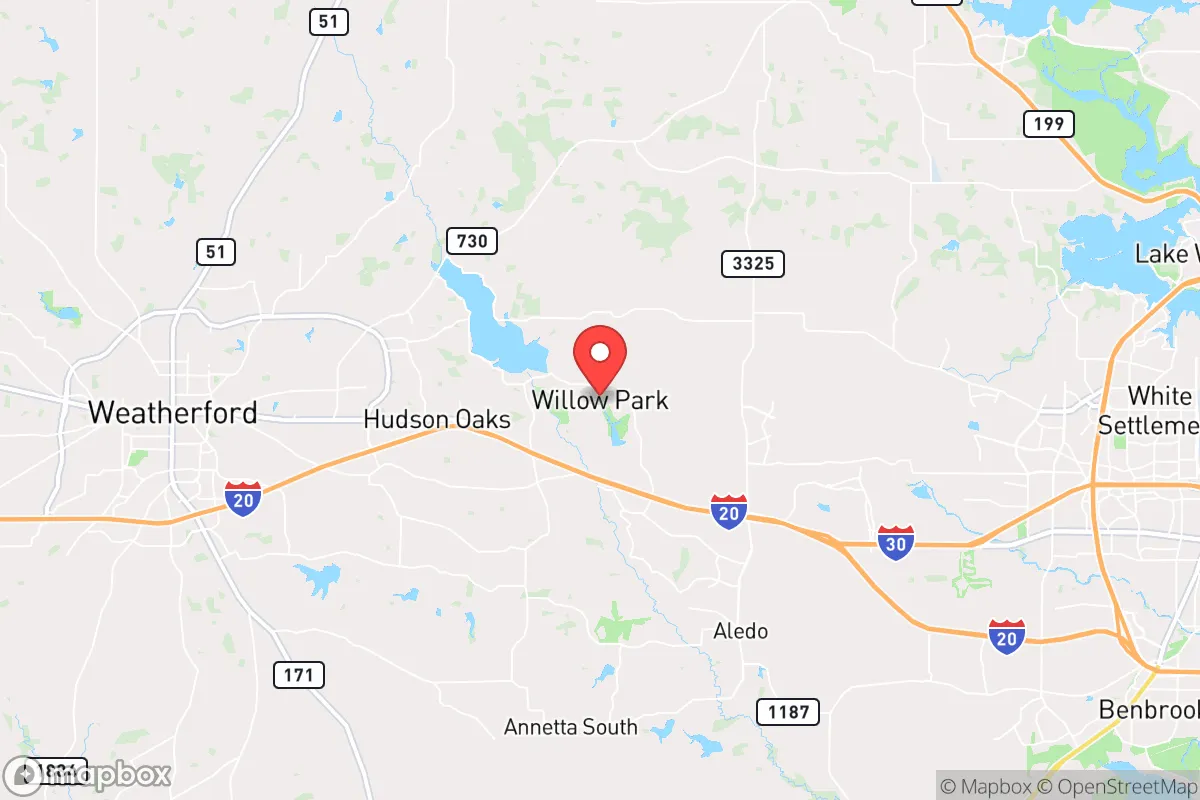
Drive ten minutes east to Weatherford, and you’ll find a similar vibe—maybe a touch more rural, but still deep red. Head south to Aledo, and it’s the same story: conservative values, strong gun rights, and a general distrust of government overreach. The real contrast comes if you go west to Fort Worth proper, where you start seeing pockets of progressive influence, especially near the cultural districts and TCU. But Willow Park? It’s a different world. The local school board, city council, and county commissioners are all reliably conservative. There’s no hand-wringing about defunding the police or imposing mask mandates here. When the state legislature passed permitless carry in 2021, it was celebrated, not debated. The surrounding Parker County voted over 75% for Trump in 2020, and that’s the baseline expectation for any candidate who wants to win locally.
What this means for residents
For someone who values personal freedom, this is a breath of fresh air. You won’t see the city council trying to regulate what kind of fence you can build or how many chickens you can keep in your backyard. Property taxes are a concern everywhere in Texas, but Willow Park keeps its municipal rates low, and there’s no appetite for new bond packages that balloon government spending. The downside? If you’re hoping for a vibrant downtown scene or a lot of public transit, you’ll be disappointed. The trade-off is that your rights—to carry a firearm, to homeschool your kids, to run a small business without a mountain of permits—are respected. The local sheriff’s office is pro-Second Amendment, and the school district (Aledo ISD) has a strong track record of parental involvement and conservative curriculum oversight. Any push toward progressive policies, like diversity equity and inclusion programs in schools or zoning changes that favor high-density development, gets shut down fast by the community.
Culturally, Willow Park still feels like a small town where neighbors know each other and the Fourth of July parade is a big deal. There’s a strong church presence, and the local politics reflect that—candidates who talk about “family values” and “fiscal responsibility” win easily. The one thing that’s shifted in recent years is the influx of new residents from California and the Northeast. Some of them bring progressive voting habits, but most seem to adapt quickly once they realize the cost of living and freedom here is worth protecting. The long-term outlook is stable: as long as the state keeps its hands off local control and the county stays red, Willow Park will remain a haven for conservatives who want to live without government breathing down their necks. If you’re looking for a place where your vote actually counts and your voice matters, this is it.

State Political ClimatePolitical Climate in Texas
State Political AnalysisPolitical Environment in the State
Texas remains a solidly Republican state at the statewide level, but the coalition that keeps it red is shifting dramatically. The GOP still holds every statewide office and both legislative chambers, but the margin of victory in presidential races has shrunk from 16 points in 2012 to about 9 points in 2020 and roughly 5.5 points in 2024. The dominant coalition is now a mix of rural and exurban conservatives, suburban fiscal conservatives, and a growing number of Hispanic voters in the Rio Grande Valley who have swung hard toward the GOP. Over the last 10-20 years, Texas has gone from a reliably red state to a battleground that still leans right — but the path to victory for conservatives now runs through places like McAllen and Laredo, not just Lubbock and Midland.
Urban vs. rural divide
The political map of Texas is a tale of three landscapes: the deep-blue urban cores, the deep-red rural expanses, and the purple-to-red suburbs that decide elections. Austin (Travis County) is the state's most liberal major city, voting +50 points for Biden in 2020 and +45 for Harris in 2024. El Paso and Houston (Harris County) are also reliably Democratic, with Harris County flipping blue in 2018 and staying there. But the real story is the suburbs: Collin County (north of Dallas) voted for Trump by 10 points in 2024, down from 23 points in 2016, while Tarrant County (Fort Worth) flipped from red to purple and back to red in 2024 by a slim margin. Meanwhile, the Rio Grande Valley — Hidalgo County (McAllen) and Webb County (Laredo) — saw a historic shift: Hidalgo went from +40 points for Clinton in 2016 to +15 for Biden in 2020 to a near-tie in 2024. Rural West Texas and the Panhandle remain deeply red, with counties like Loving County and King County routinely voting 90%+ Republican. The divide isn't just urban vs. rural — it's increasingly about which suburbs hold and which rural Hispanic communities flip.
Policy environment
Texas has no state income tax, which remains the single biggest policy draw for conservatives and businesses alike. Property taxes are high — the effective rate is about 1.6%, among the highest in the nation — but the 2023 property tax reform (SB 2 and Proposition 4) cut school property tax rates by roughly 15 cents per $100 valuation and raised the homestead exemption to $100,000. The regulatory posture is famously business-friendly: no state-level occupational licensing for many trades, right-to-work laws, and a tort reform system that caps noneconomic damages in medical malpractice cases at $250,000. On education, the 2023 school choice bill (HB 3) created education savings accounts for special needs students, but a broader universal school choice bill failed in the House. The 2021 "bathroom bill" (SB 6) was not passed, but the 2023 "Save Women's Sports Act" (HB 25) bans transgender athletes from female school sports. Healthcare policy is largely unregulated: Texas did not expand Medicaid under the ACA, leaving roughly 1.5 million uninsured adults in the coverage gap. Election laws tightened in 2021 with SB 1, which banned drive-through and 24-hour voting, added ID requirements for mail ballots, and gave partisan poll watchers more access. For a conservative, the policy environment is broadly favorable, but property taxes and the lack of school choice remain sore points.
Trajectory & freedom
On personal liberty, Texas has moved in two directions at once. On gun rights, the state expanded freedom significantly: the 2021 permitless carry law (HB 1927) allows any law-abiding adult to carry a handgun without a license or training. On parental rights, the 2023 "Parental Bill of Rights" (HB 900) requires school libraries to get parental consent before students can check out "sexually explicit" books, and the 2021 "Save Our Kids" law (HB 567) requires schools to notify parents of any changes in a student's mental health or medical care. On medical autonomy, the 2021 Texas Heartbeat Act (SB 8) bans abortion after roughly six weeks and allows private citizens to sue violators — a major expansion of what many conservatives see as the right to life. On the other hand, the state has clamped down on medical freedom in other ways: the 2023 ban on gender-affirming care for minors (SB 14) and the 2021 ban on vaccine mandates by private employers (HB 4399) were both passed. Property rights remain strong: Texas has no state-level rent control, and the 2023 "Takings" bill (HB 2791) limits the use of eminent domain for private economic development. The overall trajectory is toward more freedom on guns, family, and life issues, but with growing government involvement in medical decisions for minors and election administration.
Civil unrest & political movements
Texas has seen its share of political flashpoints. The 2020-2021 protests in Austin and Dallas over police brutality were large but largely peaceful, though Austin saw property damage and the city council later cut the police budget by $150 million — a move that was partially reversed after a 2023 ballot measure (Prop A) restored police funding. The "Trump Train" incident on I-35 in 2020, where a Biden campaign bus was surrounded by Trump supporters, became a national story and led to an FBI investigation but no charges. Immigration politics are front and center: Governor Abbott's Operation Lone Star (2021-present) has deployed state troopers and National Guard to the border, bused migrants to New York and Chicago, and installed razor wire along the Rio Grande — leading to a legal standoff with the Biden administration that reached the Supreme Court in 2024. The "sanctuary city" ban (SB 4, 2017) remains in effect, allowing local law enforcement to ask about immigration status. Secession rhetoric flares up periodically — the Texas Nationalist Movement pushes for a 2025 referendum — but it remains a fringe movement. Election integrity remains a hot topic: the 2020 audit of four counties (Harris, Dallas, Tarrant, Collin) found no widespread fraud, but the 2021 SB 1 was passed anyway. A new resident will notice the heavy police presence at polling places in urban counties and the constant political ads on TV.
Projection
Over the next 5-10 years, Texas is likely to remain a Republican-leaning state, but the margin will continue to narrow. The key demographic trends are: (1) continued in-migration from California and the Northeast, which brings more moderate-to-liberal voters to the suburbs; (2) the ongoing shift of Hispanic voters in the Rio Grande Valley toward the GOP, which could offset losses in the suburbs; and (3) the growth of the Austin-San Antonio corridor, which is becoming a blue island in a red sea. The 2024 election showed that Trump's gains with Hispanic men and working-class voters in South Texas were real, but he lost ground in the suburbs of Dallas and Houston. If the GOP can hold the suburbs while continuing to flip Hispanic voters, Texas stays red. If the suburbs keep drifting left faster than the Valley shifts right, Texas becomes a true swing state by 2032. For a conservative moving in now, expect the state to remain broadly friendly to your values for at least the next decade, but the political culture in the major metros will continue to feel more like California-lite — especially in Austin and Dallas. The rural and exurban areas will stay deeply red.
For a new resident, the bottom line is this: Texas still offers a low-tax, business-friendly, gun-friendly environment with strong parental rights and a conservative judiciary. But the political landscape is not static — the cities are becoming more progressive, the suburbs are contested, and the border is a constant flashpoint. If you're moving for freedom from government overreach, you'll find it in the suburbs and rural areas, but you'll need to be politically engaged to keep it that way. The state's trajectory is toward a more competitive two-party system, which means your vote will matter more than ever — and the fight over school choice, property taxes, and election laws is far from over.
* Values derived from national, state, county, city and local statistics and may differ in a specific area. Last updated: 2026-04-14T01:02:57.000Z
Narrative content on this page is AI-generated and may contain mistakes. Verify any details that matter before acting on them.
ReloMaps may earn a commission from affiliate links at no extra cost to you.

