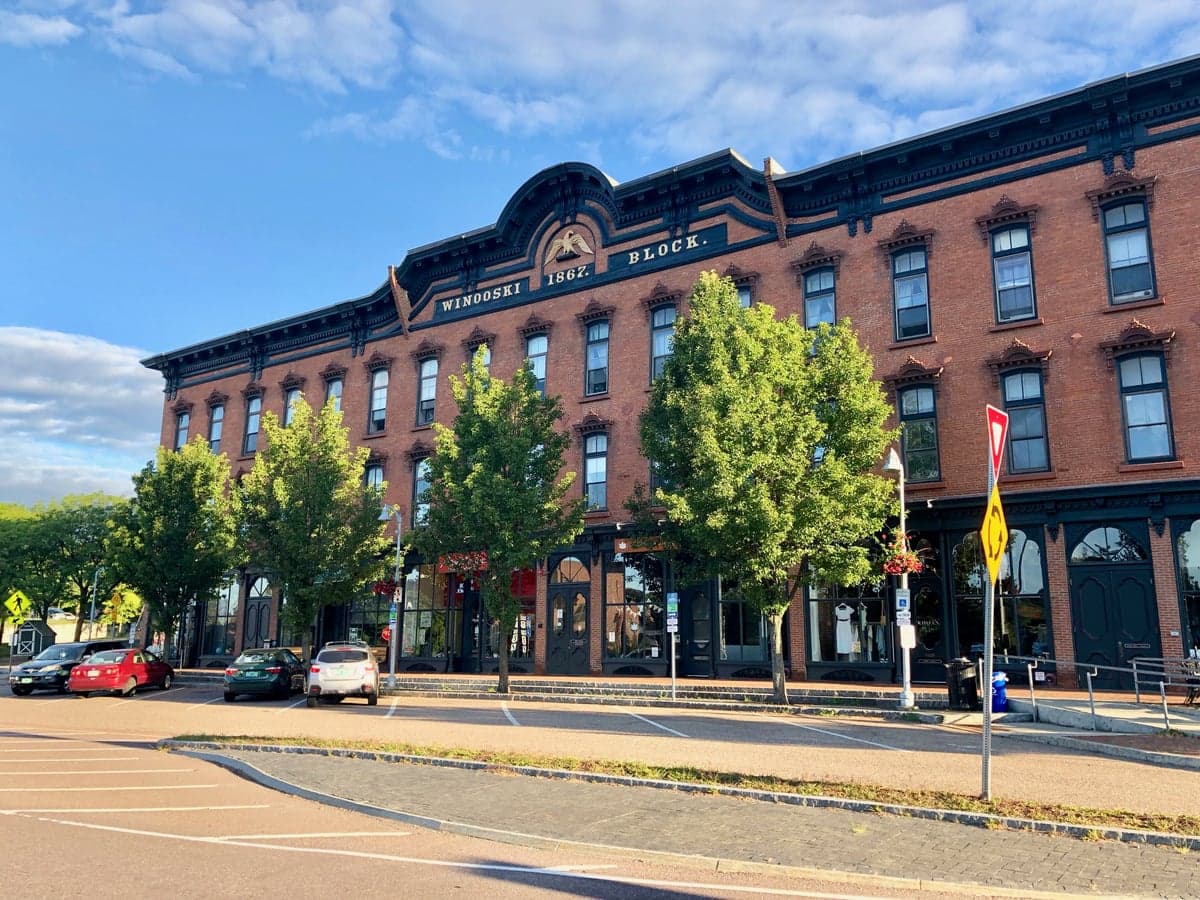
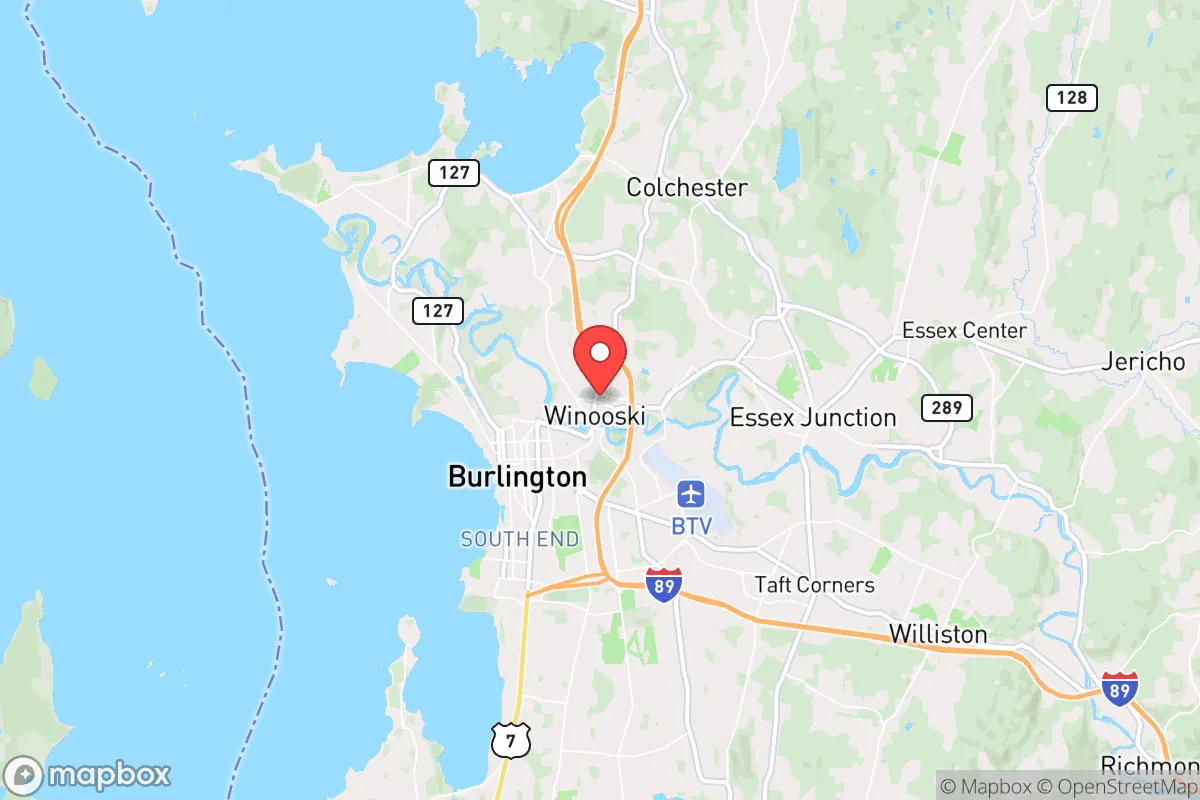
Photo: Wikipedia
Demographics of Winooski, VT
Affluence Level in Winooski, VT
A middle-class area roughly in line with national averages across income, home values, education, and employment.
People of Winooski, VT
Winooski, Vermont, is a dense, walkable city of 8,198 residents that feels more like an urban neighborhood than a typical New England mill town. Its population is notably diverse for Vermont, with a foreign-born share of 8.7% and significant communities of East/Southeast Asian (6.0%) and Indian-subcontinent (5.3%) residents, alongside a White population of 77.1% and a Black population of 4.5%. The city’s character is shaped by its compact geography—just 1.5 square miles—and a high concentration of college-educated adults (56.2%), giving it a progressive, youthful, and internationally-inflected identity that stands apart from the surrounding Chittenden County suburbs.
How the city was settled and grew
Winooski’s human history begins with the Abenaki people, who used the Winooski River falls as a fishing and trading site for centuries. European settlement began in the late 18th century, but the city’s real population boom came with industrialization. The Winooski River’s water power drove textile mills—most notably the American Woolen Company—which drew waves of French-Canadian immigrants from Quebec starting in the 1850s. These families settled in the Upper Winooski district, building the dense triple-decker homes and St. Francis Xavier Church that still define the neighborhood. A second wave of Irish immigrants arrived to build the railroad and work in the mills, clustering along East Allen Street and the Malletts Bay Avenue corridor. By 1900, Winooski was a working-class mill city with a population that was overwhelmingly French-Canadian and Catholic, a demographic that persisted through the mid-20th century as the mills declined and the city’s population shrank to under 6,000 by 1960.
Modern era (post-1965)
The 1965 Hart-Cellar Act opened the door to new immigration, but Winooski’s modern demographic shift began later, in the 1980s and 1990s, when refugee resettlement agencies placed families from Southeast Asia—particularly Vietnamese and Cambodian communities—in the city’s affordable housing stock. These East/Southeast Asian arrivals concentrated in the Champlain Mill area and the Winooski Housing Authority complexes near the river, where rents were low and public transit to Burlington was accessible. A second, more recent wave of Indian-subcontinent immigrants—many working in tech, healthcare, and at the University of Vermont Medical Center—began arriving after 2000, settling in the West Winooski neighborhood and the newer condominium developments along Main Street. The city’s Black population, at 4.5%, includes African American families drawn by the same affordable housing and a smaller number of African refugees, particularly Somali Bantu, who have established a presence near the Winooski School District campus. The Hispanic population (3.0%) is smaller but growing, with families from Central America settling in the same mixed-income blocks near the river. Domestic in-migration—young professionals and empty-nesters from Burlington and out of state—has accelerated since 2010, drawn by Winooski’s walkability, restaurant scene, and lower home prices relative to Burlington. These newcomers have pushed the college-educated share to 56.2% and are gentrifying the historic French-Canadian triple-deckers along East Allen Street and West Canal Street.
The future
Winooski’s population is heading toward greater density and higher educational attainment, but the city is not homogenizing into a single demographic bloc. The Indian-subcontinent community is likely to continue growing as professionals follow job opportunities at nearby GlobalFoundries in Essex Junction and the University of Vermont, and they are already forming distinct social networks around Main Street’s ethnic grocery stores and restaurants. The East/Southeast Asian community, by contrast, is plateauing: second-generation Vietnamese and Cambodian families are moving to larger homes in South Burlington and Williston, while new refugee arrivals have slowed. The White population, which includes both long-standing French-Canadian families and newer gentrifiers, is becoming more bifurcated—older working-class residents are being priced out of the Upper Winooski district, while younger college-educated transplants buy in. The city’s small Black and Hispanic communities are likely to grow modestly, driven by continued refugee resettlement and service-sector employment. Over the next 10-20 years, Winooski will likely become more educated, more expensive, and more segmented by income, with immigrant enclaves persisting in the older housing stock near the river while new development along Main Street attracts a wealthier, whiter demographic.
For a conservative-leaning individual or family moving in now, Winooski offers a rare mix of urban density and small-town scale, but it is not a culturally or politically conservative place—the city’s politics are solidly progressive, and its schools serve a diverse, low-income student body. The trade-off is a walkable, affordable (by Vermont standards) city with genuine ethnic diversity and a strong sense of local identity, but one where property values are rising and the character of the historic French-Canadian neighborhoods is shifting rapidly.

* Values derived from national, state, county, city and local statistics and may differ in a specific area. Last updated: 2026-04-22T21:40:17.000Z
Narrative content on this page is AI-generated and may contain mistakes. Verify any details that matter before acting on them.
ReloMaps may earn a commission from affiliate links at no extra cost to you.

