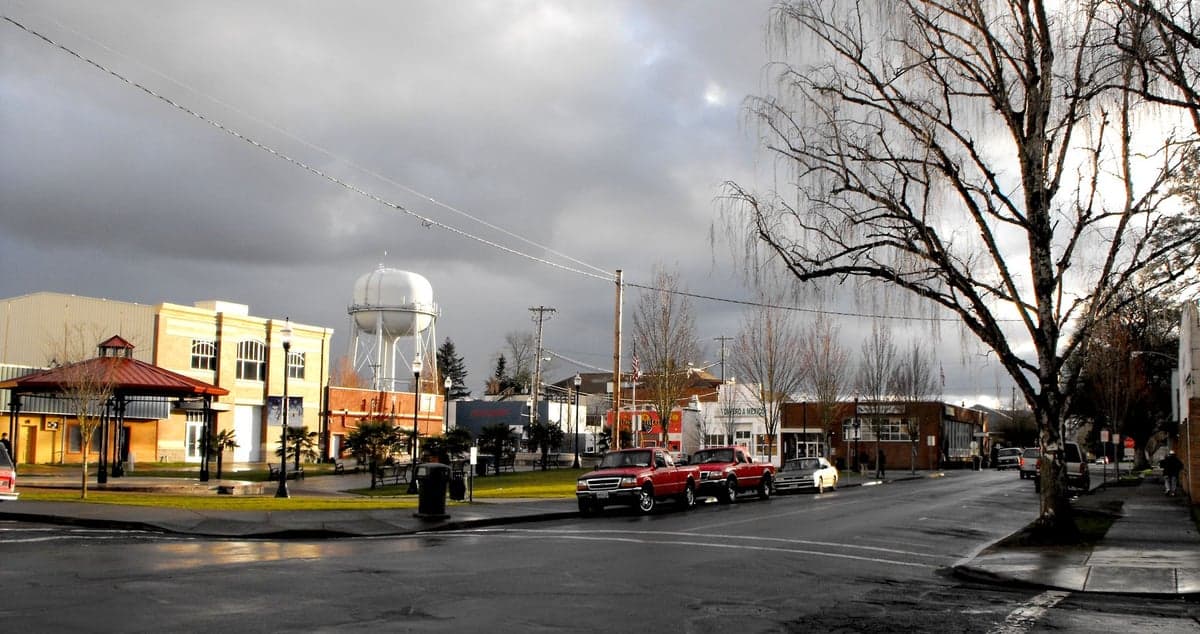
Photo: Wikipedia
Demographics of Woodburn, OR
Affluence Level in Woodburn, OR
A middle-class area roughly in line with national averages across income, home values, education, and employment.
People of Woodburn, OR
The people of Woodburn, Oregon, today form a community of 26,845 residents defined by its striking Hispanic majority (62.6%) and a White population of 32.8%, creating a demographic profile that is unique in the Willamette Valley. With 20.4% foreign-born residents and a low college attainment rate of 16.7%, Woodburn is a working-class, family-oriented city where Spanish is widely spoken and cultural identity is deeply tied to agriculture and food processing. The city’s identity is less about a single melting pot and more about distinct, layered enclaves that reflect successive waves of migration, from early Euro-American settlers to mid-century farm laborers to modern suburban commuters.
How the city was settled and grew
Woodburn’s human history begins not with indigenous settlement—the area was traditionally Kalapuya territory, but disease and displacement had largely cleared the land by the 1850s—but with Euro-American homesteaders drawn by the Donation Land Claim Act of 1850. The city’s founding in the 1870s was tied directly to the Oregon and California Railroad, which established a station here in 1871. The original core, now known as Downtown Woodburn, was platted around the depot and attracted a mix of Anglo-American farmers, merchants, and railroad workers. By the early 20th century, Woodburn was a small agricultural service center, with North Woodburn developing as a modest residential area for railroad and cannery workers. The first significant non-Anglo group arrived during World War I and the 1920s: a small number of Mexican laborers recruited to work in the hop fields and berry farms that surrounded the town. They settled in what became known as La Colonia, a neighborhood south of the railroad tracks that remains the historic heart of Woodburn’s Mexican-American community. The Great Depression and World War II slowed growth, but the Bracero Program (1942–1964) brought a second, larger wave of Mexican laborers, many of whom stayed and established families in La Colonia and the adjacent South Woodburn area.
Modern era (post-1965)
The post-1965 era transformed Woodburn’s population dramatically. The Immigration and Nationality Act of 1965 ended national-origin quotas, and the subsequent surge in immigration from Mexico and Central America reshaped the city. By the 1970s, Woodburn’s Hispanic population had grown from a small minority to a near-majority, driven by year-round demand for labor in the area’s nurseries, nurseries, and food-processing plants—especially at the massive NORPAC Foods (now part of Seneca Foods) plant that opened in the 1960s. The West Woodburn neighborhood, developed in the 1970s and 1980s, became a newer hub for Hispanic families moving out of La Colonia into single-family homes. Meanwhile, domestic in-migration from other parts of Oregon and California brought a smaller but steady stream of White retirees and commuters to subdivisions like Woodburn Estates and Heritage Park, creating a de facto residential divide: the older, denser, Hispanic-majority south and west sides versus the newer, Whiter, more suburban north and east sides. The 1990s and 2000s saw the arrival of a small East/Southeast Asian community (0.8% today), primarily Vietnamese and Filipino families, who settled in the Northeast Woodburn area near the Woodburn Premium Outlets, drawn by service-sector jobs. The Indian-subcontinent population remains negligible at 0.1%, and the Black population at 0.3%—reflecting Woodburn’s lack of the urban pull factors that attract those groups to Portland or Salem.
The future
Woodburn’s population trajectory points toward continued Hispanic growth and gradual White decline, but not toward homogenization. The Hispanic share has risen from roughly 50% in 2000 to 62.6% today, driven by both higher birth rates and ongoing immigration, though the pace of foreign-born growth has slowed since 2010. The White population, aging and not being replaced by younger White families, is likely to shrink further as a share. The city is not tribalizing into hostile enclaves—interaction in schools and workplaces is routine—but residential patterns remain distinct: La Colonia and South Woodburn are overwhelmingly Hispanic and working-class, while Heritage Park and Woodburn Estates are predominantly White and middle-class. The East/Southeast Asian community is small and stable, not growing rapidly. The next 10–20 years will likely see Woodburn become even more Hispanic-majority, with the White share falling toward 25–28% and the foreign-born share plateauing as second- and third-generation Mexican-Americans become the dominant cultural force. The city’s low college attainment rate (16.7%) suggests limited economic mobility for many families, but the growth of commuter-oriented subdivisions on the north side may attract more White and Asian families seeking affordable housing near I-5.
For someone moving in now, Woodburn is a city where the past is visible in its neighborhoods: a historic Mexican-American core in La Colonia, a newer Hispanic middle class in West Woodburn, and Whiter, more suburban pockets in the north. It is not a cosmopolitan or highly educated place, but it is a stable, family-oriented community where agriculture and food processing remain the economic backbone. The demographic trend is clear—Woodburn is becoming more Hispanic, more working-class, and more distinct from the surrounding Willamette Valley towns—and newcomers should expect a city where Spanish is as common as English and where community life revolves around family, church, and the harvest cycle.

* Values derived from national, state, county, city and local statistics and may differ in a specific area. Last updated: 2026-05-04T16:15:39.000Z
Narrative content on this page is AI-generated and may contain mistakes. Verify any details that matter before acting on them.
ReloMaps may earn a commission from affiliate links at no extra cost to you.

