 Popular
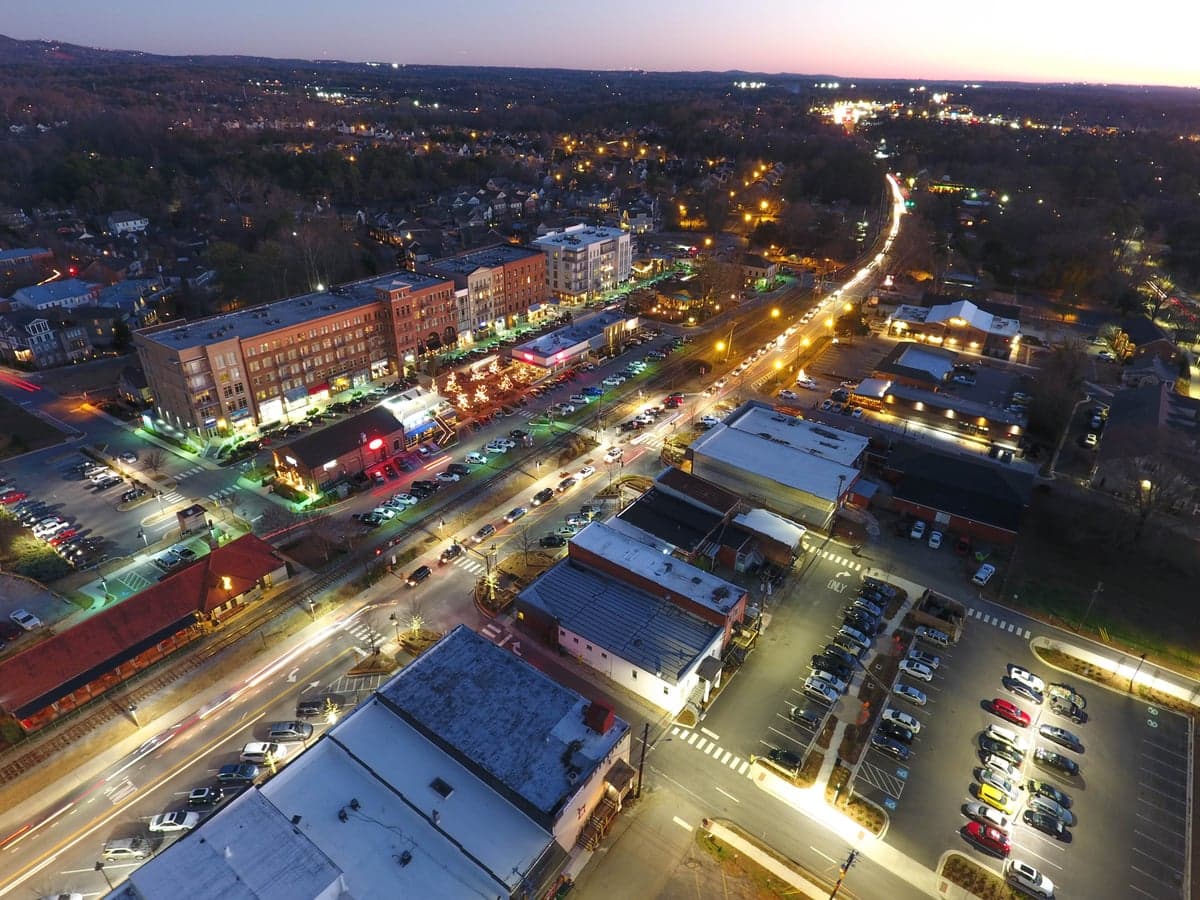
Photo: Wikipedia
Demographics of Woodstock, GA
Affluence Level in Woodstock, GA
An upper-middle-class area. Household wealth, education levels, and homeownership run ahead of national benchmarks.
People of Woodstock, GA
Woodstock, Georgia, is a predominantly white, college-educated suburb of Atlanta with a population of 36,297, where 69.4% of residents identify as white, 9.5% as Hispanic, 9.5% as Black, 2.4% as East/Southeast Asian, and 1.6% as Indian. The city’s character is defined by a blend of historic small-town charm and rapid suburban growth, with a median household income well above the national average and a highly educated workforce—51.9% of adults hold a bachelor’s degree or higher. Foreign-born residents make up just 5.1% of the population, a figure notably lower than the national average, reflecting a community shaped primarily by domestic in-migration rather than international immigration. Woodstock today feels like a family-oriented, politically moderate-to-conservative enclave where newcomers are drawn by good schools, new housing, and a downtown that has been carefully revitalized.
How the city was settled and grew
Woodstock’s original population was built by white settlers of English and Scots-Irish descent who arrived in the 1830s and 1840s, drawn by the promise of cheap land in the Cherokee territory that had just been opened by the forced removal of the Cherokee Nation. The town was officially incorporated in 1897 as a railroad stop along the Louisville and Nashville line, which made it a shipping point for cotton, timber, and later, granite from nearby quarries. The historic Downtown Woodstock district, centered on Main Street, was the commercial and social hub for these early farming families, and many of their descendants still live in the surrounding Olde Rope Mill and Lickskillet neighborhoods, where century-old farmhouses sit alongside newer infill construction. Through the first half of the 20th century, Woodstock remained a small, overwhelmingly white farming community—the 1950 census recorded fewer than 1,000 residents, nearly all of them native-born whites. No significant wave of immigrant labor arrived during this period, as the local economy did not industrialize in the way that mill towns like nearby Canton did.
Modern era (post-1965)
The post-1965 transformation of Woodstock was driven not by the Hart-Cellar Act’s immigration reforms but by the explosive suburbanization of metro Atlanta. The completion of Interstate 575 in the 1980s turned Woodstock from a sleepy crossroads into a bedroom community for commuters working in Marietta, Sandy Springs, and Atlanta. This wave of domestic in-migration was overwhelmingly white and middle-to-upper-middle-class, and it filled new subdivisions such as Towne Lake and Eagle Watch with families seeking larger homes and better schools than those available closer to the city. The Black population, which had been negligible in Woodstock for most of its history, began to grow slowly after 2000, reaching 9.5% by 2024, with many Black families settling in newer developments like Ridgewalk and the Woodstock Crossing area. The Hispanic share (9.5%) and East/Southeast Asian share (2.4%) also grew during this period, though both remain modest compared to the broader Atlanta metro. Indian residents (1.6%) are a small but visible presence, concentrated in professional fields and living in the same master-planned subdivisions as their white neighbors—there is no distinct ethnic enclave in Woodstock. The foreign-born share of 5.1% is roughly half the national average, confirming that Woodstock remains a destination for domestic movers, not international ones.
The future
Woodstock’s population is likely to continue growing at a steady pace, driven by the same forces that have fueled its expansion for the past four decades: good schools, relatively affordable housing compared to intown Atlanta, and a downtown that has become a regional destination for dining and events. The city is not homogenizing into a single demographic bloc, but it is also not tribalizing into distinct ethnic enclaves—instead, the trend is toward a broad, mostly white, mostly college-educated middle class that absorbs smaller minority groups into the same neighborhoods and school zones. The Hispanic and Black shares are likely to rise slowly as metro Atlanta’s diversity spreads outward, but Woodstock will probably remain less diverse than Cobb or Gwinnett counties for the foreseeable future. The East/Southeast Asian and Indian populations are small and professional, and they are more likely to assimilate into the existing suburban culture than to form separate communities. The biggest demographic wild card is the city’s ability to maintain housing affordability: if home prices continue to climb faster than incomes, Woodstock could begin to price out younger families and become an older, wealthier enclave.
For someone moving to Woodstock now, the bottom line is that this is a stable, family-oriented suburb where the population is overwhelmingly native-born, college-educated, and politically moderate-to-conservative. The city is not a melting pot in the traditional sense—it is a place where domestic migrants have created a comfortable, low-crime environment with a strong sense of local identity. New residents will find a community that values its historic roots while embracing managed growth, and where the demographic story is one of continuity rather than dramatic change.

* Values derived from national, state, county, city and local statistics and may differ in a specific area. Last updated: 2026-04-30T07:38:47.000Z
Narrative content on this page is AI-generated and may contain mistakes. Verify any details that matter before acting on them.
ReloMaps may earn a commission from affiliate links at no extra cost to you.

