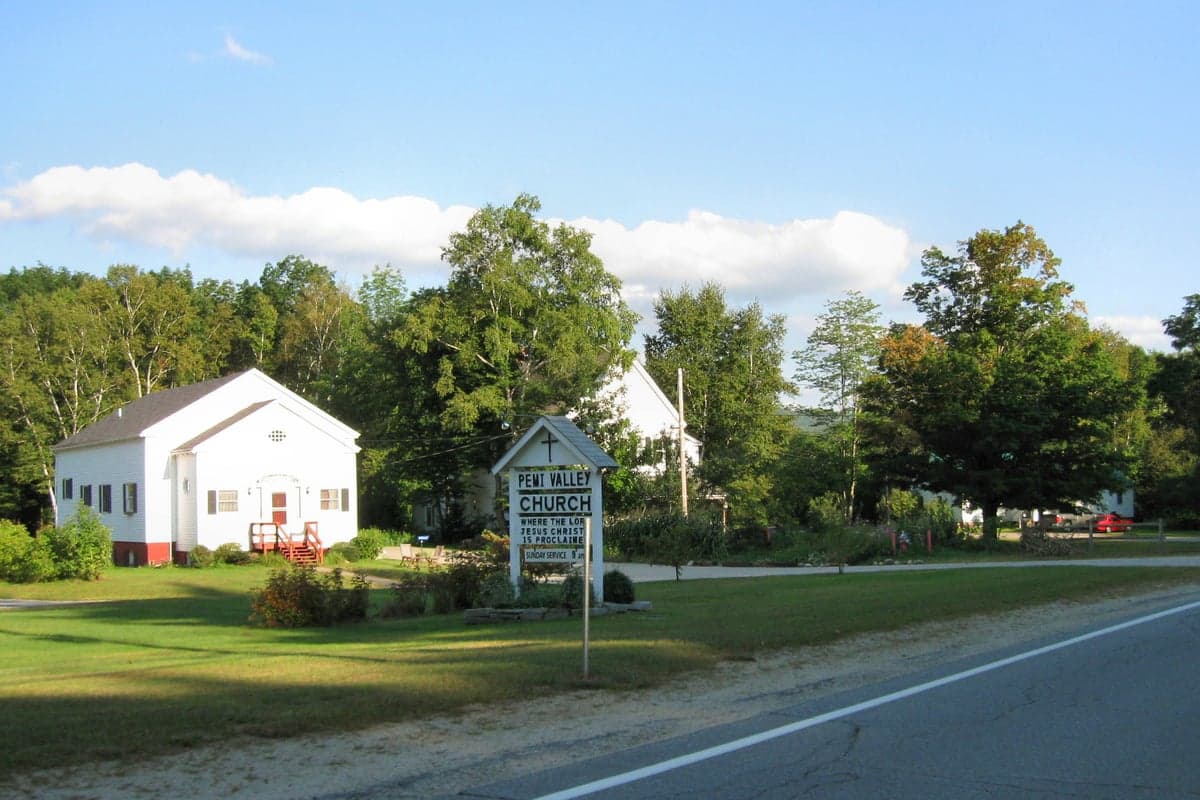
Photo: Wikipedia
Political ClimatePolitical Climate in Woodstock, NH
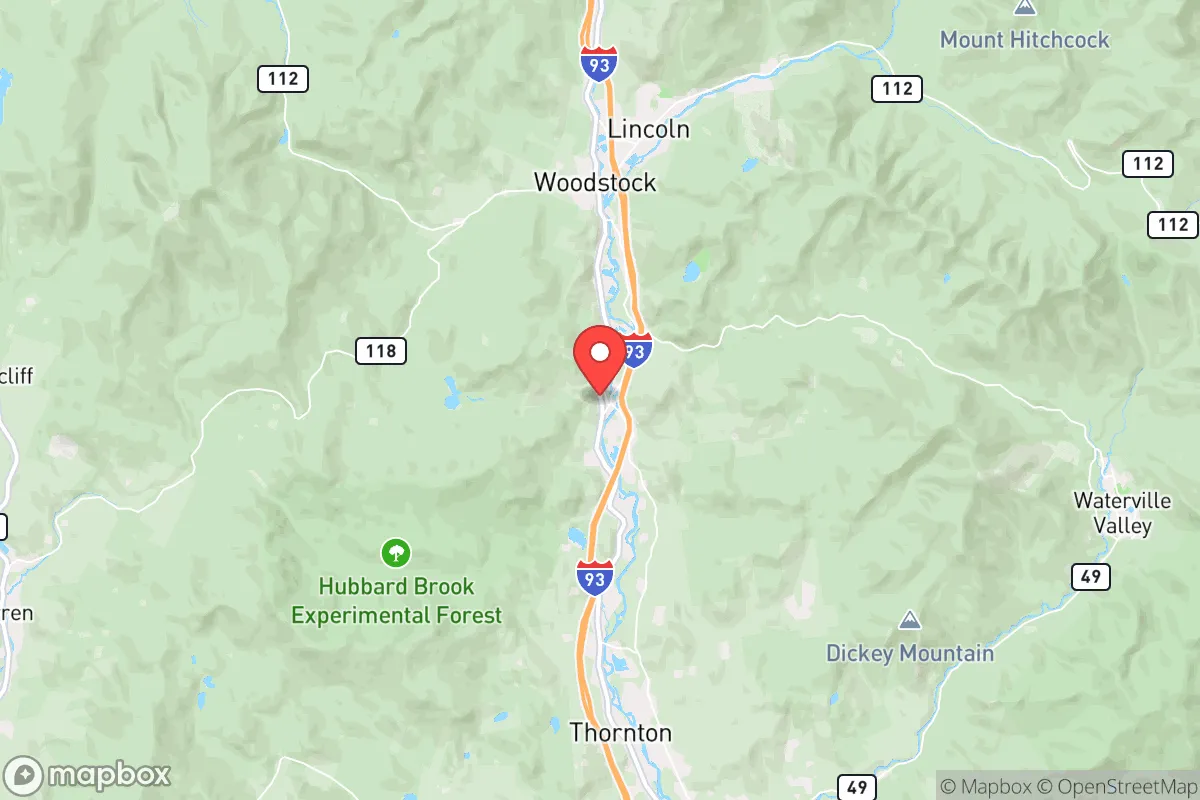
District shown is the primary district for this city’s centroid. Cities may span multiple districts.
Local Political AnalysisPolitical Analysis of Woodstock, NH
Woodstock, New Hampshire, sits in a politically interesting pocket of the state. Its Cook Partisan Voting Index (PVI) of D+2 means it leans slightly Democratic, but that’s a relatively recent shift—historically, this part of the White Mountains was more of a swing area, with local elections often decided by a few dozen votes. Over the past decade, the town has trended leftward, driven largely by an influx of remote workers and second-home owners from Massachusetts and the Boston metro area, who tend to bring more progressive voting habits with them. That said, Woodstock is no liberal stronghold; you’ll still see plenty of Trump signs in the yards along Route 3, and the town’s independent streak runs deep.
How it compares
Woodstock’s D+2 PVI is identical to New Hampshire’s statewide PVI of D+2, which makes it a near-perfect microcosm of the state’s political balance. But that surface-level match hides real local variation. Drive 15 minutes south to Plymouth, home to Plymouth State University, and you’ll find a noticeably more liberal tilt—think D+5 or D+6, with younger voters and faculty driving the margin. Head 20 minutes north to Lincoln, and the politics shift rightward, closer to R+3, thanks to a heavier concentration of tourism-industry workers and year-round residents who lean conservative on taxes and gun rights. Woodstock sits right in the middle, both geographically and ideologically. In the 2020 presidential election, the town voted for Joe Biden by a margin of roughly 52% to 46%, which mirrors the statewide result almost exactly. The key difference? Woodstock’s swing voters are more likely to split tickets—they’ll vote for a Democrat for president but a Republican for governor or local selectman, a pattern that’s less common in the state’s more polarized urban centers like Manchester or Nashua.
What this means for residents
For conservative residents, Woodstock’s D+2 lean means they’re in the minority, but not a marginalized one. Local town meetings still see robust debate on issues like property taxes, school funding, and road maintenance, and conservative voices carry weight—especially on fiscal matters. You won’t feel out of place at the town hall or the general store. For liberal residents, the political climate is generally comfortable, but not complacent. The town’s small size (about 1,300 year-round residents) means that local politics are personal, not partisan; your neighbor’s opinion on the school budget matters more than their party registration. In practice, this creates a live-and-let-live atmosphere. The biggest flashpoints tend to be development and conservation—Woodstock sits near the White Mountain National Forest, and debates over short-term rentals, trail access, and land use often split along lines that don’t neatly follow red-blue divisions.
Culturally, Woodstock stands out for its stubborn independence. Unlike some New Hampshire towns that have become bedroom communities for Portland or Boston, Woodstock retains a distinct identity rooted in outdoor recreation and small-scale agriculture. You won’t find a Democratic or Republican town committee that dominates local discourse; instead, the political reality is shaped by a shared skepticism of overreach, whether from Concord or Washington. That’s the real takeaway: Woodstock’s D+2 lean is less a statement of ideology and more a reflection of its residents’ desire to be left alone to live their lives, hunt their deer, and keep their taxes low—a sentiment that transcends party lines. If you’re moving here, expect to be judged more by how you handle a snow shovel than by your bumper stickers.

State Political ClimatePolitical Climate in New Hampshire
State Political AnalysisPolitical Environment in the State
New Hampshire is the rare state that wears its political independence like a badge of honor, and the numbers back it up. The state carries a Cook PVI of D+2, but that barely tells the story of a place that has voted for the winner in every presidential election since 2000, backed both parties for governor repeatedly, and flipped its congressional delegation between red and blue more often than almost any other state. Over the last two decades, the Granite State has drifted from a classic swing state into a lean-Democratic posture driven by the southern tier's explosive growth, yet it retains a stubborn libertarian streak that keeps it from ever becoming reliably blue.
Urban vs. rural divide
The political map of New Hampshire is essentially a tale of two geographies divided by the state's middle. The southern and southeastern corner — the Manchester-Nashua corridor, plus the seacoast around Portsmouth and Dover — is where the state's population and Democratic votes concentrate. Manchester, the largest city, has trended blue for a decade, and the bedroom communities along Route 3 and Route 93 like Bedford and Londonderry have shifted from reliably red to purple, with many college-educated professionals voting Democratic in presidential years while still pulling the lever for Republican governors. Nashua, the second-largest city, is similarly Democratic-leaning, driven by a growing immigrant population and younger tech workers.
North of the Lakes Region, the state turns deeply red. The North Country — places like Berlin, Littleton, and Colebrook — is economically struggling mill and paper country that votes Republican by wide margins, though with a populist edge that has sometimes backed Democrats like Jeanne Shaheen. The western border towns along the Connecticut River, including Lebanon and Hanover (home to Dartmouth College), are the exception: Hanover and its surrounding Grafton County towns are among the most liberal in the state, while just down the road, Claremont and Newport lean conservative. The 2024 election showed this split clearly: Democrat Kamala Harris won the state by about three points, but Donald Trump carried 10 of the state's 14 counties, with his strength concentrated in the rural north and west while the southern suburbs and seacoast delivered the margin for Democrats.
Policy environment
New Hampshire's policy environment is defined by its famous "Live Free or Die" motto, and the state's tax structure is the clearest expression of that. There is no state income tax on wages, no sales tax, and no capital gains tax — a combination that makes it a magnet for high earners from Massachusetts and Connecticut. The trade-off is among the highest property taxes in the nation, which funds local schools and services, and a heavy reliance on business taxes and rooms-and-meals taxes. The regulatory posture is generally light-touch, with no state-level minimum wage law (it defaults to the federal $7.25), and a right-to-work law passed in 2021 over then-Governor Chris Sununu's veto.
On education, the state has no income tax to redistribute wealth, so school funding is deeply local, leading to wide disparities between wealthy southern towns and poorer northern districts. The state's school choice movement has gained ground, with Education Freedom Accounts — a voucher-style program — expanded in 2021 to allow any family below 300% of the federal poverty line to use public funds for private or homeschool expenses. Healthcare is a mixed bag: the state expanded Medicaid under the Affordable Care Act in 2014, and the exchange is robust, but the state has no certificate-of-need law for most facilities, keeping the market relatively open. Election law is notably accessible — same-day voter registration is allowed, and the state has no voter ID requirement, though Republicans have pushed for one repeatedly.
Recent policy direction
The last five years have seen New Hampshire chart a distinctly mixed course that reflects its split personality. On gun rights, the state is among the most permissive in the nation: it has constitutional carry (permitless concealed carry), no magazine capacity limits, no assault weapons ban, and a 2021 law that prohibits state and local police from enforcing federal gun laws they deem unconstitutional — a direct nullification-style challenge to Washington. In 2024, the legislature passed a "Second Amendment Financial Privacy Act" to block credit card companies from tracking firearm purchases.
On education and parental rights, the state passed a Parents' Bill of Rights in 2022 requiring schools to notify parents of curriculum changes and allowing them to opt children out of sex education. A 2024 law banned transgender girls from competing in girls' school sports, and the state has moved to restrict gender-affirming surgeries for minors. On taxes, the state is phasing out the interest and dividends tax, which will be fully eliminated by 2027, and the business enterprise tax is being reduced. On voting, the legislature passed a voter ID requirement in 2024, though it was vetoed by Governor Sununu and the veto was sustained — a sign that the state's live-free ethos still protects ballot access. On medical freedom, New Hampshire was one of the first states to pass a broad COVID-19 vaccine and mask mandate ban in 2021, and that law remains on the books.
Civil unrest & political movements
New Hampshire's political activism is intense but largely civil, channeled through the state's famous first-in-the-nation presidential primary, which brings national candidates and their supporters to every diner and town hall in the state every four years. The Free State Project, a libertarian migration movement that has brought over 6,000 activists to the state since 2003, has a visible presence in the legislature — its members have held dozens of seats and pushed the state toward its most libertarian policies, including the 2021 federal gun law nullification and the COVID mandate bans. The movement's influence is strongest in the southern tier around Keene and in the legislature's Republican caucus.
On the left, the state has seen organized resistance to the school choice expansion and the transgender sports ban, with protests at the State House in Concord drawing hundreds. Immigration politics are comparatively muted — New Hampshire has no sanctuary city policies, and Manchester's Democratic mayor has cooperated with federal immigration enforcement, a contrast with neighboring Massachusetts. The state saw some election integrity controversy after 2020, with Republican activists raising concerns about same-day registration, but no major fraud was found, and the state's election system is widely regarded as well-run. The most visible flashpoint for newcomers is the sheer volume of political signage and lawn activism during election years — New Hampshire residents take their civic duty seriously, and turnout is consistently among the highest in the nation.
Projection
Looking ahead five to ten years, New Hampshire's trajectory points toward continued Democratic gains in the south and a hardening Republican identity in the north, with the state's overall lean likely to settle somewhere between D+2 and D+5. The demographic driver is in-migration: the state is growing fastest in the southern tier, with Rockingham and Hillsborough counties attracting remote workers and retirees from Massachusetts, and those newcomers skew Democratic. The seacoast around Portsmouth is becoming younger and more liberal, while the North Country continues to lose population and age. The Free State Project's influence may plateau as its early wave of activists ages, but its policy legacy — the tax phase-outs, the gun laws, the mandate bans — is likely to persist because they are popular across party lines.
The wildcard is the national environment. If the Republican Party continues to emphasize cultural issues like transgender sports bans and school curriculum, it may hold the rural north but lose more ground in the suburbs. If the Democratic Party moves left on taxes or gun control, it could alienate the state's independent-minded voters who currently split tickets. The state's governorship, currently held by Republican Kelly Ayotte after Sununu's retirement, will be a key battleground, and the 2026 midterms will test whether the state's purple status holds.
For someone moving to New Hampshire now, the practical reality is this: you will live in a state where your vote genuinely matters, where the political culture rewards independence over party loyalty, and where the tax and regulatory environment is among the most favorable in the Northeast regardless of which party holds power. The trade-off is high property taxes and a state government that is often gridlocked between a Democratic-leaning House and a Republican-leaning Senate. Whether you lean conservative or liberal, you will find a state that respects your right to live as you choose — and expects you to respect your neighbor's right to do the same. That is the New Hampshire bargain, and it has held for over two centuries.
* Values derived from national, state, county, city and local statistics and may differ in a specific area. Last updated: 2026-10-20T07:45:58.000Z
Narrative content on this page is AI-generated and may contain mistakes. Verify any details that matter before acting on them.
ReloMaps may earn a commission from affiliate links at no extra cost to you.

