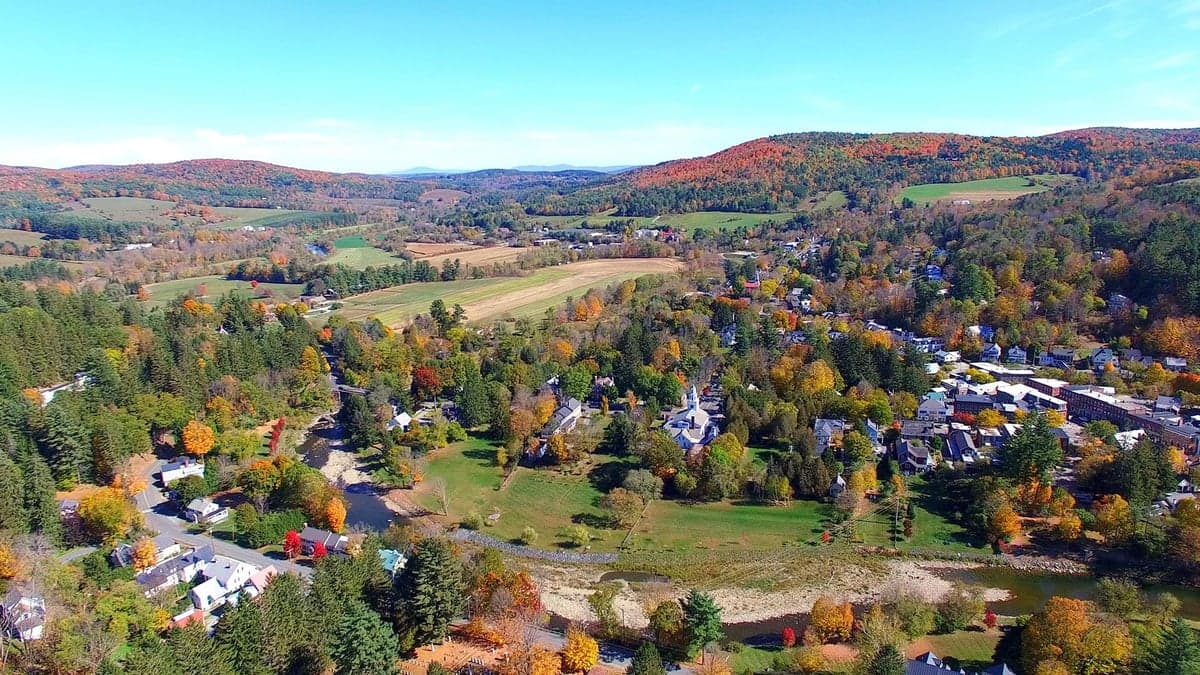
Photo: Wikipedia
Demographics of Woodstock, VT
Affluence Level in Woodstock, VT
An upper-middle-class area. Household wealth, education levels, and homeownership run ahead of national benchmarks.
People of Woodstock, VT
Woodstock, Vermont, is a small, predominantly white community of 983 residents that blends historic New England character with a highly educated, affluent population. With 92.7% of residents identifying as white and 64.6% holding a college degree, the village is marked by a strong preservationist ethos and a demographic profile shaped by decades of selective in-migration. The foreign-born population is minimal at 1.2%, and the largest minority group is Hispanic residents at 6.3%, reflecting a community that has remained ethnically homogeneous even as its economic and educational composition has shifted.
How the city was settled and grew
Woodstock’s original population arrived in the mid-18th century, following a 1761 land grant from New Hampshire’s colonial governor. The first settlers were primarily English and Scottish Protestants, drawn by the promise of fertile river valleys and timber along the Ottauquechee River. By the early 1800s, the village center—now known as The Green—became the commercial and civic hub, with mills and small factories clustering along the river. A second wave of Irish immigrants arrived in the 1840s and 1850s, fleeing the Great Famine and finding work on the railroad and in local quarries. These families settled in what is still called Irish Hill, a modest neighborhood on the village’s eastern edge. A smaller number of French-Canadian laborers came in the late 19th century, drawn by textile and woodworking jobs, and established a presence in the Pleasant Street area. By 1900, Woodstock was a stable, overwhelmingly white, English-speaking community of about 1,200, with a local economy based on farming, milling, and tourism.
Modern era (post-1965)
The post-1965 period brought no significant immigration from Asia, Africa, or Latin America to Woodstock. Instead, the village’s demographic story is one of domestic in-migration by affluent, college-educated professionals and retirees. The 1960s and 1970s saw a wave of urban-to-rural migrants—many from the Northeast corridor—who were drawn by Woodstock’s preserved 19th-century architecture and the countercultural appeal of rural Vermont. These newcomers concentrated in the Mountain Avenue and South Street districts, where large historic homes were renovated. The 1980s and 1990s brought a second wave of wealthy second-home buyers and telecommuters, particularly from New York and Boston, who settled in the River Street corridor and the West Woodstock area. The Hispanic population, now 6.3%, is a very recent phenomenon, largely composed of service-sector workers employed in hospitality and landscaping. They are concentrated in rental housing along Route 4 west of the village center, a corridor of motels and older apartment buildings. The Black population remains negligible at 0.7%, and there are no recorded East/Southeast Asian or Indian-subcontinent residents. The net effect is a community that has become more economically stratified—wealthy newcomers and a small service workforce—while remaining racially homogeneous.
The future
Woodstock’s population is likely to continue its trajectory of slow decline or stagnation, with an aging demographic profile. The village’s high property values and strict historic preservation rules limit new housing construction, making it difficult for younger families or lower-income workers to settle. The Hispanic population may grow modestly as the service economy expands, but it will likely remain a small share. There is no evidence of emerging ethnic enclaves; the community is too small and too expensive for significant immigrant clustering. The white, college-educated majority will persist, with in-migration from affluent retirees and remote workers continuing to replace departing locals. The village is not tribalizing into distinct ethnic neighborhoods—it is homogenizing by income and education, with the few Hispanic residents dispersed along the Route 4 corridor. Over the next 10–20 years, Woodstock will likely become slightly older, slightly more expensive, and no more diverse than it is today.
For someone moving to Woodstock now, the bottom line is clear: this is a place of deep historic continuity, where the population is shaped more by economic selection than by ethnic change. The community is stable, highly educated, and overwhelmingly white, with a small and slowly growing Hispanic service workforce. New residents should expect a village that values preservation over growth, and a social environment where income and education—not race or origin—define the primary social divides.

* Values derived from national, state, county, city and local statistics and may differ in a specific area. Last updated: 2026-04-30T14:34:09.000Z
Narrative content on this page is AI-generated and may contain mistakes. Verify any details that matter before acting on them.
ReloMaps may earn a commission from affiliate links at no extra cost to you.

