Photo: Wikipedia
Demographics of Crook County
Affluence Level in Crook County
A middle-class area roughly in line with national averages across income, home values, education, and employment.
People of Crook County
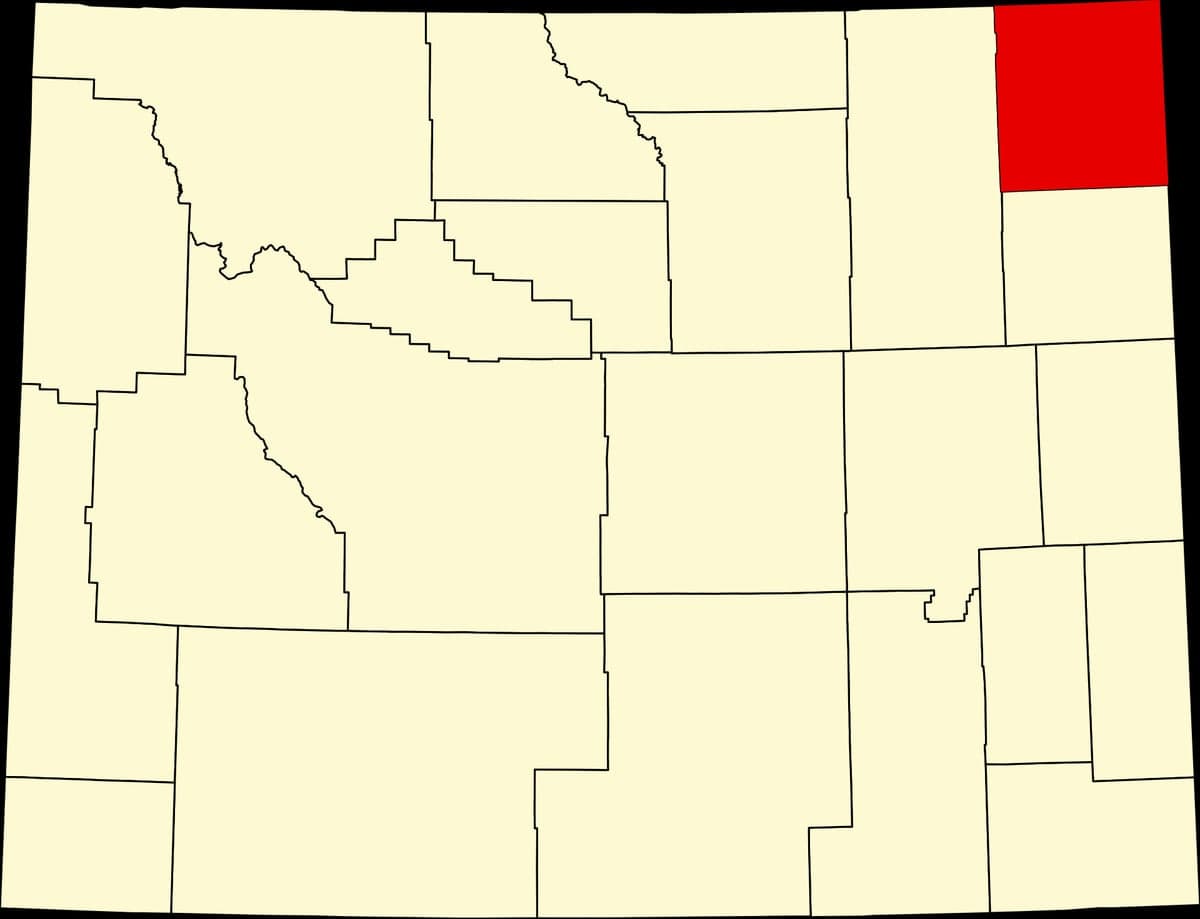
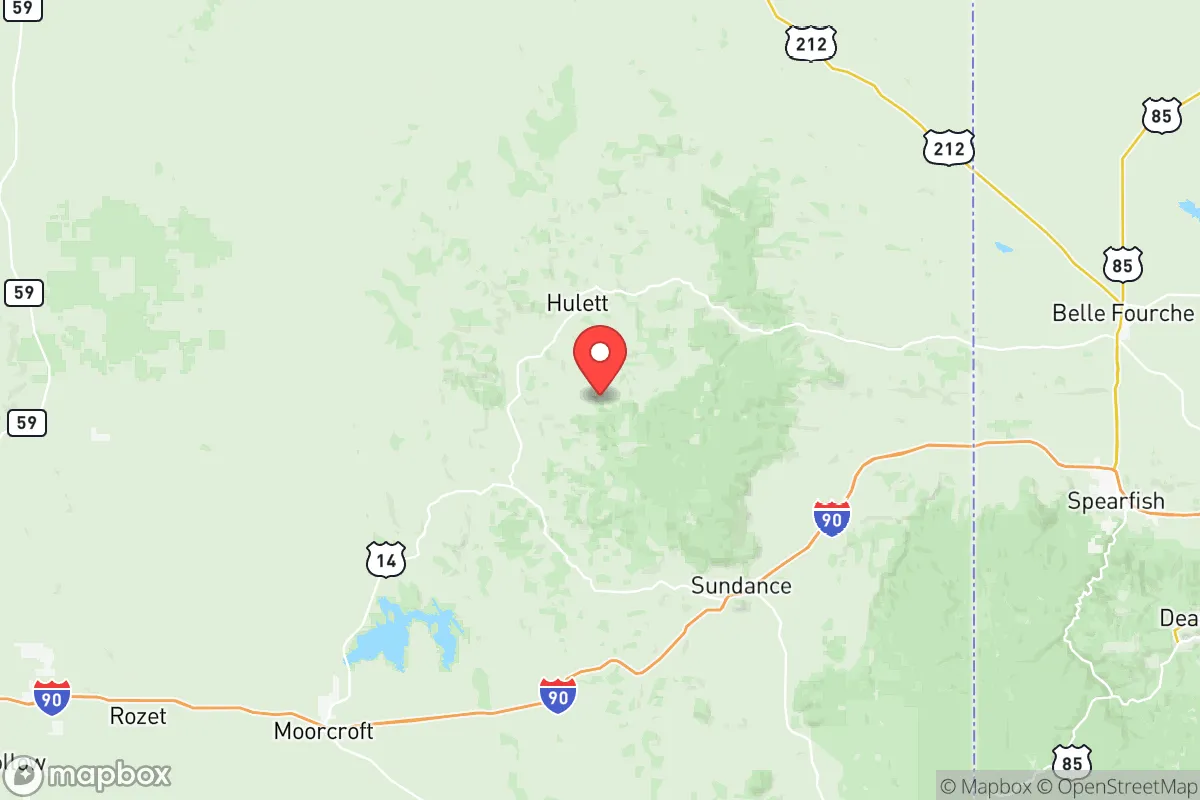
Today, Crook County, Wyoming is home to 7,339 residents, making it one of the state’s least densely populated counties at roughly 2.5 people per square mile. The population is overwhelmingly white (93.3%) and native-born, with a foreign-born share of just 0.9% — one of the lowest in the nation. Its people are characterized by deep-rooted ranching and energy-industry ties, a strong conservative ethos, and a fiercely independent rural identity centered on the towns of Sundance, Hulett, Moorcroft, and Pine Haven.
Settlement & growth (pre-1960)
Long before European settlement, the area now known as Crook County was part of the traditional territory of the Crow, Cheyenne, and Lakota Sioux nations. These nomadic peoples followed bison herds across the Black Hills and the Belle Fourche River valley, leaving behind tipi rings, hunting camps, and the region’s earliest human footprint. The first non-Native presence came with fur trappers and traders in the early 1800s, but permanent settlement did not begin until after the 1868 Fort Laramie Treaty and the subsequent U.S. government push to open the region to homesteading.
The first major wave of American settlers arrived in the 1870s and 1880s, drawn by the promise of cheap land under the Homestead Act and the discovery of gold in the nearby Black Hills. These early pioneers were predominantly of Northern European stock — English, Scots-Irish, and German — who established cattle ranches along the Belle Fourche River and its tributaries. The town of Sundance was founded in 1879 as a stagecoach stop and supply center for the Black Hills gold fields, and it quickly became the county’s political and commercial hub. Nearby Moorcroft followed in the 1890s as a railroad town on the Chicago, Burlington and Quincy line, serving as a shipping point for cattle and wool.
The 1890s through the 1910s saw a second wave of settlement, this time by Scandinavian immigrants — Norwegians, Swedes, and Danes — who were attracted by the region’s open range and the availability of homestead claims. These families established small farming communities like Aladdin and Beulah, where they raised wheat, oats, and hay alongside cattle. The town of Hulett was platted in 1900 and grew as a service center for the surrounding ranches, while Pine Haven remained a sparsely populated area of summer cabins and fishing camps until the mid-20th century. By 1920, Crook County’s population had reached roughly 5,000, a figure that would remain relatively stable for the next four decades as the region’s agricultural economy matured.
The Dust Bowl and Great Depression of the 1930s hit the county hard, causing a modest out-migration of families who could not sustain dryland farming. However, the post-World War II era brought a new economic driver: the discovery of oil and natural gas in the Powder River Basin. This energy boom, beginning in the 1950s, attracted a small but significant influx of workers from Texas, Oklahoma, and the Rocky Mountain states, many of whom settled in Moorcroft and Sundance. The county’s population reached 5,500 by 1960, still overwhelmingly white and native-born, but now with a growing blue-collar energy sector alongside the traditional ranching economy.
Modern era (post-1965)
The 1965 Hart-Cellar Act, which dramatically reshaped U.S. immigration patterns, had virtually no effect on Crook County. The county’s foreign-born population remains at 0.9% in 2026, essentially unchanged from the 1960s. Unlike much of the nation, Crook County did not experience the post-1965 waves of Asian, Latin American, or Middle Eastern immigration. The county’s Hispanic population stands at just 2.0%, and East/Southeast Asian residents make up only 0.5% of the population. There are no measurable Black or Indian-subcontinent communities.
Instead, the county’s modern demographic story is one of domestic migration and suburbanization. The energy boom of the 1970s and 1980s brought a second wave of workers from the Gulf Coast and the Rocky Mountain region, many of whom settled in Moorcroft and the newly developed lakeside community of Pine Haven. Pine Haven, incorporated in 1981, grew from a handful of cabins into a bedroom community for workers commuting to coal mines and power plants in Campbell County. By 2000, Pine Haven’s population had reached 500, and it has since become the county’s fastest-growing municipality, attracting retirees and remote workers drawn to the Keyhole State Park recreation area.
The 1990s and 2000s saw a modest influx of out-of-state retirees and second-home buyers from Colorado, California, and the Midwest, particularly in Sundance and the Bear Lodge Mountains area. These newcomers were attracted by the county’s low taxes, low crime, and outdoor recreation opportunities. However, the county’s overall population growth has been slow — from 7,100 in 2000 to 7,339 in 2026 — as the energy sector has faced boom-and-bust cycles and young adults have left for college and urban jobs. The county’s college-educated share is just 24.0%, below the state average, reflecting the dominance of blue-collar industries.
The future
Crook County’s population is projected to remain stable or grow very slowly over the next 10-20 years, likely reaching 7,500-8,000 by 2040. The county is not becoming more diverse; the white share is expected to remain above 90%, with Hispanic growth limited to a few percentage points driven by natural increase rather than immigration. The most significant demographic shift will be aging: the median age, already above 45, will rise as retirees continue to move to Pine Haven and Sundance, while younger residents leave for employment in Gillette, Rapid City, or the Front Range.
New residential development will concentrate in Pine Haven and along the I-90 corridor near Moorcroft, where land is cheaper and access to jobs in Campbell County is easiest. Sundance will likely see modest growth as a tourism and government center, while Hulett and Aladdin will remain small, stable ranching communities. The county’s cultural identity — conservative, self-reliant, and deeply connected to the land — will persist, though tensions may emerge between longtime ranching families and newer retirees or remote workers who favor conservation and recreation over resource extraction.
For someone moving in now, Crook County offers a rare combination of low population density, low crime, and a strong sense of community, but with limited economic diversity and few opportunities for those outside the energy, ranching, or tourism sectors. It is a place where the population is stable, the culture is homogeneous, and the future looks much like the present — a quiet, rural corner of the West that has changed little in a century and is likely to change little in the next one.

* Values derived from national, state, county, city and local statistics and may differ in a specific area. Last updated: 2026-08-20T04:23:13.000Z
Narrative content on this page is AI-generated and may contain mistakes. Verify any details that matter before acting on them.
ReloMaps may earn a commission from affiliate links at no extra cost to you.

