Photo: Wikipedia
Political ClimatePolitical Climate in Crook County
Showing state-level results — no local-only data available.
Local Political AnalysisPolitical Analysis of Crook County
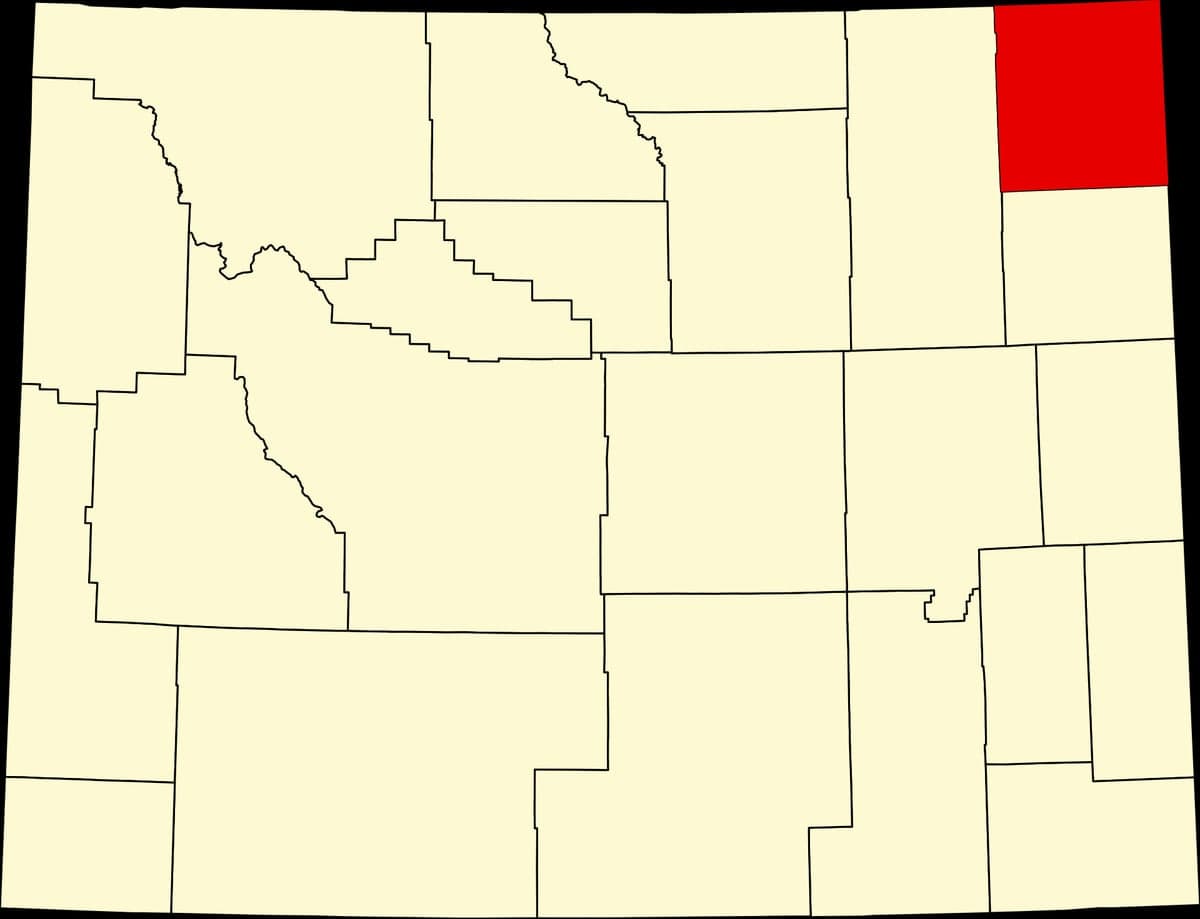
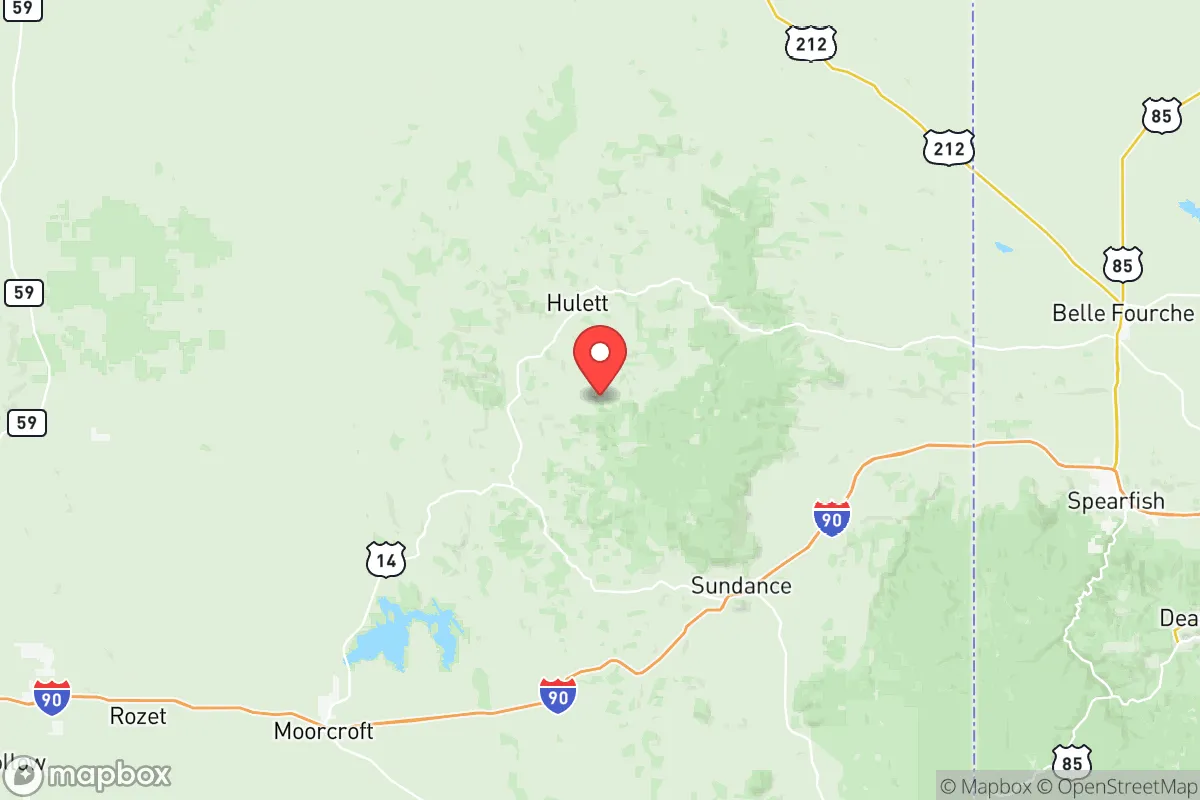
Crook County is about as reliably Republican as any place in Wyoming, with a Cook PVI of R+23 that puts it among the most conservative counties in the nation. The county has voted for the GOP presidential candidate by margins of 70-80% in every election since 2000, and there's no sign of that shifting — if anything, the rural character and resource-based economy have deepened the red over the past decade. Sundance, the county seat, and Hulett, the other main town, both lean heavily Republican, though you'll find a few more moderate or independent voters in the smaller unincorporated areas like Aladdin or Beulah, where ranching families sometimes split tickets on local issues.
How it compares
Comparing Crook County to the rest of Wyoming is tricky because the state as a whole is also deeply red — Wyoming hasn't voted for a Democratic presidential candidate since 1964. But Crook County stands out even within that context. Its R+23 rating is a few points redder than the statewide average (which hovers around R+20 to R+22 depending on the cycle). In practice, that means Crook County is less likely to see competitive primaries or any serious Democratic challenge at the county commission or legislative level. While towns like Laramie or Jackson Hole have pockets of blue voters (thanks to the university and tourism industries), Crook County has no such counterbalance — Sundance and Hulett are small, homogeneous, and deeply tied to agriculture and energy, which reinforces conservative values. The nearest city with any political diversity is Gillette in Campbell County, about 45 minutes west, and even there the tilt is still heavily Republican.
What this means for residents
For conservative residents, Crook County is a comfortable place where their views align with the majority on taxes, gun rights, and energy development. Local government tends to be low-tax and pro-business, and there's little pushback on issues like school curriculum or land use. For liberal or moderate residents, the reality is more isolating — they're likely in the minority on most local boards and in social circles, and they may feel pressure to keep their politics private, especially in smaller communities like Aladdin or Beulah where everyone knows everyone. That said, the county's small population (around 7,500) means that personal relationships often trump political labels in day-to-day life; a neighbor's help during calving season matters more than their yard sign. The trajectory is toward even deeper conservatism as younger residents move to cities and the remaining population ages, but the change is gradual — Crook County has been this way for decades and will likely stay that way for the foreseeable future.
One cultural distinction worth noting: Crook County residents tend to be more libertarian-leaning than the national GOP on land use and federal oversight, given the area's reliance on grazing and mineral rights. You'll hear more skepticism about the Bureau of Land Management and federal land policies here than in, say, Cheyenne, where state government jobs create a different dynamic. This isn't a place where national culture wars dominate local conversation — it's more about water rights, county road maintenance, and the price of hay. For anyone moving here, the political climate is straightforward: you'll find a community that values self-reliance, tradition, and a quiet life, and you'll be expected to respect that, regardless of your own leanings.

State Political ClimatePolitical Climate in Wyoming
State Political AnalysisPolitical Environment in the State
Wyoming is one of the most reliably Republican states in the nation, with a partisan lean that has only deepened over the past two decades. In 2024, Donald Trump carried the state by roughly 40 points, and Republicans hold every statewide office and supermajorities in both legislative chambers. The state’s political identity is rooted in a libertarian-leaning conservatism that prizes individual autonomy, limited government, and resource extraction, but that consensus has frayed in recent years as national culture-war issues have reshaped local politics. The trajectory since 2000 has been a steady march rightward, with the old moderate Republican establishment—think former Senator Alan Simpson—giving way to a more populist, Trump-aligned faction that dominates the state party today.
Urban vs. rural divide
The political map of Wyoming is less about urban-versus-rural and more about degrees of rural. The only real population center is Cheyenne (Laramie County), which leans Republican but is the state’s most competitive county—Trump won it by about 20 points in 2024, compared to 40+ points in most other counties. Casper (Natrona County) and Laramie (Albany County) are the other notable exceptions: Laramie, home to the University of Wyoming, is the state’s only reliably blue county, voting for Biden in 2020 and Harris in 2024 by narrow margins. Jackson (Teton County) is a wealthy, tourist-driven enclave that also votes Democratic, though its population is small. The rest of the state—places like Gillette (Campbell County), Rock Springs (Sweetwater County), and Riverton (Fremont County)—is deeply red, driven by energy-industry workers, ranchers, and a culture of self-reliance. The divide isn’t really city vs. country; it’s more about which rural economy you’re in—energy and agriculture lean hard right, while university and tourism towns lean left.
Policy environment
Wyoming’s policy environment is defined by a low-tax, low-regulation posture that has been in place for decades. There is no state income tax, and sales tax is capped at 4% (local options can push it to 6%). Property taxes are among the lowest in the nation, though a 2024 legislative session saw a push to further cap residential property tax increases after a boom in home values. The state’s regulatory posture is heavily pro-energy: oil, gas, and coal extraction are the economic backbone, and permitting is streamlined. Education policy is a mixed bag—Wyoming spends above the national average per pupil (thanks to mineral revenue), but teacher pay has stagnated, and the state has embraced school choice, including a 2023 law creating education savings accounts. Healthcare is a weak spot: the state did not expand Medicaid under the ACA, leaving a coverage gap for low-income adults, and rural hospital closures are a recurring concern. Election laws are restrictive by national standards: voter ID is required, same-day registration is not allowed, and absentee voting requires an excuse. The state also passed a 2021 law banning drop boxes and limiting mail ballot distribution.
Recent policy direction
The last five years have seen Wyoming move aggressively on cultural and liberty issues. In 2022, the legislature passed a near-total abortion ban (trigger law) with no exceptions for rape or incest, only for the life of the mother. Gun laws are among the most permissive in the country: permitless carry was enacted in 2021, and the state has a “Second Amendment Sanctuary” statute that prohibits enforcement of federal gun restrictions. Parental rights in education were strengthened via a 2023 law requiring schools to notify parents of any curriculum involving “sexuality” and allowing them to opt their children out. On speech and privacy, Wyoming passed a 2024 law restricting government surveillance of social media and requiring warrants for electronic data. Property rights are strongly protected: the state has a robust “right to farm” law and limits on eminent domain for private development. On voting, the 2021 law (SF 145) tightened absentee ballot rules and banned private funding of election administration. The overall direction is toward maximizing individual autonomy on guns, speech, and property, while restricting it on abortion and voting access.
Civil unrest & political movements
Wyoming has not seen the kind of large-scale civil unrest common in bigger states, but it has its own flashpoints. The most visible political movement in recent years has been the rise of the Wyoming Freedom Caucus, a hardline conservative faction that has clashed with the more traditional GOP leadership over budget priorities and culture-war bills. In 2023, the Freedom Caucus successfully pushed for a ban on transgender athletes in school sports and a bill requiring schools to out transgender students to parents. On the left, activism is concentrated in Laramie and Jackson, with groups like the Wyoming Democratic Party and local Indivisible chapters organizing around abortion rights and climate policy—though they have little legislative success. Immigration politics are less heated than in border states, but in 2024 the legislature considered a bill to allow local law enforcement to enforce federal immigration law (it failed). There is a small but vocal secessionist movement in the state’s far-right circles, with some calling for Wyoming to leave the Union—though it has no real political traction. Election integrity controversies flared in 2020 and 2022, with the state GOP calling for an audit of the 2020 election (none was conducted), and a 2024 bill to require hand-counting of ballots was debated but not passed.
Projection
Over the next 5-10 years, Wyoming is likely to become even more conservative, but with a growing tension between the old-school libertarian wing and the new populist-nationalist wing. In-migration is modest but noticeable—people moving from Colorado and California for lower taxes and a slower pace of life—and these newcomers tend to be conservative, not liberal, which reinforces the state’s rightward drift. The energy transition will be the biggest wildcard: if coal continues to decline, the state’s budget (heavily reliant on mineral severance taxes) will face pressure, potentially forcing tax increases or spending cuts that could reshape the political landscape. The University of Wyoming in Laramie will remain a blue island, but its influence is limited. Expect continued fights over abortion (possibly a push for a more restrictive ban), school choice expansion, and election laws. A new resident moving in now should expect a state where conservative values are deeply embedded in daily life—from the lack of mask mandates in 2020 to the prevalence of gun culture—but also a place where the political conversation is increasingly nationalized and polarized, even in a state that votes 70% Republican.
For a new resident, the bottom line is this: Wyoming offers a political environment that is overwhelmingly conservative, with low taxes, strong gun rights, and a hands-off government on most personal and economic matters. If you’re a conservative, you’ll find a community that largely shares your values, though you may encounter internal battles between traditional and populist factions. If you’re a liberal, you’ll be in a distinct minority, but you’ll find like-minded people in Laramie and Jackson, and the state’s libertarian streak means you’ll generally be left alone. The practical takeaway is that Wyoming is a place where your politics will be visible—from the bumper stickers on trucks to the conversations at the grocery store—but where the culture of live-and-let-live still holds, at least for now.
* Values derived from national, state, county, city and local statistics and may differ in a specific area. Last updated: 2026-08-20T04:23:13.000Z
Narrative content on this page is AI-generated and may contain mistakes. Verify any details that matter before acting on them.
ReloMaps may earn a commission from affiliate links at no extra cost to you.

