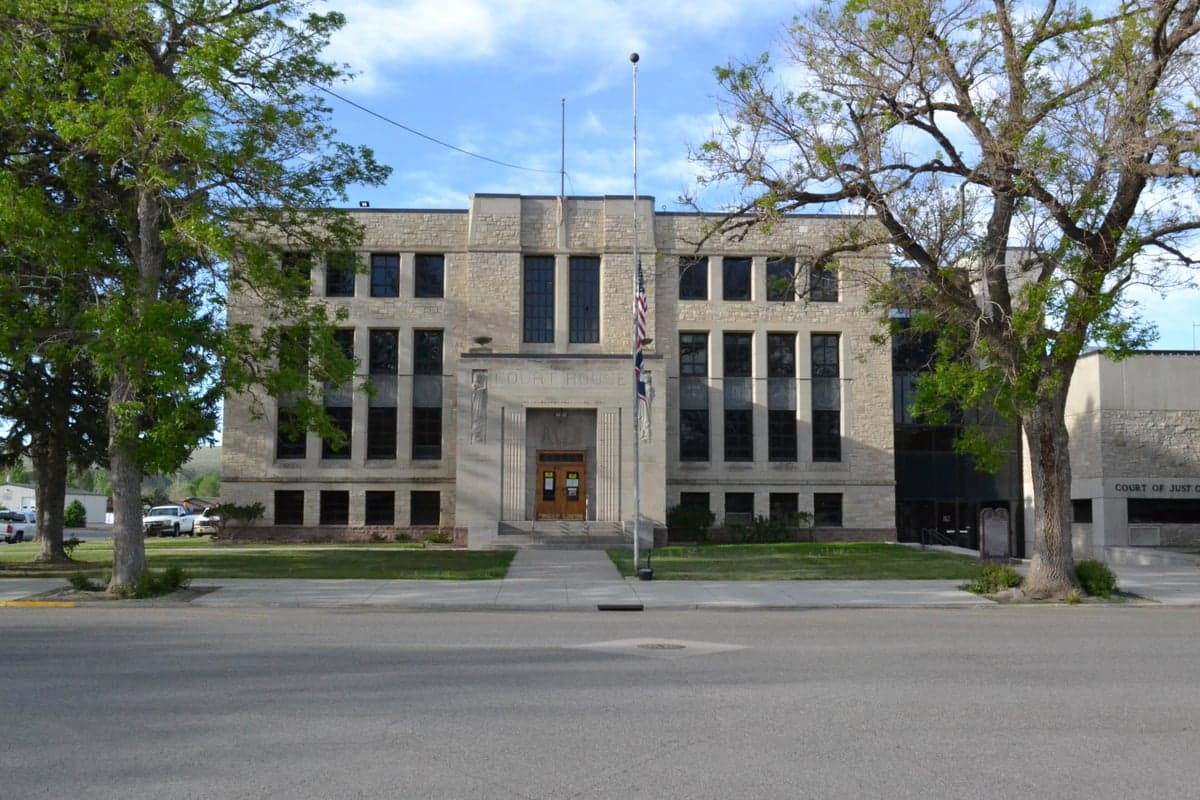
Photo: Wikipedia
Demographics of Hot Springs County
Affluence Level in Hot Springs County
A middle-class area roughly in line with national averages across income, home values, education, and employment.
People of Hot Springs County
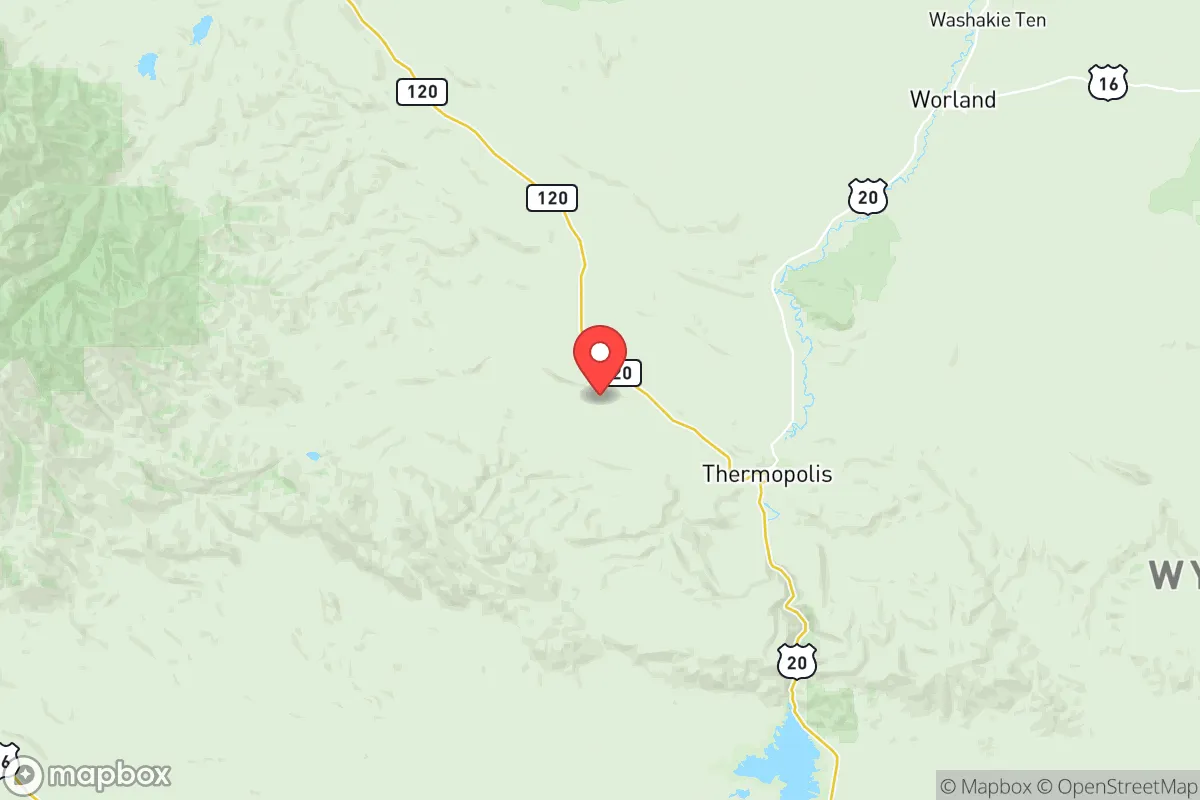
Hot Springs County, Wyoming, is home to 4,618 residents, a population that is 88.9% White and 3.9% Hispanic, with a foreign-born share of just 0.4%. The county’s identity is rooted in its rural, resource-extraction history and a culture of self-reliance, centered on the town of Thermopolis, the only incorporated municipality. The population is older than the state average, with a notable concentration of families who have lived in the area for multiple generations, creating a tight-knit, conservative social fabric.
Settlement & growth (pre-1960)
The area now known as Hot Springs County was originally inhabited by several Native American nations, including the Shoshone and Arapaho. The region’s hot springs, which give the county its name, were considered sacred neutral ground where tribes could camp and bathe without conflict. The 1896 purchase of the Big Horn Hot Springs by the U.S. government from the Shoshone and Arapaho tribes, under the Treaty of Fort Bridger, opened the area to permanent non-Native settlement. The hot springs were then deeded to the state of Wyoming, forming the core of what would become Hot Springs State Park.
The first major wave of non-Native settlers arrived in the late 1890s and early 1900s, drawn by the promise of land under the Homestead Act and the economic opportunities of the region’s natural resources. These early settlers were predominantly of Northern European descent—English, German, and Scandinavian stock—who had already established themselves in the Midwest and Great Plains before pushing westward. They founded the town of Thermopolis in 1897, which quickly became the county’s commercial and administrative hub. The town’s name, meaning "hot city" in Greek, reflected the primary tourist draw, but the real economic engine was agriculture, particularly cattle ranching and dryland farming.
A second wave of settlement occurred during the 1910s and 1920s, driven by the expansion of the Chicago, Burlington & Quincy Railroad, which connected Thermopolis to the national rail network. This brought a smaller influx of laborers, including some Irish and Italian immigrants, who worked on the railroad and in the nascent oil fields. The discovery of oil in the nearby Owl Creek Mountains in the 1910s spurred a modest boom, attracting workers to small camps like Gebo and Kirby. Gebo, now a ghost town, was a company town for the oil industry, while Kirby remains a tiny unincorporated community. The population of Hot Springs County peaked at around 5,000 in the 1920s, then stabilized as the oil boom subsided and the Great Depression slowed migration.
From the 1930s through the 1950s, the county’s population remained relatively static. The Dust Bowl and the Great Depression did not trigger a major influx of "Okies" to this part of Wyoming, as the arid landscape offered little relief for displaced farmers. Instead, the county experienced a slow out-migration of younger residents seeking opportunities in larger cities. The post-World War II era saw a modest uptick in tourism, with Hot Springs State Park drawing visitors, but no significant new settlement wave. By 1960, the population was overwhelmingly White, native-born, and concentrated in Thermopolis, with a scattering of ranching families on the surrounding plains.
Modern era (post-1965)
The 1965 Hart-Cellar Act had virtually no impact on Hot Springs County. The county’s foreign-born population today stands at just 0.4%, one of the lowest rates in the United States. Unlike many parts of the West that saw significant Hispanic and Asian immigration after 1965, Hot Springs County remained demographically isolated. The small Hispanic population (3.9%) is largely composed of families who arrived in the 1970s and 1980s to work in the agricultural and service sectors, primarily in Thermopolis. There is no distinct ethnic enclave; Hispanic residents are dispersed throughout the town and county.
Domestic migration patterns have also been muted. The county did not experience the Rust Belt-to-Sun Belt movement that reshaped much of the Mountain West. Instead, the population has slowly declined from its mid-20th-century peak, as younger residents continue to leave for college and jobs in larger Wyoming cities like Casper or out of state. The 2020 census recorded 4,618 residents, down from 4,812 in 2010. The county’s economy has shifted from oil and agriculture toward tourism and healthcare, with the Hot Springs County Memorial Hospital and the Wyoming Dinosaur Center being major employers. The population is aging, with a median age of about 48, well above the national average.
Suburbanization has not occurred in any meaningful sense. Thermopolis remains a compact town of about 2,700 people, with no significant suburban fringe. The unincorporated areas of the county, including the small settlements of Lucerne and Hamilton Dome, are home to ranching families and a few retirees. There has been no influx of out-of-state retirees or remote workers, as the county lacks the amenities and connectivity that attract such migrants to places like Jackson Hole or Laramie.
The future
The population of Hot Springs County is projected to continue its slow decline over the next 10-20 years. The county’s birth rate is below replacement level, and out-migration of young adults is unlikely to reverse without a major economic shift. The small Hispanic population is expected to grow slightly, as some families remain in the service sector, but it will not approach the levels seen in other parts of Wyoming, such as Sweetwater County. The White, native-born majority will continue to dominate, but the county will become older and smaller.
There is no sign of the county becoming more diverse or tribalizing into distinct enclaves. The cultural identity remains deeply rooted in the ranching and small-town ethos of the early settlers. In-migration is negligible, and those who do move in—typically retirees with family ties or workers in the healthcare and tourism industries—are quickly absorbed into the existing social structure. The county is not homogenizing in a national sense; rather, it is becoming more insular, with a population that is increasingly disconnected from the demographic trends reshaping urban and suburban America.
For someone moving in now, Hot Springs County offers a stable, predictable community where the population is small, aging, and culturally homogeneous. The lack of diversity and growth means that newcomers will find a place where social networks are established and change comes slowly. The county’s future is one of gentle contraction, not transformation, making it a fit for those seeking a quiet, rural life with a strong sense of local history and continuity.

* Values derived from national, state, county, city and local statistics and may differ in a specific area. Last updated: 2026-05-12T08:41:48.000Z
Narrative content on this page is AI-generated and may contain mistakes. Verify any details that matter before acting on them.
ReloMaps may earn a commission from affiliate links at no extra cost to you.

