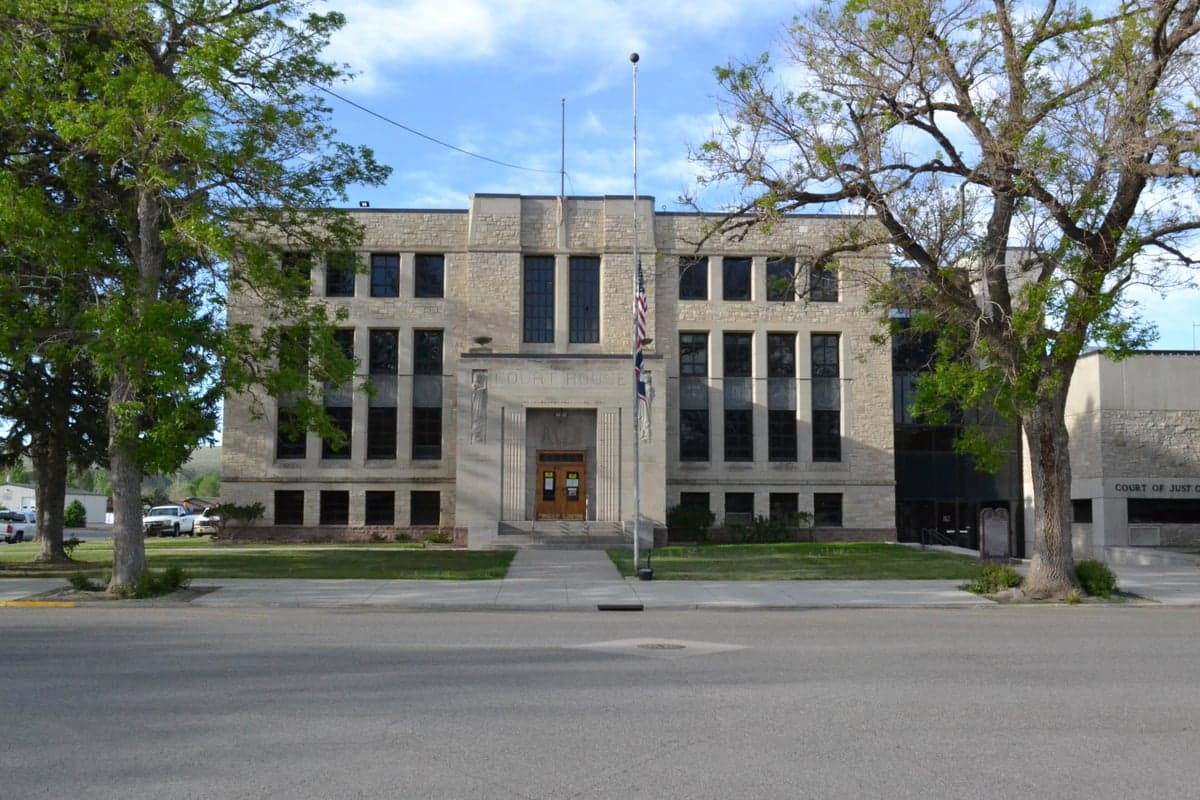
Photo: Wikipedia
Political ClimatePolitical Climate in Hot Springs County
Showing state-level results — no local-only data available.
Local Political AnalysisPolitical Analysis of Hot Springs County
Hot Springs County, Wyoming, is about as solidly conservative as it gets, with a Cook PVI of R+23—the same as the state of Wyoming as a whole. That number tells you the county hasn't budged much from its deep-red roots, and honestly, most folks here like it that way. The political lean is overwhelmingly Republican, and the trajectory has been steady, with no real signs of a shift toward the left, though you'll see a few more independent voters in the mix than you might expect.
How it compares
When you compare Hot Springs County to the rest of Wyoming, the numbers are nearly identical—both sit at R+23. But the real story is in the local variation. The county seat, Thermopolis, is the heart of the area and leans heavily red, with precincts like the one around the Hot Springs State Park consistently voting Republican by wide margins. Over in the smaller town of Kirby, you'll find an even deeper shade of red, where conservative values are practically baked into the soil. The only real exception is the precinct around the town of Lucerne, which has a slightly higher number of independent and even a few Democratic-leaning voters, likely due to a mix of state employees and folks working in the tourism industry. But even there, it's not a blue stronghold—just a lighter shade of red. Compared to the state as a whole, Hot Springs County is a bit more rural and less influenced by the energy boom towns like Gillette or the college crowd in Laramie, so the political culture feels more grounded in traditional Western independence.
What this means for residents
For residents, this political climate means a government that generally stays out of your business. Taxes are low, regulations are minimal, and there's a strong expectation that local officials respect personal freedoms—whether that's the right to own firearms, run a small business without endless red tape, or raise your family without outside interference. The county commission and school board are reliably conservative, so you won't see the kind of progressive overreach that's creeping into other parts of the country. That said, there's a growing concern among longtime locals about the influence of federal land management policies, since so much of the county is public land. Some worry that outside environmental groups are pushing for restrictions that could limit access to hunting, fishing, and grazing—core parts of the local way of life. If that trend continues, you might see a pushback in the form of more libertarian-leaning candidates, but for now, the Republican establishment holds firm.
Culturally, Hot Springs County is a place where neighbors still help each other, and political disagreements are handled over coffee, not social media. There's a strong sense of self-reliance, and most folks are skeptical of any government—local, state, or federal—that tries to tell them how to live. The biggest policy distinction from the rest of Wyoming is the county's focus on tourism and geothermal resources, which means there's a bit more openness to small-scale economic development, but always with an eye on preserving the area's character. In the long term, as long as the county can keep outside influences at bay and maintain its conservative foundation, it'll stay the kind of place where freedom isn't just a slogan—it's how you live.

State Political ClimatePolitical Climate in Wyoming
State Political AnalysisPolitical Environment in the State
Wyoming is about as rock-ribbed Republican as it gets, with a Cook PVI of R+23 that makes it the reddest state in the nation by that measure. The dominant coalition is a mix of ranchers, energy workers, and libertarian-leaning conservatives who have kept the state in GOP hands for generations, though the last decade has seen a subtle but real shift as out-of-state transplants and a growing tech-adjacent crowd in places like Jackson and Laramie start to nudge the political temperature. Over the last 20 years, the state has actually gotten more Republican at the presidential level—Trump won by 43 points in 2020, up from 39 for Romney in 2012—but the internal dynamics are more complicated than the top-line numbers suggest.
Urban vs. rural divide
The political map breaks down into three distinct zones. The rural expanse—places like Worland, Thermopolis, and Rawlins—votes 70-80% Republican and drives the state’s overall lean. These are energy and agriculture communities where the Second Amendment and property rights are non-negotiable. The two population centers, Cheyenne and Casper, are reliably red but more moderate, with Cheyenne’s state government workforce and Casper’s oil-and-gas base producing GOP margins closer to 60-65%. The real outlier is Jackson (Teton County), which is the only blue spot in the state—it went for Biden by 30 points in 2020, driven by wealthy out-of-state transplants, tourism money, and a growing environmentalist presence. Laramie (Albany County), home to the University of Wyoming, is a lighter shade of blue, flipping to Biden by 6 points in 2020 after going for Trump in 2016. That’s the only county that flipped in the state, and it’s a warning sign for conservatives: the university town is becoming a progressive beachhead.
Policy environment
Wyoming’s policy environment is a conservative dream on paper, but the devil is in the details. There is no state income tax, and property taxes are among the lowest in the nation—the median effective rate is about 0.6%, though a 2024 legislative session saw a push to cap annual increases at 4% after a spike in valuations in Teton and Sublette counties. The regulatory posture is light-touch, especially for energy extraction, but the state’s reliance on mineral royalties (coal, oil, gas, trona) means the budget is volatile—when commodity prices drop, so do services. Education policy is a mixed bag: school choice is limited compared to states like Arizona, with no universal ESA program, though a 2023 law created a modest education savings account for special-needs students. Healthcare is a sore spot—Wyoming did not expand Medicaid under the ACA, leaving a coverage gap for about 25,000 low-income adults, and the state has only one Level 1 trauma center (in Cheyenne). Election laws are solid: voter ID is required, same-day registration is not allowed, and the state has no mail-in ballot expansion beyond absentee with an excuse. The 2021 session passed a law banning private funding of election administration, a direct response to Zuckerberg-style grants.
Trajectory & freedom
On the freedom front, Wyoming is generally moving in the right direction, but there are warning signs. The state passed constitutional carry in 2011 and has not rolled it back—no permit needed to carry a concealed firearm. In 2023, the legislature passed a Second Amendment Protection Act that purports to nullify federal gun laws, though its practical effect is mostly symbolic. Parental rights got a boost with a 2023 law requiring schools to notify parents of any curriculum changes involving sexuality or gender identity, and a 2024 law banned transgender athletes from girls’ sports. Medical autonomy is strong—Wyoming has no mask or vaccine mandates at the state level, and a 2022 law prohibits employers from requiring COVID-19 vaccines as a condition of employment. Property rights are generally respected, but the state’s reliance on federal land (48% of Wyoming is federally owned) creates tension—the Transfer of Public Lands Act, passed in 2014, demands the feds hand over control, but it’s been stalled in court. The biggest red flag for conservatives is the influx of wealthy liberals into Teton County, who are pushing for higher property taxes, land-use restrictions, and environmental regulations that could spill over into state policy if their numbers grow.
Civil unrest & political movements
Wyoming is not a hotbed of civil unrest, but there are organized movements worth noting. The Wyoming Liberty Group is a prominent free-market think tank that has successfully pushed for tax cuts and school choice. On the right, the Wyoming Republican Party has seen internal battles between establishment conservatives and more populist, Trump-aligned factions—the 2022 state convention was a mess, with delegates voting to censure Liz Cheney (who is from the state) for her role on the January 6 committee. On the left, the Wyoming Democratic Party is a shell, but activist groups like Better Wyoming and the Wyoming Outdoor Council are vocal on environmental issues, particularly opposing new oil and gas leases. Immigration politics are low-key—Wyoming has a small foreign-born population (about 3%), and there are no sanctuary cities. The state did pass a 2019 law requiring law enforcement to cooperate with ICE, but it’s rarely a flashpoint. Election integrity controversies are minimal—the state uses paper ballots and has no widespread fraud allegations. The most visible flashpoint a new resident would notice is the “Keep Wyoming Wild” bumper stickers, which signal opposition to energy development, versus the “Wyoming First” signs that advocate for resource extraction.
Projection
Over the next 5-10 years, Wyoming is likely to stay deeply red, but the margins will narrow in specific pockets. The demographic shift is real: Teton County’s population grew 10% from 2010 to 2020, and it’s attracting remote workers and second-home owners who bring progressive voting habits. Laramie is also growing slowly, and the university’s leftward tilt could make Albany County a permanent blue spot. Meanwhile, the rural counties—Carbon, Sweetwater, Fremont—are losing population as coal jobs decline, which could dilute the GOP’s base. The state’s fiscal dependence on mineral revenues is a ticking clock: if coal continues to decline (production dropped 40% from 2010 to 2023), the legislature will face pressure to raise taxes or cut services, which could trigger a backlash. The wild card is in-migration from blue states—Wyoming’s “free” branding (no income tax, low regulation) is attracting libertarians and conservatives from California and Colorado, but also some left-leaning remote workers who want mountain views. If the latter group clusters in Jackson and Laramie, they could eventually flip a few state house seats. But for the foreseeable future, the state’s political culture is dominated by the rural, energy-producing, gun-owning majority that sees government overreach as the enemy.
Bottom line for a new resident: If you’re moving to Wyoming for freedom, you’ll find it—low taxes, strong gun rights, and a government that mostly stays out of your life. But don’t expect a libertarian utopia. The state has real problems with healthcare access, education choice, and economic diversification, and the political fights are increasingly about how to manage decline in rural areas versus growth in the tourist towns. Pick your county carefully: Sublette or Johnson County for the most conservative, Laramie or Teton if you want a more mixed environment. And keep an eye on the legislature—the 2025 session is likely to see another push for school choice expansion and property tax relief, but also a fight over whether to allow a data center tax break that could bring in more out-of-state workers. Wyoming is still the closest thing to a free state in the Lower 48, but it’s not immune to the national trends that are reshaping every red state.
* Values derived from national, state, county, city and local statistics and may differ in a specific area. Last updated: 2026-05-12T08:41:48.000Z
Narrative content on this page is AI-generated and may contain mistakes. Verify any details that matter before acting on them.
ReloMaps may earn a commission from affiliate links at no extra cost to you.

