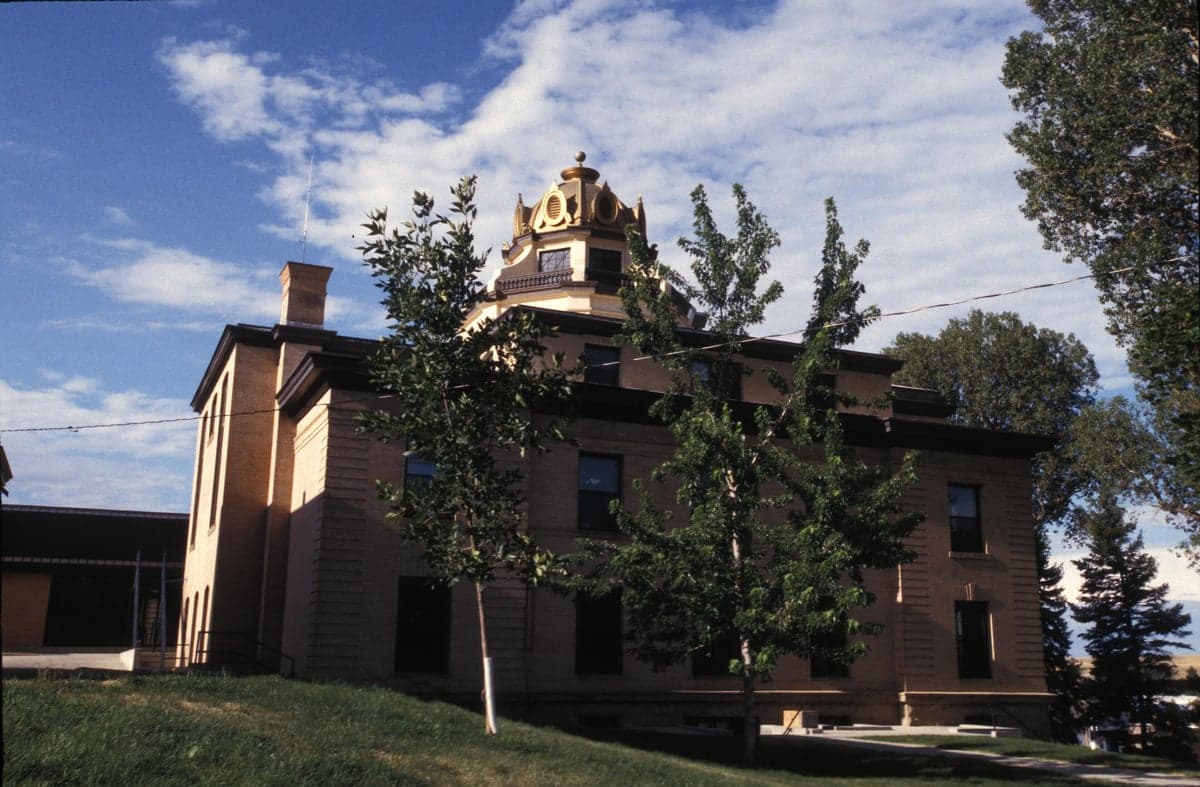
Photo: Wikipedia
Demographics of Sheridan County
Affluence Level in Sheridan County
A middle-class area roughly in line with national averages across income, home values, education, and employment.
People of Sheridan County
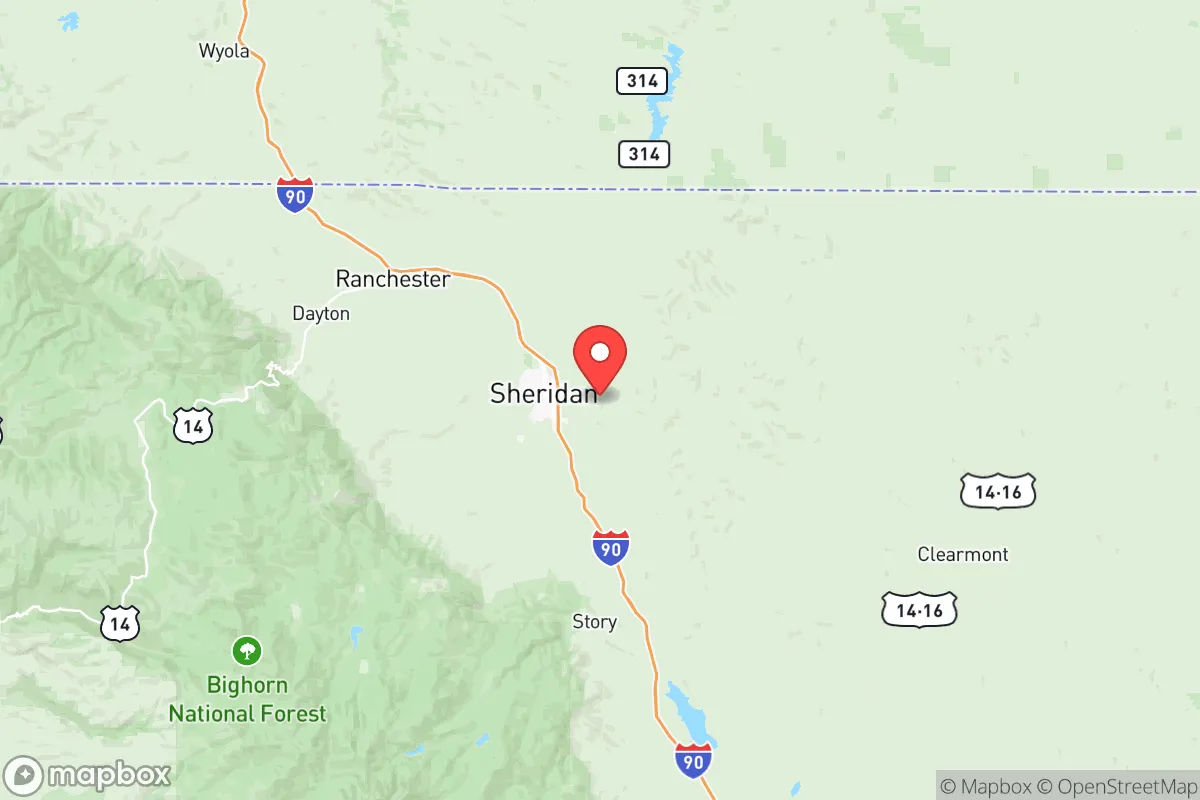
Sheridan County, Wyoming, is home to roughly 31,600 residents, a population that remains overwhelmingly white (89.7%) and native-born (only 0.9% foreign-born), with a small but growing Hispanic community (4.8%). The county’s identity is rooted in its ranching and energy heritage, with a distinctly Western, conservative character that draws families and individuals seeking space, safety, and a slower pace of life. The population is concentrated in the city of Sheridan (the county seat and economic hub) and the smaller towns of Ranchester, Dayton, and Big Horn, with the rest spread across expansive ranchlands and the Bighorn National Forest foothills.
Settlement & growth (pre-1960)
Long before European settlement, the area that is now Sheridan County was home to several Native American nations, including the Crow, Cheyenne, Lakota, and Arapaho, who used the Bighorn Mountains and the Tongue River Valley for hunting and seasonal camps. The region was part of the vast territory contested during the Plains Indian Wars, and the Bozeman Trail (which ran through the eastern edge of the county) became a flashpoint for conflict in the 1860s, leading to the establishment of Fort Phil Kearny near present-day Story. The U.S. Army’s presence and the subsequent forced removal of Native tribes onto reservations opened the land to white settlement by the late 1870s.
The first major wave of American settlers arrived in the 1880s and 1890s, drawn by the promise of cheap land under the Homestead Act and the expansion of the railroad. The Chicago, Burlington and Quincy Railroad reached the area in 1887, and the town of Sheridan was platted that same year, named after General Philip Sheridan. These early settlers were predominantly of Northern European stock—English, Irish, German, and Scandinavian—who came from the Upper Midwest and the Great Plains, seeking open range for cattle ranching. The town of Big Horn, founded in the 1880s, became a center for wealthy Eastern investors and English aristocrats who established large cattle operations, earning it the nickname "the Polo Capital of the West." Smaller communities like Dayton (founded 1884) and Ranchester (founded 1890) grew as agricultural service centers for homesteaders and ranchers in the Tongue River Valley.
By the early 1900s, the county’s economy diversified with the discovery of coal in the nearby Powder River Basin and the development of the timber industry in the Bighorn Mountains. This brought a modest influx of workers, including some Italian and Eastern European immigrants who labored in the mines and sawmills, though their numbers remained small compared to the dominant Northern European stock. The Dust Bowl and Great Depression of the 1930s pushed some displaced farmers from the Great Plains into Sheridan County, but the region’s population grew slowly and steadily, reaching about 16,000 by 1950. The post-World War II era saw a modest suburban expansion around Sheridan, as returning veterans and their families settled into new housing developments, but the county remained overwhelmingly rural, agricultural, and ethnically homogeneous.
Modern era (post-1965)
The 1965 Hart-Cellar Act, which reshaped U.S. immigration, had minimal direct impact on Sheridan County. The foreign-born population today is less than 1%, and the county did not experience the waves of immigration from Asia, Latin America, or the Middle East that transformed many urban and suburban areas. Instead, the county’s demographic story since the 1970s has been one of domestic migration and gradual diversification from within the United States.
The most significant shift has been the growth of the Hispanic population, which rose from negligible levels in 1970 to 4.8% today. This growth is driven primarily by Mexican-American families moving from the Southwest and the Mountain West for work in the energy sector (oil and gas drilling in the Powder River Basin), construction, and the service industry. These families are dispersed across the county, with small concentrations in Sheridan and Ranchester, but no distinct ethnic enclave has formed. The East/Southeast Asian population (1.0%) and Black population (0.4%) remain very small, largely composed of professionals in healthcare, education, and the military (the county has no major base, but some veterans settle in the area). The Indian subcontinent population is essentially zero.
Domestically, Sheridan County has attracted a steady stream of in-migrants from other parts of the West and Midwest, particularly from Colorado, California, and the Pacific Northwest. These are often families and retirees seeking lower taxes, less crime, and a more traditional, conservative community. The city of Sheridan has seen new subdivisions and retail development, while the unincorporated area of Big Horn remains a haven for horse properties and ranchettes. The county’s population grew by about 10% between 2010 and 2020, a pace that has continued into the 2020s, driven by both natural increase and net migration.
The future
Sheridan County is likely to continue its gradual growth, with the population projected to approach 35,000 by 2040. The county will remain overwhelmingly white and native-born, but the Hispanic share is expected to rise to 7-9% as younger families settle in and the energy sector continues to draw workers. The East/Southeast Asian and Black populations will likely remain small, as the county lacks the urban job base or cultural infrastructure to attract significant numbers of immigrants from those groups.
The most notable trend is the continued in-migration of domestic migrants from high-cost, high-regulation states like California, Colorado, and Washington. These newcomers are often politically conservative or libertarian, and they are drawn to Sheridan County’s low taxes, gun-friendly culture, and outdoor recreation opportunities. This influx is gradually shifting the county’s housing market, with home prices rising faster than local wages, and creating some tension between long-time ranching families and new residents who work remotely or commute to jobs in the energy sector. The county’s cultural identity—rooted in ranching, hunting, and self-reliance—is likely to persist, but it may become more suburban and service-oriented as the population grows and ages.
For someone moving in now, Sheridan County offers a stable, safe, and politically conservative community with strong ties to the land and a clear sense of place. The population is not becoming dramatically more diverse, but it is becoming more connected to the broader Western economy through energy and remote work. The county’s future is one of modest growth, continued cultural homogeneity, and a gradual shift from a purely rural ranching economy to a more diversified mix of energy, tourism, and professional services.

* Values derived from national, state, county, city and local statistics and may differ in a specific area. Last updated: 2026-08-08T16:39:13.000Z
Narrative content on this page is AI-generated and may contain mistakes. Verify any details that matter before acting on them.
ReloMaps may earn a commission from affiliate links at no extra cost to you.

