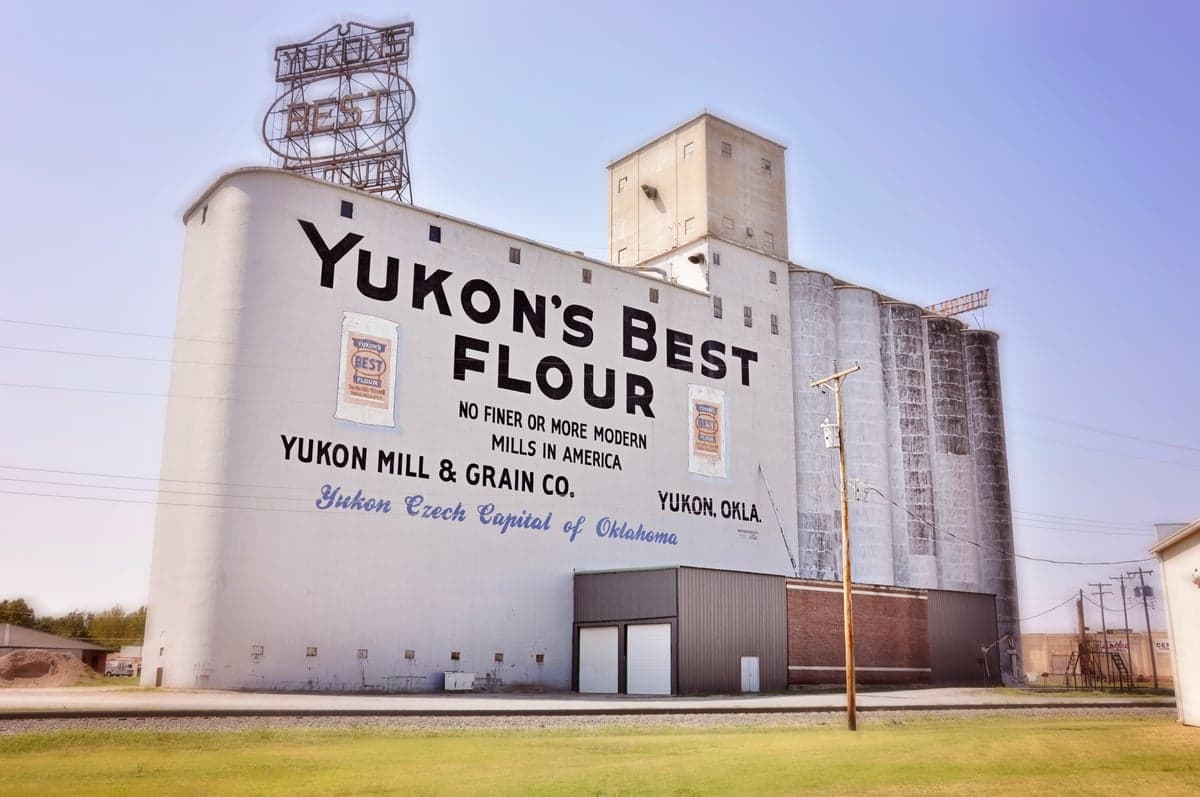
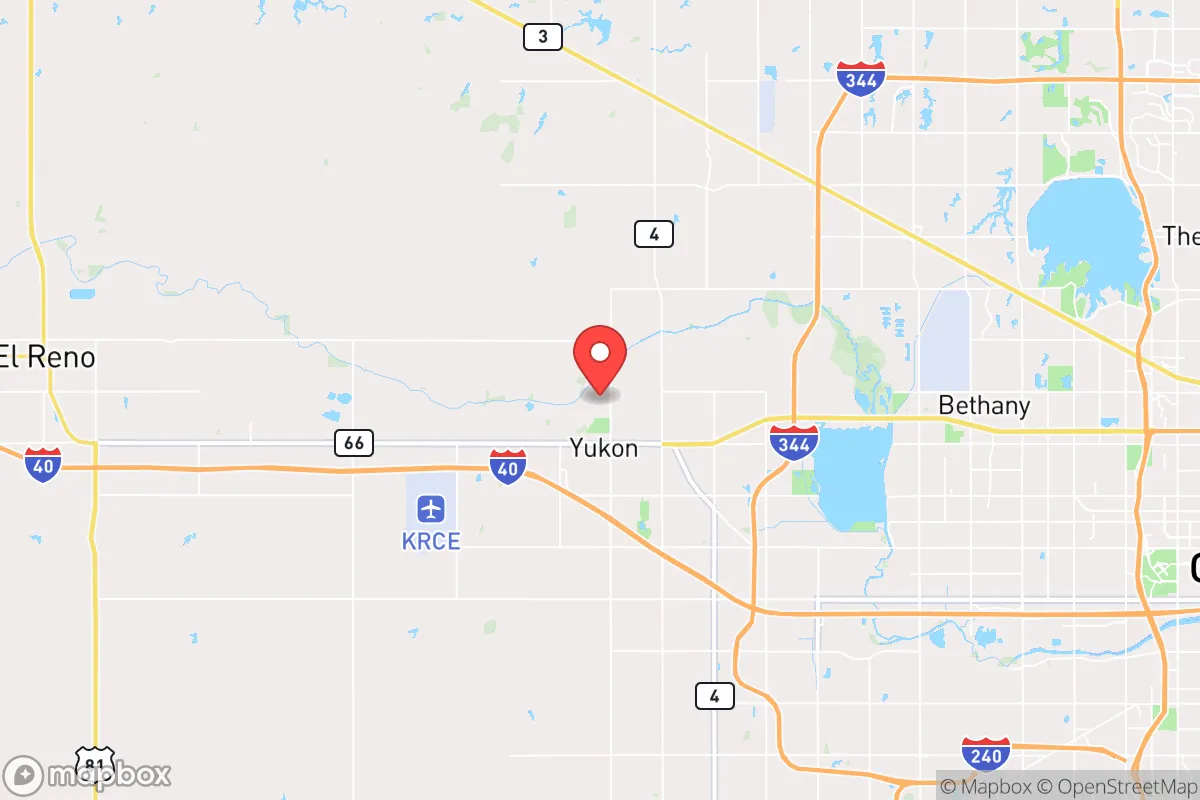
Photo: Wikipedia
Demographics of Yukon, OK
Affluence Level in Yukon, OK
A middle-class area roughly in line with national averages across income, home values, education, and employment.
People of Yukon, OK
Yukon, Oklahoma, is a predominantly white, family-oriented suburb of Oklahoma City with a population of 24,802 that retains a distinct small-town identity. The city is characterized by a low foreign-born rate of 1.4% and a 77.1% white population, with a Hispanic community of 8.0% and smaller Black (3.4%), East/Southeast Asian (0.4%), and Indian subcontinent (0.6%) groups. With 32.0% of adults holding a college degree, Yukon’s population is moderately educated and leans conservative, reflected in its strong local school system and active civic life centered around Main Street and the historic downtown.
How the city was settled and grew
Yukon’s population history begins with the Land Run of 1889, which opened unassigned lands in Oklahoma Territory to non-Native settlers. The town was founded in 1891 along the Choctaw, Oklahoma and Gulf Railroad, named after the Yukon River by a railroad official. The earliest settlers were predominantly white homesteaders from the Midwest and Upper South—farmers and merchants drawn by cheap land and the railroad’s promise of commerce. These founding families built the Historic Downtown Yukon district, centered around Main Street and the railroad depot, which remains the city’s core. A second wave arrived during the 1920s oil boom, when workers and their families settled in the Shepherd Addition neighborhood, a modest grid of homes built for oil-field laborers and railroad employees. By 1950, Yukon’s population hovered around 1,500, almost entirely white and native-born, with a strong agricultural and railroad economy.
Modern era (post-1965)
Yukon’s modern growth began in the 1970s and accelerated through the 1990s as suburbanization pushed outward from Oklahoma City. The 1965 Hart-Cellar Act had minimal direct impact here—foreign immigration remained negligible—but domestic in-migration reshaped the city. White families from Oklahoma City and rural Oklahoma moved to Yukon for its low crime rates, strong school district, and affordable housing. The Forest Hills subdivision, developed in the 1980s, absorbed many of these newcomers, offering larger lots and newer homes. The Lakeview Addition and Briarwood neighborhoods, built in the 1990s and 2000s, attracted younger families and professionals, including a small number of Hispanic and Black households. The Hispanic population grew from under 2% in 1990 to 8.0% today, concentrated in the West Yukon area near Highway 66, where some service-industry workers and construction laborers settled. The East/Southeast Asian and Indian subcontinent communities remain tiny (0.4% and 0.6% respectively), with most households in the Stone Creek subdivision, a newer development near the Canadian River. The Black population, at 3.4%, is dispersed across the city but slightly more present in the South Yukon area near Interstate 40.
The future
Yukon’s population is projected to continue growing, driven by ongoing suburban expansion from Oklahoma City and the development of new housing in the Mustang Road Corridor and Garth Brooks Boulevard areas. The city is likely to remain predominantly white and native-born, with the Hispanic share slowly rising as families move from Oklahoma City’s south side for better schools and lower housing costs. The foreign-born rate, at 1.4%, is unlikely to increase significantly, as Yukon lacks the industrial or service-sector jobs that attract immigrant labor. The East/Southeast Asian and Indian subcontinent communities are expected to remain small, with growth limited to a few professional households drawn by the school district. The city is not tribalizing into distinct ethnic enclaves; instead, it is homogenizing as a white, conservative, family-oriented suburb, with Hispanic and Black residents largely assimilating into existing neighborhoods. The next 10-20 years will likely see Yukon’s population reach 30,000-35,000, with a slightly more diverse but still overwhelmingly white character.
For someone moving in now, Yukon is becoming a stable, culturally homogeneous suburb where demographic change is slow and incremental. The city offers a predictable, family-focused environment with strong schools and low crime, but little ethnic or cultural diversity. New residents should expect a community where the population is growing through domestic migration, not immigration, and where the social fabric remains rooted in its white, conservative, small-town origins.

* Values derived from national, state, county, city and local statistics and may differ in a specific area. Last updated: 2026-04-21T11:42:44.000Z
Narrative content on this page is AI-generated and may contain mistakes. Verify any details that matter before acting on them.
ReloMaps may earn a commission from affiliate links at no extra cost to you.

