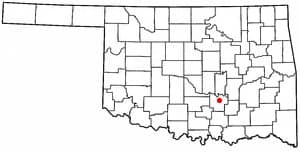
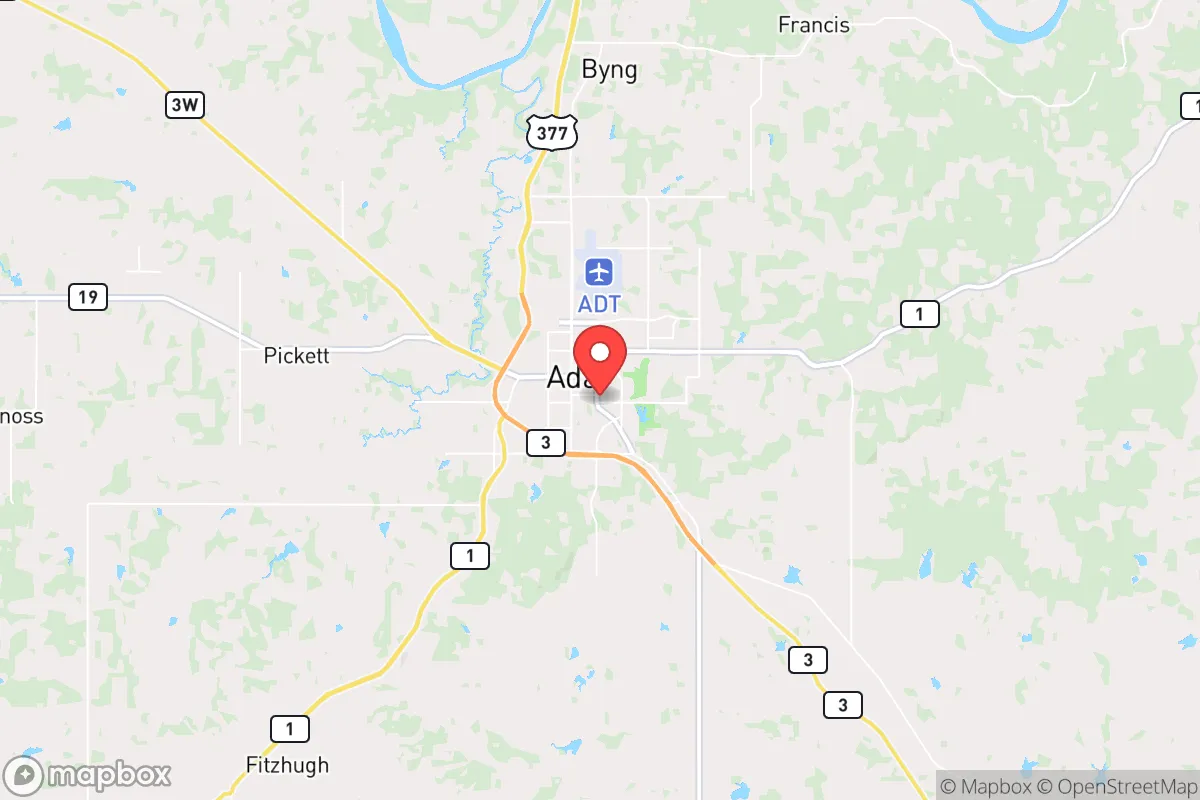
Photo: Wikipedia
Demographics of Ada, OK
Affluence Level in Ada, OK
A below-average socioeconomic profile. Incomes, home values, and educational attainment trail the U.S., with higher poverty and unemployment.
People of Ada, OK
The people of Ada, Oklahoma today form a community of roughly 16,500 residents that is predominantly white (59.9%) with a notable Native American presence—reflecting the city’s Chickasaw Nation roots—and small but established Hispanic (6.9%), Black (4.9%), and East/Southeast Asian (1.6%) populations. The foreign-born share is low at 1.8%, and 30.3% of adults hold a college degree, a figure that aligns with Ada’s role as a regional education and healthcare hub anchored by East Central University. Distinctive identity markers include a strong sense of local tradition, a visible Chickasaw cultural influence, and a conservative-leaning civic character shaped by its rural Oklahoma setting and historic reliance on oil, agriculture, and state government employment.
How the city was settled and grew
Ada was founded in 1889 as a railroad town on land that had been part of the Chickasaw Nation, with the first permanent settlers arriving after the 1890s land runs opened the area to non-Native homesteaders. The original population was overwhelmingly white and Anglo-American, drawn by the promise of fertile farmland and the new St. Louis and San Francisco Railway line. By the early 1900s, oil discoveries in the nearby Greater Seminole Field triggered a boom that brought a wave of white laborers, speculators, and merchants, many of whom settled in the Historic Downtown district and the working-class neighborhoods east of the tracks, such as East Ada. A smaller but significant Black community formed during this era, concentrated in the South Ada area near the railroad, where African American families worked as domestic servants, railroad hands, and farm laborers. The Chickasaw population, while present, was largely displaced from the town core during the early decades, with many families living in rural areas or in the Byng community just south of Ada, which remains a Chickasaw cultural anchor today. By the 1950s, Ada’s population had stabilized around 15,000, supported by the opening of East Central State College (now East Central University) and the expansion of the Ada State School (a state-run facility for people with developmental disabilities), which brought a steady inflow of state employees and educators.
Modern era (post-1965)
After the 1965 Hart-Cellar Act, Ada saw only modest immigration-driven change, reflecting its inland, non-metropolitan location. The foreign-born share remains low at 1.8%, and the city’s demographic shifts since the 1970s have been driven primarily by domestic migration and natural change. The white share has declined from roughly 85% in 1970 to 59.9% today, a drop largely explained by out-migration of younger white residents to larger Oklahoma cities like Oklahoma City and Tulsa, combined with a growing Native American population that now identifies separately on census forms. The Hispanic population grew from under 1% in 1990 to 6.9% today, with most families settling in the Northwest Ada neighborhoods near the industrial parks and along the Highway 3 corridor, where lower housing costs and proximity to agricultural and construction jobs provided a foothold. The Black population has remained stable at around 4.9%, with the historic South Ada neighborhood still serving as the cultural center, though many Black families have also moved into newer subdivisions in West Ada near the university. The East/Southeast Asian community (1.6%) is small and largely composed of Vietnamese and Filipino families who arrived in the 1980s and 1990s, many connected to the Chickasaw Nation’s healthcare system or to East Central University; they are concentrated in the University Heights area near the campus. The Indian-subcontinent population is effectively zero, and there is no measurable Arab community. Suburbanization has been limited, with most growth occurring in annexed fringe areas like Oakridge Addition and Stone Creek, which attract white and Native American families seeking newer housing and larger lots.
The future
Ada’s population is projected to remain stable or grow slowly over the next 10–20 years, likely reaching 17,000–18,000 by 2040, driven by natural increase and modest in-migration from surrounding rural areas. The white share will continue to decline gradually, while the Hispanic and Native American shares are expected to rise, with Hispanic growth plateauing as second-generation families assimilate into the broader community. The city is not tribalizing into distinct enclaves—neighborhoods remain relatively integrated, with the exception of the historic South Ada Black community and the Byng-area Chickasaw concentration. The East/Southeast Asian population is likely to remain small and stable, tied to university and healthcare employment. The biggest wildcard is the Chickasaw Nation’s economic development: if the tribe expands its gaming, healthcare, and cultural tourism operations in Ada, it could attract more Native American in-migration from other parts of Oklahoma and even out of state, potentially raising the Native share from its current estimated 20–25% (including those who identify as Native alone or in combination) to over 30% by 2040. For a conservative-leaning newcomer, Ada offers a stable, low-crime, family-oriented environment with a strong sense of place, but limited ethnic diversity and a slow-growth economy that rewards those with jobs in education, healthcare, or tribal government.
Ada is becoming a more Native American and slightly more Hispanic community, but it remains fundamentally a white-majority, conservative small city where the Chickasaw Nation’s growing influence is the most significant demographic and economic force. For someone moving in now, the city offers affordable housing, a low cost of living, and a tight-knit social fabric, but little of the rapid change or cultural variety found in larger Oklahoma metros.

* Values derived from national, state, county, city and local statistics and may differ in a specific area. Last updated: 2026-04-21T19:40:24.000Z
Narrative content on this page is AI-generated and may contain mistakes. Verify any details that matter before acting on them.
ReloMaps may earn a commission from affiliate links at no extra cost to you.

