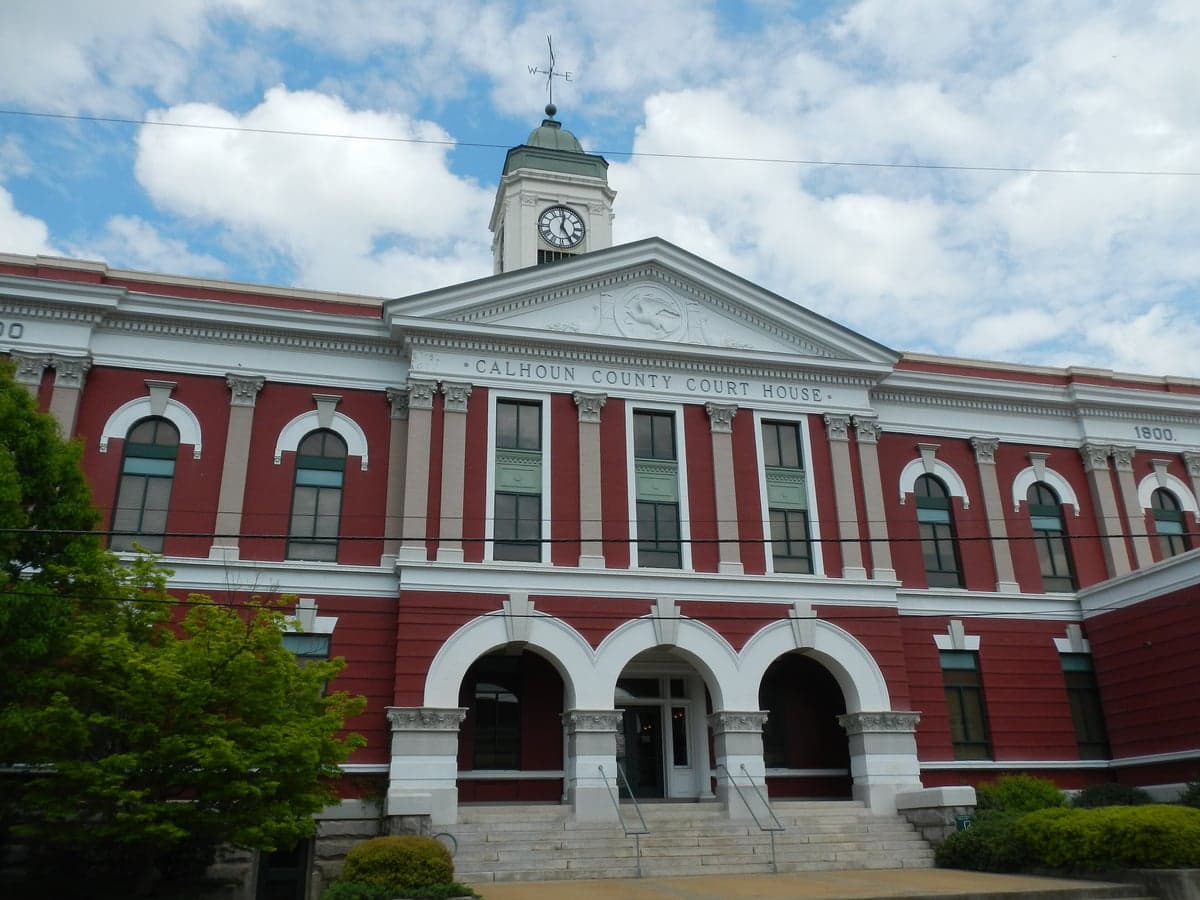
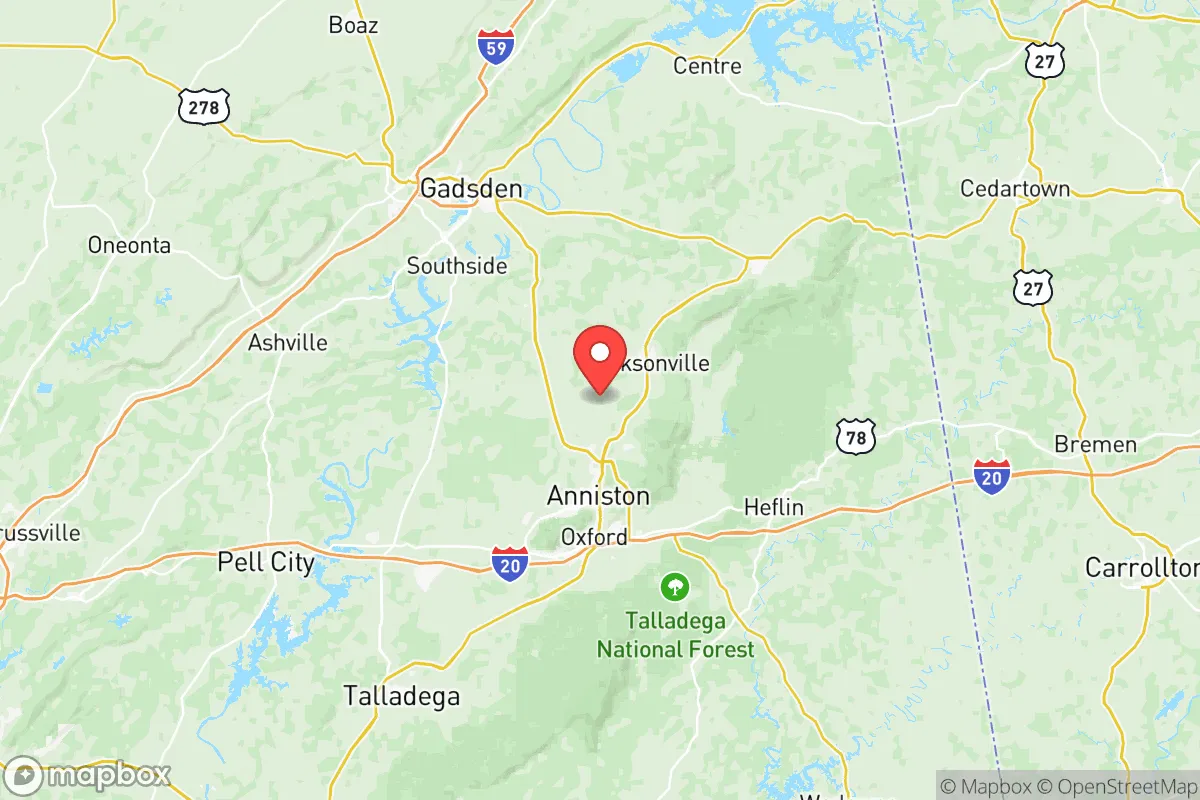
Photo: Wikipedia
Demographics of Calhoun County
Affluence Level in Calhoun County
A below-average socioeconomic profile. Incomes, home values, and educational attainment trail the U.S., with higher poverty and unemployment.
People of Calhoun County
Calhoun County, Alabama, is home to 116,141 residents, a population shaped by Deep South traditions, industrial roots, and a military presence. The county is predominantly white (69.8%) with a significant Black minority (21.6%) and a small but growing Hispanic community (4.4%). Its character is defined by the twin cities of Anniston and Oxford, a mix of blue-collar manufacturing heritage and suburban expansion, with a notably low foreign-born population of just 1.2%.
Settlement & growth (pre-1960)
Long before European settlement, the area now known as Calhoun County was the domain of the Muscogee (Creek) people, who established villages along the Coosa River and its tributaries. The Creeks were forcibly removed in the 1830s following the Indian Removal Act, opening the land to white settlers. The county was created in 1832 and named for John C. Calhoun, the South Carolina senator and vice president.
The first major wave of American settlers were Scots-Irish and English farmers from Georgia, Tennessee, and the Carolinas, who arrived in the 1830s and 1840s. They established small agricultural communities like Jacksonville (the county seat until 1899), Piedmont, and Ohatchee, growing cotton and corn on small family farms. These early settlers were largely yeoman farmers, not plantation owners, which gave the county a distinct character of independent, land-owning families rather than a planter aristocracy.
The county's trajectory changed dramatically in the late 19th century with the arrival of the railroad and the discovery of iron ore. The Woodstock Iron Company founded Anniston in 1872 as a planned industrial city, recruiting skilled workers from the North and Europe. This brought a small but notable wave of German and Irish immigrants who worked in the iron furnaces and foundries. By 1900, Anniston had grown into a major iron and steel center, attracting Black workers from the rural Deep South during the Great Migration (1910-1940). These African American families settled primarily in West Anniston and Hobson City, a historically Black town incorporated in 1899 that became a center of Black commerce and civic life.
World War II brought the next transformative wave: the establishment of Fort McClellan in 1917 (expanded massively during WWII) and the Anniston Army Depot in 1941. These military installations drew thousands of soldiers and civilian workers from across the country, including many from the rural South. The depot became a major employer, specializing in chemical weapons storage and later demilitarization. This period also saw the growth of Oxford as a bedroom community for Anniston workers, and the expansion of Weaver and Alexandria as small-town alternatives to the industrial city.
Modern era (post-1965)
The post-1965 era in Calhoun County has been defined not by international immigration but by domestic migration and suburbanization. The county's foreign-born population remains extremely low at 1.2%, far below the national average. The Hart-Cellar Act had minimal impact here; the few immigrants who arrived were primarily Mexican and Central American workers drawn to agricultural labor in the county's rural areas and to construction jobs during the 1990s and 2000s boom. These Hispanic residents have concentrated in Anniston and Oxford, where they form small but visible communities, often working in poultry processing, landscaping, and hospitality.
The most significant demographic shift since 1965 has been White flight from Anniston to Oxford and other suburbs. As Anniston's downtown declined and its Black population grew (now 21.6% countywide but higher within Anniston city limits), many white families moved to Oxford, which experienced rapid growth from the 1980s onward. Oxford's population more than doubled between 1980 and 2020, driven by new housing developments, retail expansion along Highway 78, and the perception of better schools and lower crime. This pattern mirrors the broader Sun Belt trend of suburbanization, but with a distinctly local flavor: the divide between Anniston (older, more diverse, more industrial) and Oxford (newer, whiter, more commercial) is the central axis of the county's modern identity.
The closure of Fort McClellan in 1999 was a major blow, removing thousands of military personnel and civilian jobs. However, the base was redeveloped as the McClellan Commerce Center, attracting light manufacturing and distribution centers. The Anniston Army Depot remains a major employer, and the county has also seen growth in healthcare (Northeast Alabama Regional Medical Center) and education (Jacksonville State University). The Asian population remains tiny at 0.7%, and the Indian subcontinent population is negligible at 0.1%, reflecting the county's limited draw for high-skilled immigration.
The future
Calhoun County's population is projected to remain relatively stable, with modest growth driven by suburban expansion in Oxford and the continued development of the McClellan area. The county is becoming slightly more diverse, with the Hispanic share expected to rise from 4.4% to perhaps 6-7% by 2040, driven by natural increase and continued labor migration. The Black population share is likely to hold steady or increase slightly, while the white share will continue its slow decline.
The cultural identity of the county is evolving from its industrial-military roots toward a more diversified economy. The growth of Jacksonville State University (enrolling over 9,000 students) is bringing younger, more educated residents to the county, particularly to Jacksonville itself, which retains a small-town college atmosphere. The county's political character remains conservative, but the Oxford-Anniston divide creates a nuanced landscape: Oxford is solidly Republican, while Anniston leans Democratic, reflecting national urban-rural patterns.
New communities are not forming distinct ethnic enclaves; instead, Hispanic and Black residents are dispersing across the county, with some concentration in Anniston's older neighborhoods and in mobile home parks on the outskirts of Oxford and Piedmont. The county's low housing costs and proximity to Birmingham (about 60 miles west) may attract more domestic migrants seeking affordable living, but the lack of high-skilled jobs and the low foreign-born population suggest that Calhoun County will remain a predominantly native-born, Southern place for the foreseeable future.
For someone moving in now, Calhoun County offers a stable, affordable, and culturally traditional environment. The county is becoming more suburban and service-oriented, but its core identity remains rooted in its industrial past, its military heritage, and the enduring divide between Anniston's urban challenges and Oxford's suburban aspirations. The population is slowly diversifying, but the pace is glacial compared to the rest of the Sun Belt, making this a place where change comes gradually and community ties remain strong.

* Values derived from national, state, county, city and local statistics and may differ in a specific area. Last updated: 2026-10-14T23:47:16.000Z
Narrative content on this page is AI-generated and may contain mistakes. Verify any details that matter before acting on them.
ReloMaps may earn a commission from affiliate links at no extra cost to you.

