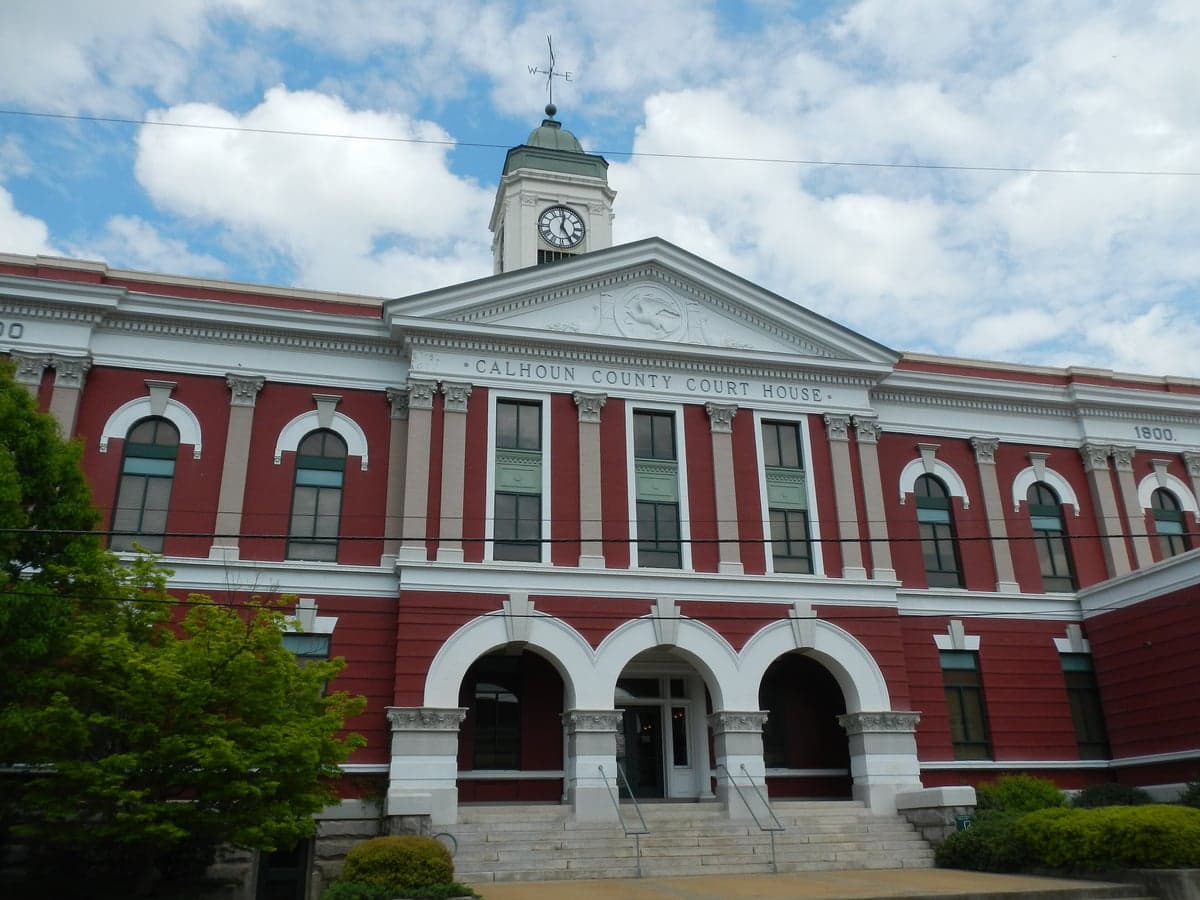
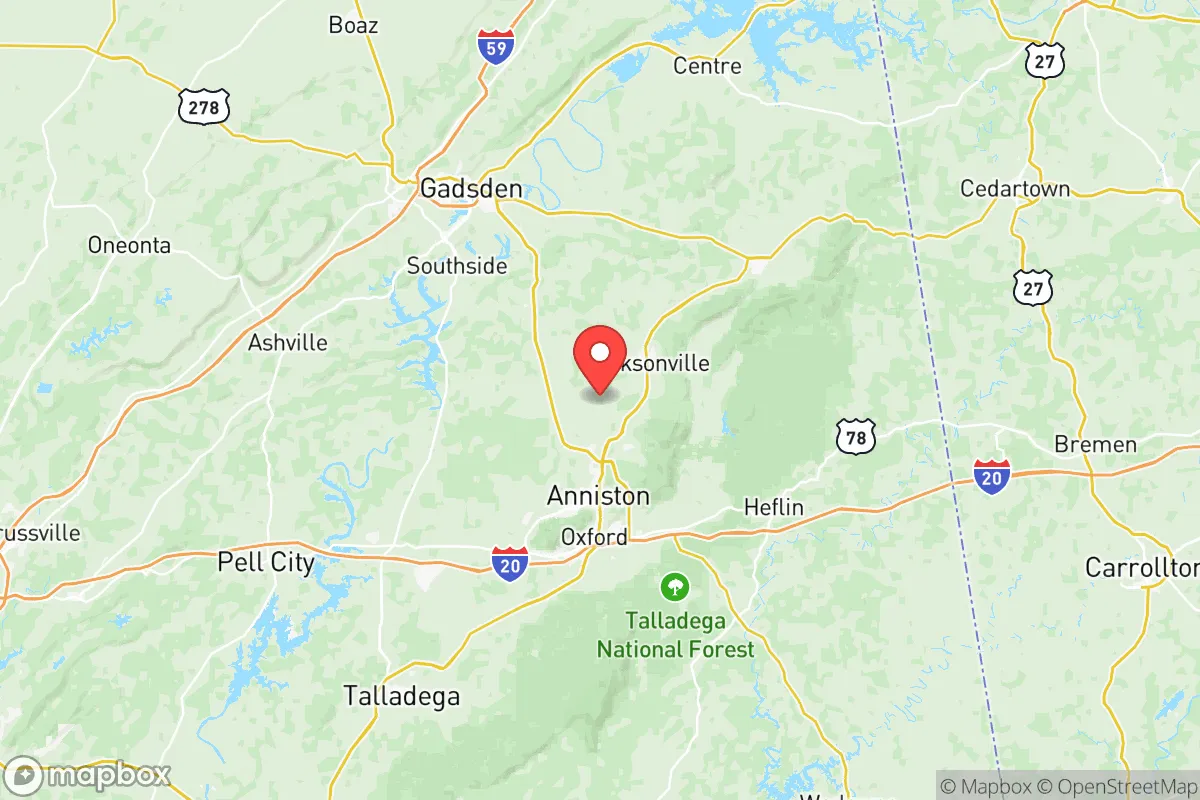
Photo: Wikipedia
Political ClimatePolitical Climate in Calhoun County
Showing district-level results — no local-only data available.
Local Political AnalysisPolitical Analysis of Calhoun County
Calhoun County, Alabama, is a reliably Republican stronghold with a Cook Partisan Voting Index (PVI) of R+23, meaning it votes about 23 points more Republican than the national average. This isn't a recent shift; the county has been consistently red for decades, though the margin has widened noticeably since the early 2000s. While the state of Alabama as a whole is also deeply conservative, Calhoun County sits slightly to the right of the state's average, making it one of the more solidly Republican counties in the eastern part of the state.
How it compares
Alabama's statewide PVI is not officially calculated in the same way, but it's widely considered to be around R+15 to R+16. That puts Calhoun County roughly 7-8 points more Republican than the state as a whole. To put that in perspective, the county is about as red as the most conservative parts of the state, like Blount County or Cullman County. The difference isn't huge, but it's meaningful. For example, in the 2020 presidential election, Donald Trump carried Calhoun County with about 72% of the vote, while he won Alabama with roughly 62%. That 10-point gap is consistent with the PVI difference. Within the county, there's some variation. The city of Anniston, the county seat, is the most Democratic-leaning area, with precincts near the city center and around the historically Black neighborhoods often voting blue. Oxford and Jacksonville are more moderate, with Jacksonville's college population occasionally producing closer races. The rural areas, particularly around Piedmont and Weaver, are the most deeply red, often voting 80% or more Republican.
What this means for residents
For conservative residents, Calhoun County is a comfortable place politically. Local elections are almost always decided in the Republican primary, and the general election is a formality. The county commission, school board, and most city councils are dominated by Republicans. Policy debates tend to center on fiscal conservatism, limited government, and traditional social values. For liberal residents, the reality is different. They are a clear minority, and their influence is largely confined to Anniston's city limits. There is no organized progressive political machine, and Democratic candidates rarely invest resources here. However, this doesn't mean liberals are silenced. The area has a long history of civil rights activism, and there are active local chapters of organizations like the NAACP. Socially, most people get along fine regardless of politics, but the political climate can feel isolating for those on the left. The key is that the county's lean is stable and deeply ingrained, so neither side expects a dramatic shift anytime soon.
Culturally, Calhoun County's politics are intertwined with its identity as a former industrial and military hub. The presence of the Anniston Army Depot and the now-closed Fort McClellan has fostered a strong pro-military, patriotic ethos. There's also a noticeable strain of populism, particularly in the rural areas, that is skeptical of both national parties but reliably votes Republican. A unique local distinction is the county's long-standing resistance to alcohol sales in certain areas, a remnant of its dry-county past that still sparks occasional local referendums. This isn't a place of political experimentation; it's a place where the political culture is stable, predictable, and deeply rooted in the broader conservative traditions of the Deep South.

State Political ClimatePolitical Climate in Alabama
State Political AnalysisPolitical Environment in the State
Alabama is one of the most reliably Republican states in the country, with a deep-red partisan lean that has only solidified over the past two decades. In the 2024 presidential election, Donald Trump carried the state by roughly 30 points, a margin that has held steady since 2016. The dominant coalition is a mix of rural white voters, evangelical Christians, and a growing conservative suburban base, while the Democratic Party’s strength is almost entirely concentrated in the Black Belt and a handful of urban centers like Birmingham, Montgomery, and Mobile. Over the last 10-20 years, the state has shifted rightward on cultural and economic issues, even as national trends have pulled other Southern states like Georgia and North Carolina toward competitiveness.
Urban vs. rural divide
The political map of Alabama is starkly divided between its rural expanses and its few urban islands. Jefferson County, home to Birmingham, is the state’s most populous county and consistently votes Democratic, delivering about 60% of its vote to Joe Biden in 2020. Montgomery County, anchored by the state capital, and Mobile County along the Gulf Coast also lean blue, though Mobile is more competitive. Meanwhile, the vast rural counties in the northern part of the state—places like DeKalb, Marshall, and Jackson—vote Republican by margins of 70% or more. The Black Belt, a crescent of counties stretching from the Mississippi border to the Georgia line, is a unique political zone: heavily African American, deeply impoverished, and overwhelmingly Democratic. Greene County, for instance, gave Biden over 80% of its vote in 2020. Suburbs like Hoover and Vestavia Hills, just south of Birmingham, are reliably Republican but have seen slight shifts toward the center as educated professionals move in. The fastest-growing parts of the state, such as Baldwin County (Gulf Shores) and Madison County (Huntsville), are solidly red, driven by retirees and aerospace workers.
Policy environment
Alabama’s policy environment is shaped by a low-tax, low-regulation philosophy that appeals to conservatives. The state has no personal income tax on wages for most residents—only a flat 5% rate on taxable income—and property taxes are among the lowest in the nation, averaging about 0.4% of home value. Sales taxes, however, are high, with state and local rates often exceeding 10% in cities like Birmingham and Montgomery. The regulatory posture is business-friendly, with right-to-work laws and minimal zoning restrictions outside major metros. Education policy is a mixed bag: the state has a school choice program (the Alabama Accountability Act) that provides tax credits for private school tuition, but public school funding remains low, ranking near the bottom nationally. Healthcare is a persistent challenge—Alabama did not expand Medicaid under the Affordable Care Act, leaving roughly 200,000 low-income adults without coverage. Election laws are among the most restrictive in the country: voter ID is required, early voting is limited to absentee ballots only, and the state has no same-day registration. The state also has a near-total abortion ban, the Human Life Protection Act of 2019, which prohibits the procedure at all stages with no exceptions for rape or incest.
Recent policy direction
Over the past five years, Alabama has moved aggressively to expand gun rights, restrict abortion, and limit LGBTQ+ protections. In 2022, the state passed permitless carry (HB 272), allowing anyone over 21 to carry a concealed firearm without a license. The same year, the legislature passed the Alabama Vulnerable Child Protection Act, which bans gender-affirming care for minors and prohibits discussion of sexual orientation or gender identity in public schools (modeled after Florida’s “Don’t Say Gay” law). On education, the state created the Alabama School Choice and Student Opportunity Act in 2024, expanding Education Savings Accounts (ESAs) to all families, a major win for school choice advocates. Property rights were strengthened with the passage of a constitutional amendment in 2022 that prohibits the state from taking private property for economic development purposes. On taxation, the state has gradually reduced its grocery tax, cutting it from 4% to 2% in 2023, with a goal of full elimination by 2025. Voting access has tightened: in 2021, the legislature passed SB 1, which criminalizes curbside voting and limits absentee ballot drop boxes. Medical marijuana was legalized in 2021 (Darren Wesley ‘Ato’ Hall Compassion Act), but the program has been slow to launch, with dispensaries not expected until 2025. Recreational marijuana remains illegal, and the state has some of the harshest drug sentencing laws in the country.
Civil unrest & political movements
Alabama has a history of civil rights activism that continues to shape its politics, but large-scale protests are rare compared to other states. The most visible flashpoints in recent years have been around abortion and LGBTQ+ rights. In 2019, after the passage of the near-total abortion ban, there were small but persistent protests outside the Alabama State Capitol in Montgomery, organized by groups like the Yellowhammer Fund and the ACLU of Alabama. Immigration politics are less heated than in border states, but there have been localized tensions in towns like Albertville and Russellville, where poultry processing plants employ large numbers of Latino immigrants. The state has no sanctuary cities, and a 2011 law (HB 56) remains on the books, though parts of it have been struck down by courts. Election integrity controversies flared after 2020, with some Republican county officials pushing for hand-count audits, but no major fraud was found. The most organized political movements are on the right: the Alabama Citizens for Life network is deeply active, and the Alabama Policy Institute, a conservative think tank, drives much of the school choice and tax reform agenda. On the left, the Alabama Poor People’s Campaign and the Alabama Coalition for Immigrant Justice are active but have limited influence in the legislature.
Projection
Over the next 5-10 years, Alabama is likely to remain deeply Republican, but demographic shifts could introduce subtle changes. The Huntsville metro area, driven by the booming aerospace and defense sector, is growing fast and attracting younger, more educated workers who tend to be slightly more moderate on social issues. Baldwin County, along the Gulf Coast, is also growing rapidly, drawing retirees from the Midwest and Northeast who are fiscally conservative but may be less culturally rigid. The Black Belt, meanwhile, continues to lose population, which weakens the Democratic base. In-migration from other states is modest but increasing, and most newcomers are moving for jobs in tech, manufacturing, or healthcare, not for political reasons. The biggest wildcard is the state’s education system: if the ESA program leads to a noticeable improvement in outcomes, it could cement conservative governance for a generation; if not, pressure for more public school funding could grow. On social issues, the state is unlikely to moderate—the abortion ban and transgender restrictions are popular with the Republican base, and any move to loosen them would face a primary challenge. A new resident moving in now should expect a state where conservative values dominate policy, but where local politics in Birmingham, Huntsville, and Mobile offer pockets of progressive influence.
For a new resident, the bottom line is this: Alabama is a state where your political views will largely align with the majority if you lean conservative, especially on taxes, guns, and social issues. If you lean liberal, you’ll find community in Birmingham, Montgomery, or Huntsville, but you’ll be voting in a state where your vote has little impact on statewide elections. The practical takeaway is that your daily life will be shaped by low taxes and limited government services—good roads in some areas, poor schools in others, and a healthcare system that leaves many without coverage. It’s a place where you can live cheaply and freely, but where the political climate is unlikely to change much in the next decade.
* Values derived from national, state, county, city and local statistics and may differ in a specific area. Last updated: 2026-10-14T23:47:16.000Z
Narrative content on this page is AI-generated and may contain mistakes. Verify any details that matter before acting on them.
ReloMaps may earn a commission from affiliate links at no extra cost to you.

