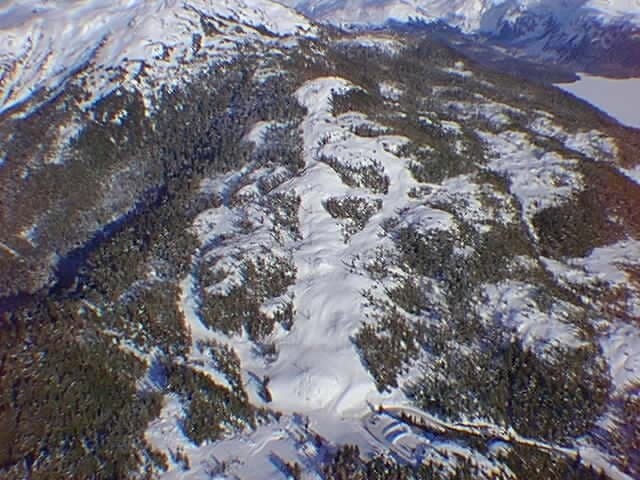
Photo: Wikipedia
Personal Sovereignty in Chugach County
Viable for self-reliance. Generally workable, though some barriers may limit total independence.
What does Personal Sovereignty tell us?
Personal Sovereignty measures your capacity for self-reliance and independence with minimal government friction. Higher scores mean fewer barriers between you and the way you want to live... but it assumes you have the space you need and good neighbors.
What does this tell us?
Personal Sovereignty measures your capacity for self-reliance and independence with minimal government friction. Higher scores mean fewer barriers between you and the way you want to live... but it assumes you have the space you need and good neighbors.
State Policy
Energy independence: Net exporter (350% of energy produced in-state)
Personal Liberty
Homesteading

Personal Liberty Analysis
Chugach County, Alaska, offers one of the most uncompromising personal sovereignty environments in the United States, but it demands a clear-eyed understanding of its unique trade-offs. While the state constitution explicitly protects individual privacy and the right to keep and bear arms, the county’s geography and sparse population create a de facto autonomy that few Lower 48 jurisdictions can match. However, this freedom is not uniform—the regulatory posture shifts dramatically between the coastal hub of Cordova, the remote interior of Valdez, and the roadless communities of Whittier and Chenega Bay. For the survivalist or prepper, the key question isn’t whether Chugach County respects personal sovereignty, but whether you can handle the logistical reality of exercising it.
Tax burden and regulatory posture in Chugach County
Alaska’s absence of state income tax and sales tax is well-known, but Chugach County adds its own layer of fiscal freedom. The borough levies no personal property tax, and real estate taxes are among the lowest in the nation—typically under 1% of assessed value, with many rural parcels assessed at near-zero due to lack of access. This means your earnings, investments, and gear are largely untouchable by local government. However, the regulatory posture is not laissez-faire across the board. Valdez, the county seat, enforces stricter building codes and environmental permitting due to its oil terminal and tsunami risk zones. In contrast, Cordova and Whittier operate with minimal zoning enforcement, though both face federal overlay from the U.S. Forest Service (Chugach National Forest covers 80% of the borough). For the prepper, the takeaway is clear: the tax burden is negligible, but federal land-use restrictions can complicate off-grid construction. The borough government itself is small and non-intrusive—its annual budget is under $20 million for a land area larger than Massachusetts—meaning most regulatory friction comes from state fish and game rules, not local ordinances.
Self-defense and gun law specifics in Chugach County
Alaska’s constitutional carry law, effective since 2003, means no permit is required to openly or concealed carry a firearm in Chugach County. The state also preempts local gun ordinances, so Valdez, Cordova, and Whittier cannot impose their own restrictions. This is a stark contrast to the Lower 48, where even conservative counties often have municipal gun-free zones. Chenega Bay, accessible only by boat or plane, has no local law enforcement presence—the Alaska State Troopers cover the area from a detachment in Cordova, with response times measured in hours. For the survivalist, this means self-defense is entirely your responsibility. Magazine capacity, firearm types, and ammunition are unregulated at the state level. However, bear defense is the practical priority: .44 Magnum revolvers and 12-gauge slug guns are common in every household, and the county’s bear density (estimated at 1 per 2 square miles in coastal areas) makes firearm proficiency a survival necessity, not a political statement. The only notable restriction is that felons and those adjudicated mentally incompetent cannot possess firearms, but enforcement is minimal outside of Cordova’s small police force.
Self-reliance and homesteading viability in Chugach County
Homesteading in Chugach County is viable but brutally conditional. The borough offers no zoning in unincorporated areas, meaning you can build a cabin, dig a well, and set up solar panels without permits—provided you own the land outright. Valdez has the most restrictive lot sizes (minimum 5 acres in rural zones) and requires septic system approval, but Cordova and Whittier have no minimum lot size for raw land. Off-grid feasibility is high: average annual solar insolation is low (3.5 kWh/m²/day), but micro-hydro from the countless streams is reliable. Chenega Bay and Tatitlek are entirely off-grid, relying on diesel generators and solar hybrids. The catch is access: Whittier is only reachable via a single-lane tunnel (closed nightly) or ferry, and Cordova has no road connection to the rest of Alaska. For the prepper, this isolation is a feature, not a bug—it creates a natural buffer against government overreach. But it also means every nail, gallon of fuel, and medical supply must be barged or flown in, at costs 2-3x Lower 48 prices. The borough’s property tax exemption for owner-occupied primary residences (up to $150,000 assessed value) further incentivizes self-built homes. Realistically, homesteading here is for those who can afford a $50,000 initial investment in a skiff, chainsaw, and solar array, and who accept that a medical emergency may require a medevac flight costing $10,000+.
Personal liberties in Chugach County: parental rights, medical autonomy, speech, and property
Parental rights in Chugach County are robust by national standards. Alaska law requires parental consent for minors’ medical procedures, and the borough’s school district (covering Valdez, Cordova, and Whittier) has no mask mandates or vaccine requirements beyond state law. Homeschooling is common—roughly 15% of school-age children in the county are homeschooled, per 2024 data—and the borough offers a correspondence program that provides $2,000 per student in annual materials funding. Medical autonomy is similarly strong: Alaska has no state-level vaccine passport, and the borough has never enacted a public health order beyond federal CDC guidelines during COVID-19. Valdez’s city council voted 5-2 against a mask mandate in 2021, reflecting the local ethos. Free speech is protected under the Alaska Constitution’s Article I, Section 5, which explicitly guarantees the right to “speak, write, and publish freely on all subjects.” Property rights are the crown jewel: the borough has no eminent domain authority beyond state-defined transportation projects, and the Alaska Land Act prohibits the state from taking private property for economic development. For the survivalist, this means your land, your medical choices, and your children’s education are genuinely yours—but the trade-off is that the county provides minimal services. There is no county-wide fire department, no public transit, and the only hospital is in Valdez (a 25-bed critical access facility).
Overall, Chugach County represents a sovereignty frontier that few other U.S. jurisdictions can match, but it is not a libertarian paradise—it is a high-cost, high-risk environment where freedom is earned through self-sufficiency. Compared to the regulatory density of Anchorage or the tax burden of the Lower 48, the borough offers near-total autonomy in taxation, self-defense, and lifestyle choices. However, the federal presence (Chugach National Forest, U.S. Coast Guard in Cordova, and the Trans-Alaska Pipeline in Valdez) means that true independence requires navigating multiple layers of jurisdiction. For the prepper who values personal sovereignty above convenience and who has the capital to absorb the logistical costs, Chugach County is arguably the best option in North America. For anyone expecting a low-effort escape from government overreach, the reality of 300 inches of annual snowfall in Valdez and $8/gallon gasoline in Whittier will quickly disabuse them of romantic notions. The freedom is real—but so is the price.

* Values derived from national, state, county, city and local statistics and may differ in a specific area. Last updated: 2026-05-12T10:29:30.000Z
Narrative content on this page is AI-generated and may contain mistakes. Verify any details that matter before acting on them.
ReloMaps may earn a commission from affiliate links at no extra cost to you.

