 Popular
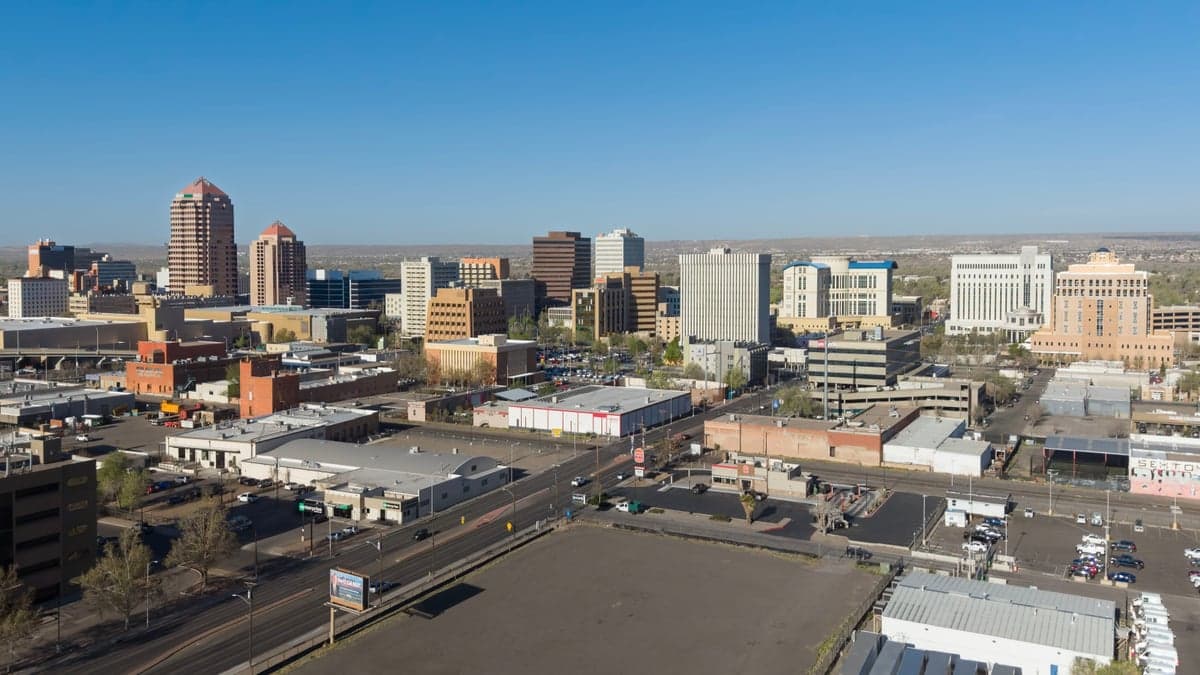
Photo: Wikipedia
Demographics of Albuquerque, NM
Affluence Level in Albuquerque, NM
A middle-class area roughly in line with national averages across income, home values, education, and employment.
People of Albuquerque, NM
Albuquerque’s 562,488 residents form a majority-minority city where Hispanic and Native American heritage is deeply woven into daily life, yet the population is notably less diverse than many Sun Belt peers. The city is 47.9% Hispanic, 38.0% white, 2.8% Black, 2.5% East/Southeast Asian, and 0.6% Indian (subcontinent), with only 5.2% foreign-born — a low share that reflects a population shaped more by domestic migration and generational roots than by recent international arrivals. With 38.7% holding a college degree, Albuquerque sits near the national average for educational attainment, but its identity is defined by a unique blend of centuries-old Hispanic and Puebloan heritage, a mid-century federal workforce, and a growing but modest professional class.
How the city was settled and grew
Albuquerque was founded in 1706 as a Spanish colonial farming and trading outpost, drawing settlers from Mexico under land grants that established the Old Town plaza as the original population center. These early Hispanic families — many still present today — built the irrigation systems (acequias) and adobe structures that define the historic core. After the U.S. takeover in 1848, Anglo-American merchants and ranchers arrived, clustering in the Railroad District after the Atchison, Topeka and Santa Fe Railway reached the city in 1880, transforming Albuquerque into a commercial hub. The 20th century brought two major waves: first, tuberculosis patients and health-seekers in the 1910s-1930s, who settled in the Nob Hill and University Heights areas near the new sanatoriums; second, a massive federal influx during World War II, when Kirtland Air Force Base and Sandia National Laboratories drew engineers, scientists, and military personnel — many white and college-educated — to the Northeast Heights and Sandia Park foothills. By 1960, Albuquerque’s population had exploded from 35,000 in 1940 to over 200,000, with the Anglo and Hispanic populations roughly equal in size.
Modern era (post-1965)
The post-1965 period saw Albuquerque’s Hispanic share rise steadily as Anglo in-migration slowed and the native-born Hispanic population grew through higher birth rates. The 1970s and 1980s brought a wave of Vietnamese refugees — part of the city’s small but established East/Southeast Asian community — who concentrated in the International District (formerly the War Zone) along Central Avenue, where they opened restaurants and markets. Meanwhile, the South Valley remained overwhelmingly Hispanic, a working-class area of old land-grant families and newer Mexican immigrants. The city’s Black population, never large, settled primarily in the International District and parts of the South Broadway neighborhood, drawn by affordable housing and proximity to Kirtland jobs. The Indian (subcontinent) community, at just 0.6%, is small but visible in the tech and healthcare sectors, with no single dominant neighborhood. The foreign-born share — only 5.2% — is low compared to the national average of 13.7%, reflecting Albuquerque’s limited role as an immigrant gateway; most growth has come from domestic migration from other parts of New Mexico and the Southwest.
The future
Albuquerque’s population is slowly homogenizing into distinct ethnic enclaves rather than blending into a single melting pot. The Hispanic share is projected to continue rising, potentially reaching 55-60% by 2040, driven by higher birth rates and continued domestic in-migration from rural New Mexico and Texas. The white share is declining as older Anglo residents age out and younger white professionals choose other Sun Belt cities. The East/Southeast Asian and Indian communities are growing modestly, fueled by tech and university hiring, but remain small and unlikely to shift the overall demographic balance. The city is not tribalizing in a conflictual sense, but residential patterns are hardening: the Northeast Heights and far North Valley remain predominantly white and affluent, the South Valley and West Side are heavily Hispanic, and the International District is the most ethnically mixed area. For a conservative-leaning newcomer, this means moving into a city where Hispanic cultural and political influence is dominant and growing, where the foreign-born population is minimal, and where the most stable, low-crime neighborhoods are the predominantly white, higher-income areas like the Northeast Heights and North Albuquerque Acres.
Albuquerque is becoming a more Hispanic city with a stable, modestly educated workforce, a small but growing Asian and Indian professional class, and a shrinking white population. For someone moving in now, the city offers a low cost of living and strong outdoor amenities, but the demographic trajectory points toward a future where Hispanic cultural norms and Spanish-language presence will be increasingly central to everyday life, while the Anglo professional class consolidates in a few affluent enclaves.

* Values derived from national, state, county, city and local statistics and may differ in a specific area. Last updated: 2026-04-14T21:50:20.000Z
Narrative content on this page is AI-generated and may contain mistakes. Verify any details that matter before acting on them.
ReloMaps may earn a commission from affiliate links at no extra cost to you.

