Photo: Wikipedia
Demographics of Alexandria, LA
Affluence Level in Alexandria, LA
A low-income area with significant economic hardship. Household wealth and educational attainment are well below national averages.
People of Alexandria, LA
The people of Alexandria, Louisiana, today form a majority-Black city of 44,566 residents, characterized by a deep-rooted sense of place and a slower pace of life than the state’s larger metros. With a foreign-born population of just 2.6%, the city is overwhelmingly native-born, and its identity is shaped by a history of plantation-era settlement, post-Reconstruction migration, and mid-century suburbanization. Distinctive markers include a strong church-going culture, a reliance on regional healthcare and manufacturing employment, and a population that is notably less transient than in many other Southern cities of similar size.
How the city was settled and grew
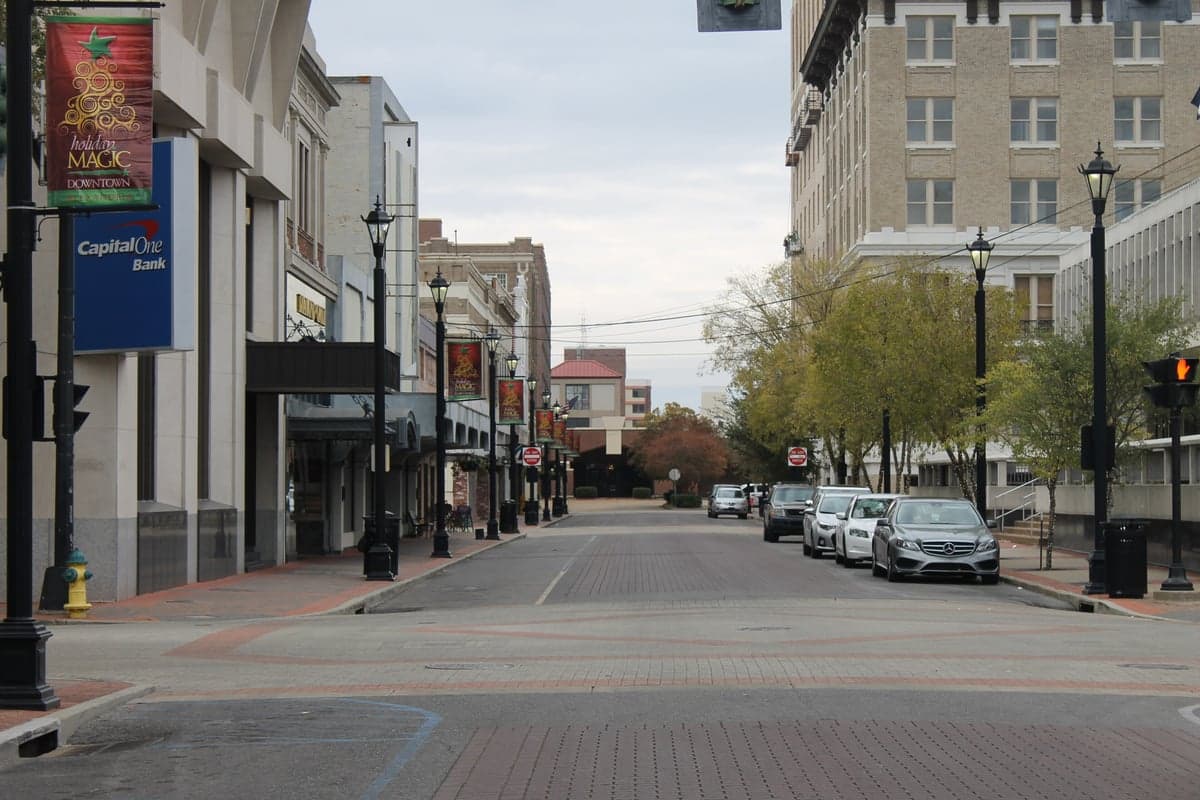
Alexandria was founded in 1818 on the Red River as a trading post and river port, drawing its earliest white settlers from the Upper South—primarily Virginia, Tennessee, and the Carolinas—who came for cotton and timber land. The city’s original core, now known as Downtown Alexandria, was built by these Anglo-American planters and merchants, who established the grid of streets and the riverfront warehouses that still define the area. Enslaved Black laborers, who made up the majority of the region’s population by 1860, worked the surrounding cotton plantations and lived in quarters that later evolved into neighborhoods like Eden Park and Brame, areas that remain predominantly Black today. After the Civil War, freedmen moved into the city, establishing churches, schools, and small businesses in what became the Garden District, a historically Black neighborhood near the river. The arrival of the railroad in the 1880s spurred a second wave of white migration from the Midwest and Northeast, drawn by the timber boom, and these workers settled in the Jackson Street corridor and the newly platted Southern Avenue district. By 1900, Alexandria’s population had reached roughly 10,000, with a clear racial geography: whites in the northern and western blocks, Blacks in the southern and eastern sections.
Modern era (post-1965)
The post-1965 era brought profound demographic change. The Immigration and Nationality Act of 1965 had little direct effect on Alexandria—the city’s foreign-born share remains tiny—but domestic migration reshaped the city. The Great Migration of Black Americans from the rural Deep South into Alexandria accelerated through the 1970s, as agricultural mechanization pushed sharecroppers off the land. These new arrivals concentrated in the Eden Park and Brame neighborhoods, swelling the Black population from 35% in 1960 to over 50% by 1990. Meanwhile, white residents began a steady suburban exodus to Pineville (across the Red River) and the Bayou Rapides area, a pattern of white flight that accelerated after school desegregation orders in the 1970s. By 2020, the city’s white share had fallen to 36.1%, while the Black share rose to 55.8%. The Hispanic population, at 3.2%, is a small but growing presence, concentrated in the Jackson Street area and in newer apartment complexes near the England Airpark, drawn by construction and service jobs. East and Southeast Asian residents (1.2%) and Indian-subcontinent residents (0.8%) are a thin but stable presence, mostly professionals employed at the Rapides Regional Medical Center and Christus St. Frances Cabrini Hospital, living in the Southern Avenue and Bayou Rapides neighborhoods.
The future
The population of Alexandria is likely to continue its slow decline—the city has lost roughly 8% of its residents since 2010—driven by out-migration of young adults and a low birth rate among the white population. The Black population is aging in place, with younger Black residents moving to Baton Rouge or Houston for better job prospects. The Hispanic share is expected to grow modestly, perhaps reaching 5-6% by 2040, as new arrivals fill gaps in construction, hospitality, and agriculture. The East/Southeast Asian and Indian communities are likely to remain small and professional, tied to the healthcare sectorched. The city is not tribalizing into distinct new enclaves so much as consolidating: the Eden Park and Brame neighborhoods will remain heavily Black, while the Bayou Rapides area will stay predominantly white and middle-class. The Downtown area, after decades of decline, is seeing modest reinvestment in loft apartments and a new riverfront park, but it has not yet attracted significant residential diversity.
For someone moving in now, Alexandria is a city where the past is still very present. The racial geography established in the 19th and 20th centuries remains largely intact, and the population is more stable than dynamic. Newcomers will find a community that values tradition, church, and family, but one that offers limited economic mobility and little ethnic diversity. It is a place for those seeking a quiet, affordable, and predictable life in a deeply Southern setting.

* Values derived from national, state, county, city and local statistics and may differ in a specific area. Last updated: 2026-04-23T05:01:39.000Z
Narrative content on this page is AI-generated and may contain mistakes. Verify any details that matter before acting on them.
ReloMaps may earn a commission from affiliate links at no extra cost to you.

