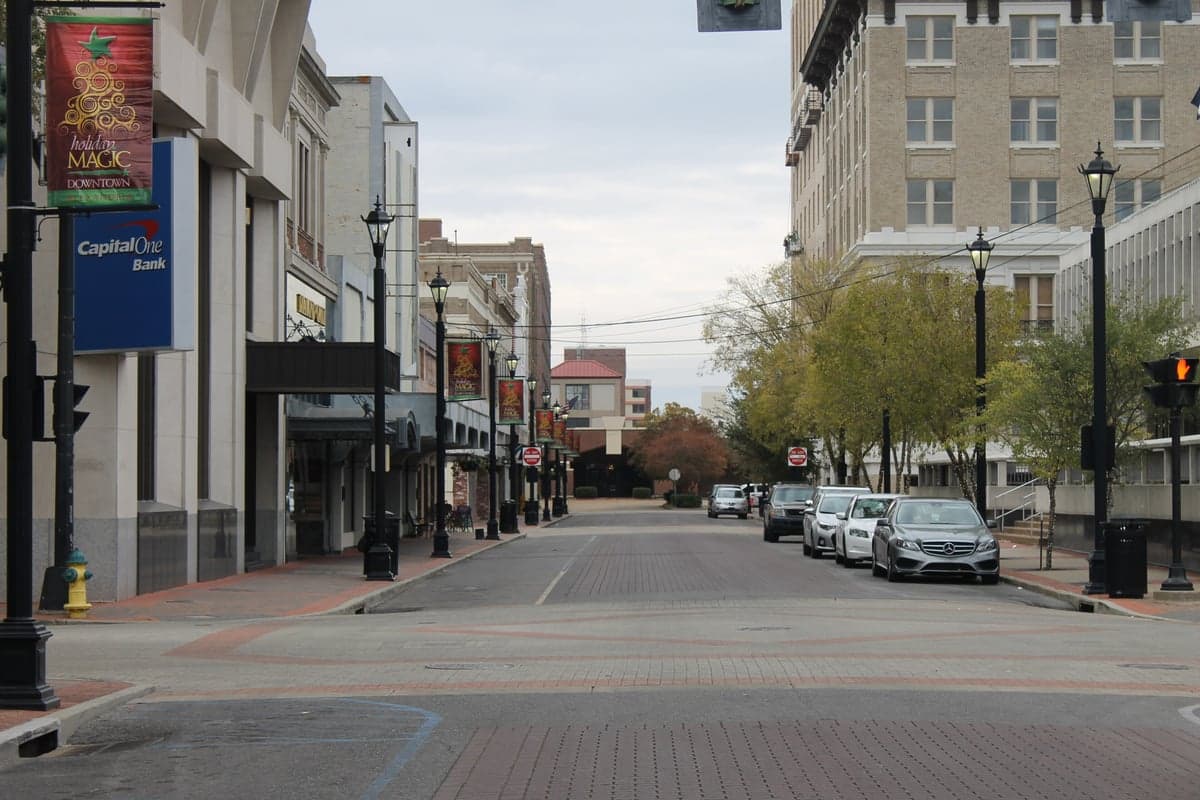
Photo: Wikipedia
Strategic Assessment of Alexandria, LA
Meaningful friction. Expect exposure to either population pressure, blast zones, or natural disaster risk. Consider buying a retreat property.
What does the Strategic Assessment tell us?
Our Strategic Assessment grades tactical survivability of an area. Major population centers, military targets, fallout zones, natural disasters, and border exposure all drive risk — lower exposure means a more defensible position in a crisis.
This is heavily inspired by Joel Skousen's Strategic Relocation book. Highly recommended you checkout the book ($)What does this tell us?
Our Strategic Assessment grades tactical survivability of an area. Major population centers, military targets, fallout zones, natural disasters, and border exposure all drive risk — lower exposure means a more defensible position in a crisis.
This is heavily inspired by Joel Skousen's Strategic Relocation book. Highly recommended you checkout the book ($)Strategic Pillars

Key Distances
Regional Safe Places
Below is our recommended "safe zones" in Louisiana and the surrounding area based on our strategic heuristics. For most people, it's unrealistic to live in a “safe zone” full-time due to work, family or other personal reasons. They tend to be more rural. However, many of these areas are perfect for second homes and retreat properties that double as a vacation home or even a short-term rental.

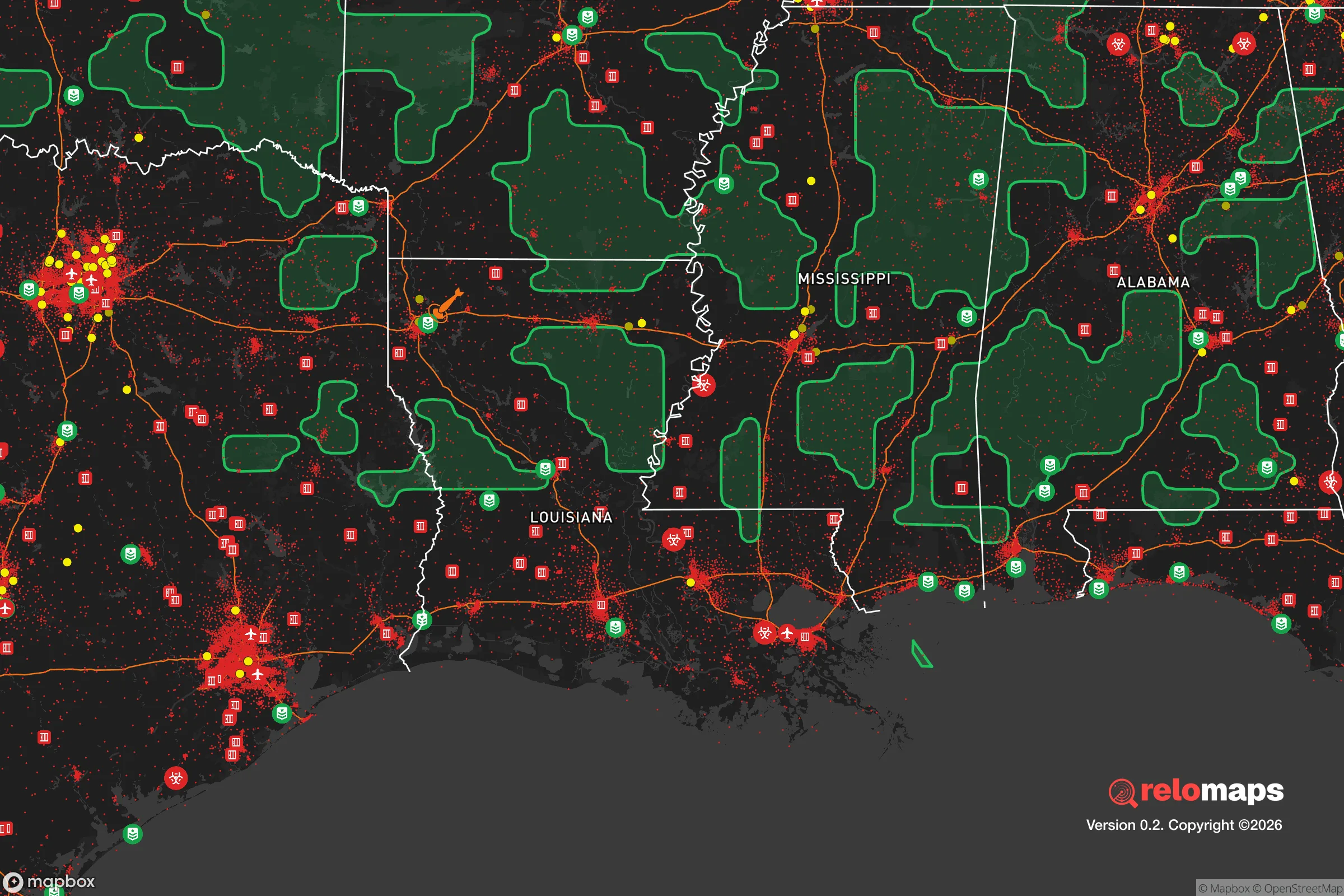


Important Note: For informational purposes only. This does not mean nothing bad ever happens in the green zones. Please use common sense. This is based on public data and modeled with AI. We tried to take a conservative approach but mistakes happen. We update this regularly as new information becomes available.
Solar Generator Recommendations
Backup power matters more here than in safer locations. We've picked three solar generators across budgets and capacity tiers — start with the budget unit if you only need a few essentials, or step up if you want to run a fridge and HVAC for days at a time.

Jackery Portable Power Station Explorer 300
Budget OptionPower on the Go: Weighing only 11 lbs, it's convenient to set up and store with book-sized foldable solar panels

BLUETTI Portable Power Station AC180
Designed for both indoor and outdoor scenarios, AC180 is highly capable as it has a robost capacity and continuous output power.

EF ECOFLOW DELTA Pro Ultra Power Station
Upgraded PickEcoFlow DELTA Pro Ultra is a whole-home energy system designed to grow with your family. Integrated with the Smart Home Panel 2, it scales to meet your evolving energy needs — keeping your home powered, intelligent, and secure through every stage of life.
We earn a commission, at no additional cost to you.
Strategic Assessment Analysis
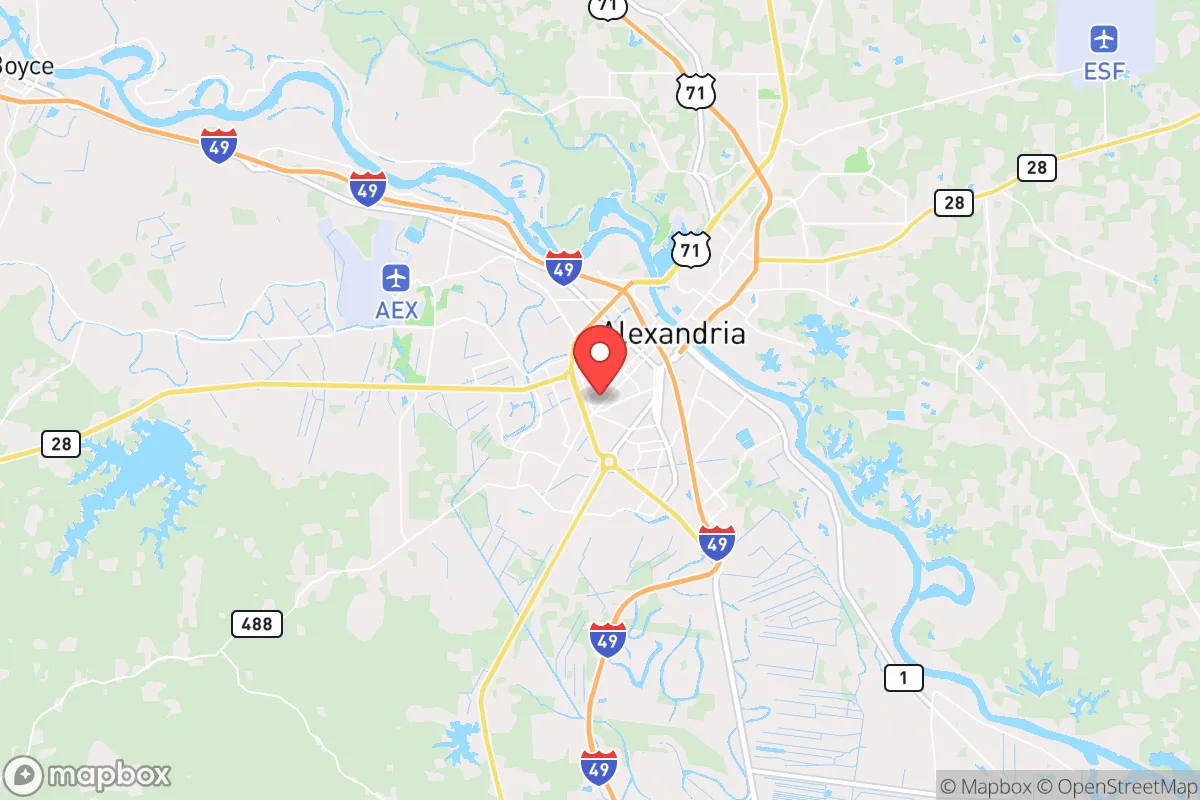
Alexandria, Louisiana, sits at a strategic crossroads in central Louisiana, offering a blend of geographic isolation and logistical access that appeals to those prioritizing resilience and self-sufficiency. Its position roughly 100 miles from the Gulf Coast and 150 miles from major urban centers like Baton Rouge and Shreveport provides a buffer against coastal storm surges and the immediate fallout of urban unrest, while still allowing for supply runs or evacuation if necessary. The area’s low population density—around 47,000 in the city proper and 130,000 in Rapides Parish—means fewer targets for large-scale disruption, and the local economy’s reliance on agriculture, timber, and the military (via Fort Johnson, formerly Fort Polk) gives it a practical, no-nonsense character that aligns with a prepper mindset. For a conservative audience concerned with national instability, Alexandria offers a solid base camp, not a fortress, but a place where you can dig in without being in the crosshairs of a major metropolitan collapse.
Geographic position and natural advantages for long-term security
Alexandria’s location on the Red River and at the intersection of Interstates 49 and 167 gives it a dual advantage: it’s connected enough to move goods and people, but far enough from the I-10 corridor and the chaos of Houston, New Orleans, or Dallas to avoid being a primary evacuation route or target. The surrounding landscape—piney woods, bayous, and farmland—offers ample opportunities for off-grid living, with plenty of undeveloped land within a 30-minute drive where you could set up a homestead or bug-out location without drawing attention. The Red River itself is a reliable water source, though you’ll need filtration or treatment given agricultural runoff and industrial activity upstream. The climate is humid subtropical, with hot summers and mild winters, meaning you can grow food year-round in a well-managed garden, and the region’s long growing season (roughly 250 days) supports staple crops like corn, beans, and squash. The area’s natural barriers—swamps and dense forests to the south and east—slow down any large-scale movement, making it harder for a displaced urban population to flood in during a crisis. That said, the flat terrain offers little in the way of natural defensive positions, so you’d rely more on distance and obscurity than on hills or chokepoints.
Risks, exposures, and proximity to fallout-relevant landmarks
Alexandria’s biggest vulnerability is its proximity to the Louisiana Chemical Corridor, often called “Cancer Alley,” which runs along the Mississippi River between Baton Rouge and New Orleans, about 100 miles to the southeast. A major industrial accident, terrorist attack, or natural disaster at one of the dozens of refineries and chemical plants there could release toxic clouds or trigger cascading failures that drift inland, potentially affecting air quality and water supplies in central Louisiana. The city itself sits near the England Airpark (a former Air Force base now used for industrial and aviation purposes), which could be a secondary target in a conflict scenario, though it’s not a major military hub like Fort Johnson, which is about 60 miles southwest. Fort Johnson’s presence is a double-edged sword: it brings economic stability and a population with military skills, but it also makes the region a potential staging area for federal responses to unrest, which could draw unwanted attention or restrict movement during a declared emergency. Hurricane risk is moderate—Alexandria is far enough inland to avoid storm surge, but heavy rain and wind from a major storm like 2020’s Hurricane Laura can knock out power for days, as seen in 2020 when over 100,000 in the region lost electricity. Tornadoes are a seasonal threat, with the area sitting in Dixie Alley, and the flat terrain offers little warning or cover. For a prepper, the key takeaway is that Alexandria avoids the worst of coastal and urban risks, but you’re still within a few hours’ drive of major failure points, so a solid bug-out plan and at least two weeks of supplies are non-negotiable.
Practical resilience for a relocator: food, water, energy, and defensibility
When it comes to daily survival logistics, Alexandria offers a mixed bag. The local water supply comes from the Red River and groundwater wells, treated by the city’s water system, but a prolonged power outage or contamination event would require backup. Many rural properties in Rapides Parish already rely on private wells, which is a plus for off-grid living, though you’ll need a hand pump or generator to keep them running when the grid goes down. Electricity is provided by Cleco, a regional utility that has a mixed track record during storms—outages can last a week or more after a hurricane, so solar panels with battery storage or a propane generator are wise investments. The area’s abundant timber means firewood is cheap and accessible for heating or cooking, but you’ll need to plan for smoke management and fire safety in a grid-down scenario. Food security is decent: local farmers’ markets and roadside stands offer fresh produce, meat, and eggs, and the region’s hunting culture means deer, wild hog, and turkey are available for those with a license and a rifle. The Alexandria Farmers Market operates year-round, and you can find bulk staples like rice and beans at local grocers or wholesale clubs in town. Defensibility is where Alexandria falls short—the city is spread out, with no natural chokepoints, and the surrounding flatwoods offer little cover for a perimeter. Your best bet is to buy land with a creek or river frontage, set back from main roads, and invest in good fencing, lighting, and a reliable communication system (ham radio is popular among preppers here). The local law enforcement presence is adequate for a city this size, but during a major event, you’d be largely on your own, as the Rapides Parish Sheriff’s Office and Alexandria Police Department would be stretched thin.
Overall, Alexandria presents a viable option for a conservative relocator looking to balance access with isolation, but it’s not a survivalist paradise. The area’s strengths—affordable land, a resilient local economy, and a culture of self-reliance—are tempered by its flat terrain, proximity to industrial hazards, and vulnerability to Gulf storms. For a single individual or a family, the key is to buy property outside the city limits, preferably with a well and septic, and to build a network with like-minded locals through churches, gun clubs, or prepper groups. The region’s political leanings are solidly conservative, with Rapides Parish voting +30 points for Trump in 2020, so you’ll find neighbors who share your concerns about federal overreach and societal decay. But don’t mistake Alexandria for a bunker—it’s a staging ground, a place to wait out the storm while keeping options open for a deeper retreat if things go truly sideways. If you’re serious about resilience, treat it as a base, not a final destination, and you’ll be better off than 90% of the population stuck in the urban kill zones.

* Values derived from national, state, county, city and local statistics and may differ in a specific area. Last updated: 2026-04-23T05:01:39.000Z
Narrative content on this page is AI-generated and may contain mistakes. Verify any details that matter before acting on them.
ReloMaps may earn a commission from affiliate links at no extra cost to you.

