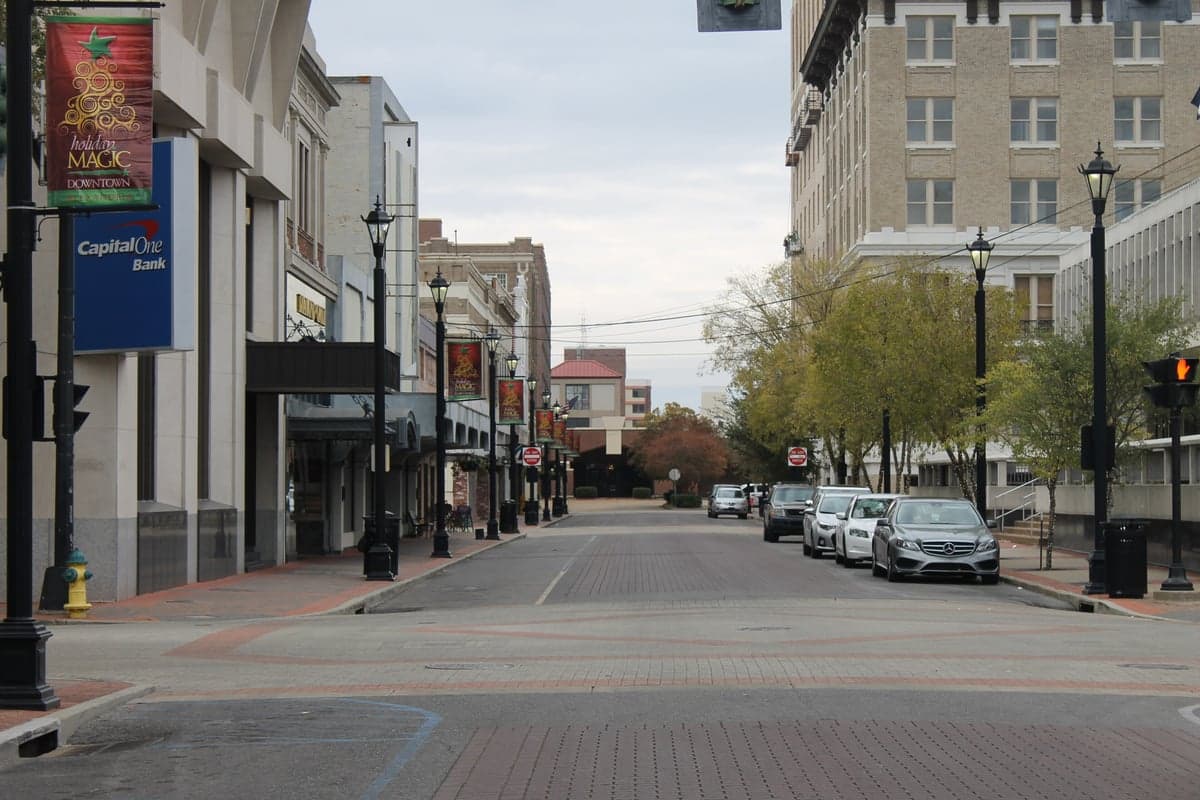
Photo: Wikipedia
Personal Sovereignty in Alexandria, LA
Strong independent fundamentals that actively favor personal liberty and low regulation.
What does Personal Sovereignty tell us?
Personal Sovereignty measures your capacity for self-reliance and independence with minimal government friction. Higher scores mean fewer barriers between you and the way you want to live... but it assumes you have the space you need and good neighbors.
What does this tell us?
Personal Sovereignty measures your capacity for self-reliance and independence with minimal government friction. Higher scores mean fewer barriers between you and the way you want to live... but it assumes you have the space you need and good neighbors.
State Policy
Energy independence: Net exporter (280% of energy produced in-state)
Personal Liberty
Homesteading

Personal Liberty Analysis
Alexandria, Louisiana, offers a notably high degree of personal sovereignty for those seeking to minimize government overreach and maximize self-reliance, particularly when compared to coastal or urban centers. The city sits within a state that has consistently pushed back against federal mandates, from COVID-era restrictions to firearm regulations, creating an environment where individual autonomy is the default rather than the exception. For the survivalist or prepper, this translates into fewer legal hurdles for daily life and a legal framework that generally respects the right to be left alone, though local zoning and parish-level ordinances require careful navigation.
Tax burden and regulatory posture: How Louisiana compares to surrounding states
Louisiana’s tax structure is a mixed bag for the sovereignty-minded. The state has no personal property tax on vehicles or boats, which is a direct win for keeping what you own without annual government fees. However, the combined state and local sales tax rate in Rapides Parish hovers around 9.5% to 10%, one of the highest in the nation, meaning every purchase of gear, supplies, or building materials carries a significant premium. Property taxes are relatively low, with effective rates around 0.5% of assessed value, which keeps the cost of land ownership manageable. The regulatory posture is generally light-touch: there are no state-level building codes in unincorporated areas of Rapides Parish, and occupational licensing requirements are less burdensome than in states like California or New York. This means you can build a workshop, start a small repair business, or modify your property with fewer bureaucratic approvals. The trade-off is that infrastructure—roads, drainage, and emergency services—can be inconsistent, so self-reliance in utilities and transportation is a practical necessity, not just a philosophical choice.
Self-defense and gun law specifics: What the Second Amendment looks like in Alexandria
Louisiana is a constitutional carry state, meaning no permit is required to carry a concealed firearm for anyone legally allowed to possess one. Alexandria sits in a region where gun ownership is the norm, and local law enforcement generally respects the right to self-defense. The state has strong Stand Your Ground and Castle Doctrine laws, with no duty to retreat in any place you have a legal right to be. This is critical for the prepper mindset: your home, vehicle, and property are legally defensible without fear of prosecution for using force to stop a threat. Magazine capacity bans and "assault weapon" restrictions do not exist at the state or local level, so you can own standard-capacity rifles and handguns without arbitrary limits. The only notable restriction is a 10-day waiting period for handgun purchases from a dealer, though private sales between individuals have no such requirement. For those building a defensive arsenal, Alexandria offers one of the most permissive legal environments in the South, with no state-level red flag law as of 2026, though federal prohibitions still apply for certain individuals.
Self-reliance and homesteading viability: Lot sizes, zoning, and off-grid feasibility
For the homesteader or off-grid enthusiast, Alexandria’s surrounding areas—particularly rural Rapides Parish—offer substantial opportunities. Minimum lot sizes in unincorporated areas can be as small as one acre, but many parcels of 5 to 20 acres are available at prices under $3,000 per acre, making land acquisition affordable. Zoning is minimal outside city limits: there are no county-wide restrictions on keeping chickens, goats, or even larger livestock, and no permits are required for rainwater collection systems or solar panel installation. Off-grid living is legally feasible, though you must comply with state health regulations for septic systems (typically a $500–$1,000 permit and inspection). The city of Alexandria itself has more restrictive codes—requiring connection to municipal water and sewer—but the rural fringe within a 15-minute drive is largely unregulated. The climate supports year-round gardening, with a growing season of 240+ days, and the Red River provides ample water access for those with property along its banks. The main challenge is the high humidity and hurricane risk, which demands robust construction and food storage methods, but these are manageable with proper planning.
Personal liberties: Parental rights, medical autonomy, speech, and property
Louisiana has strong parental rights protections, including a law that requires parental consent for most medical procedures on minors and a robust school choice system with vouchers and charter schools. This means parents in Alexandria can opt out of public school curricula they disagree with and direct their children’s education without government interference. Medical autonomy is more nuanced: the state has no vaccine mandate for adults, and COVID-era restrictions were lifted early, but emergency room protocols and insurance mandates still limit some alternative treatments. Free speech is broadly protected, with no state-level hate speech laws or social media censorship mandates, and public protests are common without excessive police presence. Property rights are reinforced by Louisiana’s civil law tradition, which gives landowners strong protections against eminent domain abuse, though the state’s "checkbook" system for mineral rights can complicate subsurface ownership. For the prepper, the key takeaway is that local government in Alexandria is generally hands-off: you can store bulk food, keep a large garden, and maintain a low profile without attracting unwanted attention from code enforcement or social services.
Overall, Alexandria ranks as a strong contender for personal sovereignty relative to other mid-sized Southern cities. It lacks the extreme libertarian lean of rural Idaho or Montana, but it offers a practical balance of low property taxes, permissive gun laws, and minimal zoning that is hard to find in more populated regions. The trade-offs—high sales tax, hurricane risk, and inconsistent infrastructure—are manageable for those willing to invest in self-sufficiency. For the conservative-leaning individual or family looking to escape the overreach of blue-state governance, Alexandria provides a legal and cultural environment where you can live largely on your own terms, with the understanding that the state’s main interference is through the wallet, not through your daily choices.

* Values derived from national, state, county, city and local statistics and may differ in a specific area. Last updated: 2026-04-23T05:01:39.000Z
Narrative content on this page is AI-generated and may contain mistakes. Verify any details that matter before acting on them.
ReloMaps may earn a commission from affiliate links at no extra cost to you.

