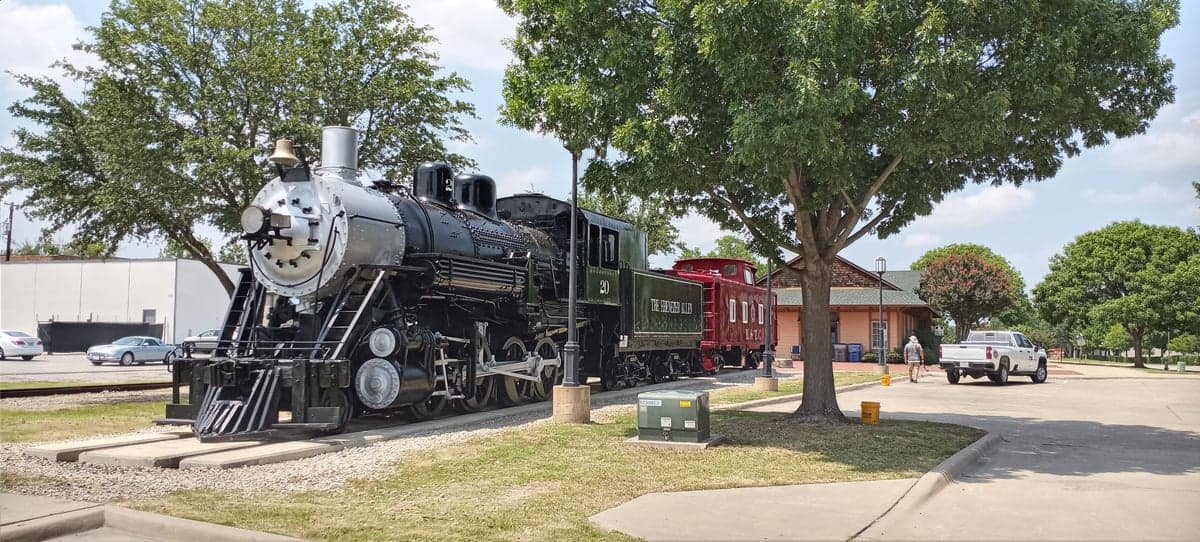
Photo: Wikipedia
Personal Sovereignty in Allen, TX
Strong independent fundamentals that actively favor personal liberty and low regulation.
What does Personal Sovereignty tell us?
Personal Sovereignty measures your capacity for self-reliance and independence with minimal government friction. Higher scores mean fewer barriers between you and the way you want to live... but it assumes you have the space you need and good neighbors.
What does this tell us?
Personal Sovereignty measures your capacity for self-reliance and independence with minimal government friction. Higher scores mean fewer barriers between you and the way you want to live... but it assumes you have the space you need and good neighbors.
State Policy
Energy independence: Net exporter (220% of energy produced in-state)
Personal Liberty
Homesteading

Personal Liberty Analysis
Allen, Texas, offers a notably high degree of personal sovereignty relative to most of the United States, largely due to Texas’s state-level legal framework that prioritizes individual rights over collective mandates. For the strategic-minded individual or family concerned with preserving autonomy in an era of expanding government overreach, Allen provides a legal and cultural environment where self-determination is the default, not the exception. The city’s governance, while not libertarian in a pure sense, operates within a state that actively limits local authority on key issues like taxation, gun rights, and parental control, creating a buffer against the more intrusive policies seen in coastal or urban centers. This analysis examines the specific pillars of sovereignty in Allen—tax burden, self-defense laws, homesteading viability, and personal liberties—to assess its viability as a relocation destination for those prioritizing freedom.
Tax burden and regulatory posture: How Allen compares to state and national averages
Texas’s lack of a state income tax is the single most impactful factor for personal financial sovereignty in Allen, allowing residents to retain 100% of their earned income from state-level taxation. This is a critical advantage for preppers and survivalists who prioritize capital accumulation for self-sufficiency investments—land, equipment, supplies—without the state taking a cut. Allen’s property tax rates, however, are a counterbalance. The total property tax rate in Allen typically falls between 2.2% and 2.5% of assessed value, which is above the national average but standard for Collin County. For a $400,000 home, this translates to roughly $8,800 to $10,000 annually. While not trivial, this is a fixed cost that can be planned for, unlike income taxes that scale with earnings. The city’s regulatory posture is business-friendly, with no local income tax, no inventory tax for businesses, and a generally streamlined permitting process for home-based enterprises. This allows individuals to operate side businesses—such as consulting, online sales, or small-scale manufacturing—without excessive bureaucratic friction. The absence of zoning restrictions on home occupations in many residential areas further supports economic self-reliance, though homeowners should verify specific HOA covenants, which can be more restrictive than city code.
Self-defense and gun law specifics: Stand your ground, permitless carry, and local enforcement culture
Allen sits squarely within Texas’s robust self-defense legal framework, which is among the most protective of individual sovereignty in the nation. The state’s permitless carry law (HB 1927), effective September 2021, allows any law-abiding adult 21 or older to carry a handgun in public—openly or concealed—without a license or training requirement. This eliminates a common point of government intrusion: the need to seek permission or pay fees to exercise a fundamental right. Allen’s local law enforcement, the Allen Police Department, operates with a generally pro-Second Amendment culture, and there are no city-level ordinances that restrict magazine capacity, firearm types, or storage requirements beyond state law. The Stand Your Ground statute (Texas Penal Code §9.31) removes any duty to retreat before using deadly force in any place where the individual has a legal right to be, which is critical for home defense scenarios. For preppers, this means a home intruder or a threat in a parking lot does not require a tactical retreat—the law backs the defender’s judgment. Additionally, Texas’s Castle Doctrine creates a legal presumption that a home intruder intends to cause harm, reducing legal risk for defensive shootings. Allen’s proximity to major highways (US 75 and Sam Rayburn Tollway) also means rapid access to rural shooting ranges and training facilities, such as the Elm Fork Shooting Sports complex in nearby Dallas, for those who want to maintain proficiency without traveling far.
Self-reliance and homesteading viability: Lot sizes, zoning, and off-grid feasibility in a suburban context
Allen is fundamentally a suburban city, which imposes constraints on full-scale homesteading but still offers meaningful opportunities for self-reliance. Standard residential lots in Allen range from 0.15 to 0.5 acres in most subdivisions, with some older neighborhoods offering up to 1-acre lots. This is sufficient for substantial vegetable gardens, small orchards, and even a few chickens (Allen allows up to six hens per household, with no roosters, under city ordinance). Backyard beekeeping is permitted with registration, and rainwater harvesting is legal and encouraged, with no state or local restrictions on collection systems. However, full off-grid living—solar panels with battery storage, well water, septic systems—is largely impractical within city limits due to mandatory connection to municipal water and sewer in most areas. Zoning is predominantly single-family residential (SF-7, SF-10, etc.), with minimum lot sizes that prevent high-density development but also restrict agricultural uses. For those seeking true homesteading, Allen serves as a base of operations rather than the homestead itself. The city’s location within 30–45 minutes of rural Collin County and Grayson County properties (where 5–20 acre parcels are available at $15,000–$30,000 per acre) allows a two-property strategy: a primary residence in Allen for work and school access, and a secondary rural property for serious food production, water storage, and emergency retreat. This hybrid approach maximizes both economic opportunity and self-sufficiency potential.
Personal liberties: Parental rights, medical autonomy, speech, and property protections
Texas has enacted several laws that directly bolster personal sovereignty in Allen, particularly around family and medical decisions. The Parental Bill of Rights (SB 1878, 2023) affirms that parents have the fundamental right to direct their children’s upbringing, education, and healthcare, including the right to opt out of any school curriculum or activity without penalty. This is a powerful tool against perceived government overreach in education, allowing parents in Allen ISD to challenge materials or policies they find objectionable. On medical autonomy, Texas law prohibits any requirement for COVID-19 vaccination or masking in schools and government buildings, and the state’s ban on vaccine passports (HB 1687) ensures no business or agency can demand proof of vaccination for services. This extends to a broader ethos: there is no state-level mandate for any medical procedure as a condition of employment or public access. Free speech protections are robust, with no local hate speech ordinances or content-based restrictions on public expression. Allen’s city council meetings and public forums are generally open to robust debate, though decorum rules apply. Property rights are strongly protected under Texas’s private property rights laws, which require just compensation for any regulatory taking and limit the use of eminent domain for private economic development. This means a homeowner in Allen is less likely to face a government-backed seizure of land for a corporate project than in states with weaker protections. The combination of these laws creates an environment where the individual, not the state, holds the default authority over personal and family decisions.
In the broader landscape of American cities, Allen ranks among the top tier for personal sovereignty, particularly for those who value gun rights, low taxation, and parental control. It is not a libertarian enclave—HOA restrictions, property taxes, and municipal utility requirements impose real limits—but it offers a legal foundation that actively resists the most intrusive forms of government overreach seen in states like California, New York, or Illinois. For the survivalist or prepper, Allen provides a secure suburban base with strong legal protections, access to rural retreat land, and a community culture that largely respects individual autonomy. The key trade-off is the suburban footprint: you cannot fully disconnect from the grid or live off the land within city limits, but you can live with minimal government interference in your daily life, your home defense, and your family’s education. For those weighing relocation, Allen represents a pragmatic balance—a place where personal sovereignty is the rule, not the exception, and where the state’s legal framework backs your right to live as you see fit, as long as you respect the same right for others.

* Values derived from national, state, county, city and local statistics and may differ in a specific area. Last updated: 2026-04-21T10:28:52.000Z
Narrative content on this page is AI-generated and may contain mistakes. Verify any details that matter before acting on them.
ReloMaps may earn a commission from affiliate links at no extra cost to you.

