Photo: Wikipedia
Political ClimatePolitical Climate in Allen, TX
District shown is the primary district for this city’s centroid. Cities may span multiple districts.
Local Political AnalysisPolitical Analysis of Allen, TX
Allen, Texas, has long been a reliably conservative stronghold, and that hasn't changed much at the ballot box. The city sits in Collin County, which has a Cook Partisan Voting Index of R+10, meaning it votes about ten points more Republican than the national average. In the 2024 presidential election, Collin County went for Trump by a solid 10-point margin, and Allen itself has consistently backed GOP candidates for local, state, and federal offices. But if you’ve lived here as long as I have, you’ve noticed the political winds shifting under the surface. The rapid growth from Dallas transplants and out-of-state newcomers has brought a noticeable uptick in progressive energy, especially in the newer subdivisions and around the schools. It’s not a blue wave yet, but it’s a definite purple tinge that has a lot of us longtime residents watching closely.
How it compares
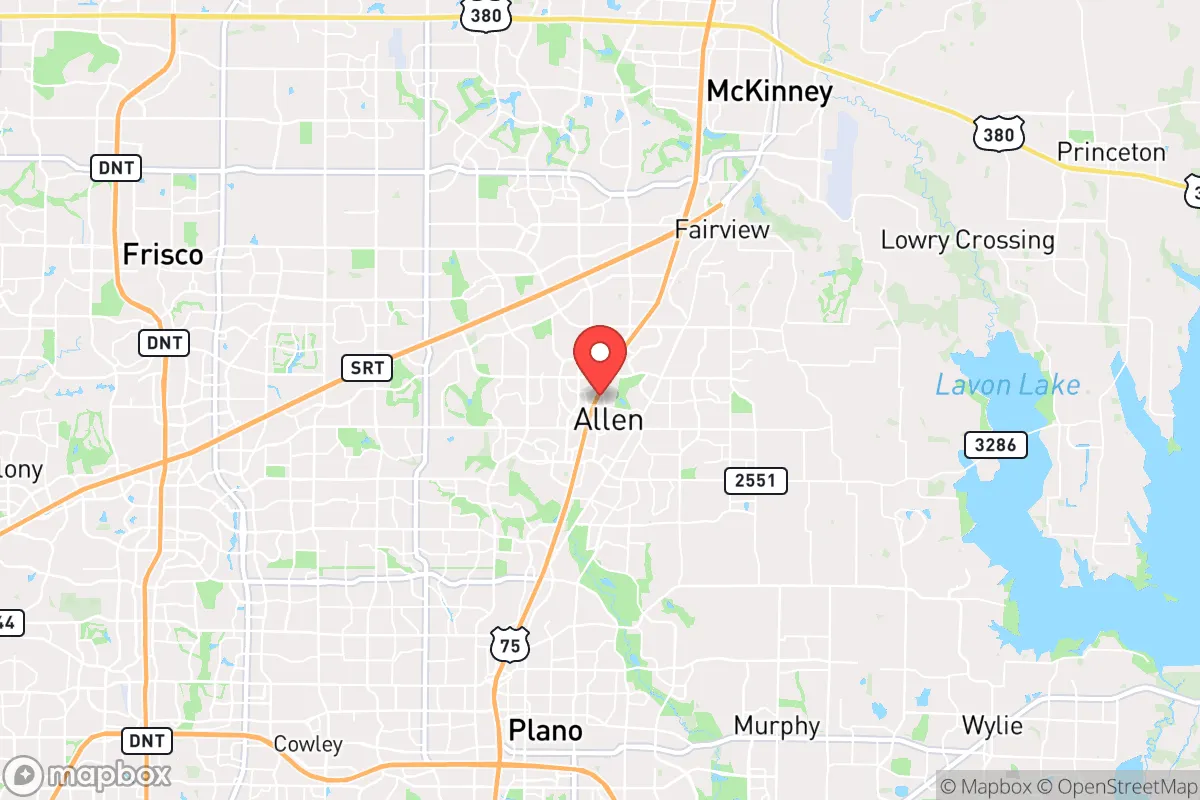
Allen’s political climate is still distinctly more conservative than what you’ll find just a few miles south in Dallas County, where places like Richardson and Garland lean reliably blue. Drive north up to McKinney or Frisco, and you’ll find a similar R+10 vibe, though Frisco has seen a faster influx of younger, more moderate voters. The real contrast is with Plano, just west of Allen. Plano has shifted noticeably left in recent years, with its city council and school board becoming battlegrounds for progressive policies. Allen, by comparison, has held the line better, but the same pressures are building. The surrounding rural areas—like Princeton, Melissa, and Anna—remain deeply red, often voting 70% or more Republican. So Allen sits in a kind of buffer zone: still conservative, but with a growing progressive minority that’s becoming more vocal, especially on social issues and school curriculum.
What this means for residents
For residents who value limited government and personal freedoms, the trend is concerning. The most visible flashpoint has been the school board. In the last few years, we’ve seen heated debates over library books, critical race theory, and transgender policies in Allen ISD. The conservative majority on the board has held firm so far, but the elections are getting tighter, and the progressive side is well-funded and organized. Outside the schools, the city council has stayed mostly hands-off on things like mask mandates and business restrictions, which is a relief. But there’s a creeping sense that the county-level government in McKinney is starting to feel pressure from the growing urban population. Property taxes remain a sore spot—Texas has no income tax, but the trade-off is high property levies, and Allen’s are among the highest in Collin County. That’s a direct hit on personal freedom, in my book. If you’re looking for a place where the government stays out of your life and your wallet, Allen still fits the bill better than most DFW suburbs, but you’ll want to keep an eye on the next few election cycles.
Culturally, Allen is still a place where you can fly your American flag without getting side-eye, and the local churches are full on Sunday. The annual Allen USA Celebration on July 4th is a big deal, and the city’s police department is well-supported. But the biggest policy distinction I’d flag is the city’s approach to development. Allen has been aggressive in courting corporate headquarters and mixed-use developments like The Village at Allen, which brings in tax revenue but also attracts a more diverse, often more liberal, workforce. That’s a double-edged sword. In the long term, I see Allen staying red, but the shade is fading. If you’re moving here for the conservative values, you’ll still find them—just know you’ll have to work a little harder to keep them that way.

State Political ClimatePolitical Climate in Texas
State Political AnalysisPolitical Environment in the State
Texas has been a reliably Republican state for decades, but the picture is more complicated than a simple red-state label. The GOP holds every statewide office and both legislative chambers, and Donald Trump carried the state by 5.6 points in 2024—a tighter margin than 2020’s 5.8 points. Over the last 10-20 years, the dominant coalition has been a mix of rural conservatives, suburban moderates, and business-friendly fiscal hawks, but rapid in-migration from blue states and explosive growth in the urban core are slowly shifting the ground beneath your feet. The state is still solidly right-of-center, but the margin of comfort is narrowing, and the internal battles are getting louder.
Urban vs. rural divide
The political map of Texas is a tale of three worlds. The big metros—Houston, Dallas-Fort Worth, San Antonio, and Austin—are the Democratic engine rooms. Harris County (Houston) alone delivered a 15-point margin for Biden in 2020, and Travis County (Austin) went +52 points blue. These areas are growing fast, driven by young professionals and transplants from California and New York, and they’re pulling the state leftward. Meanwhile, the rural expanse—places like the Panhandle around Lubbock, East Texas piney woods, and the Hill Country west of Austin—votes 70-80% Republican. The suburbs are the real battleground. Collin County (north of Dallas) was once a GOP fortress; Trump still won it by 14 points in 2024, but that’s down from 27 points in 2016. Tarrant County (Fort Worth) flipped to Biden in 2020 and stayed close in 2024. The urban-rural chasm is widening, and the suburbs are where the next decade’s political future will be decided.
Policy environment
Texas’s policy posture is still aggressively conservative by national standards, but it’s not uniform. The state has no personal income tax, a cap on property tax growth (Proposition 4, 2023), and a regulatory climate that’s famously business-friendly. Education policy is a flashpoint: the 2023 school voucher battle (SB 8, which failed in the House) showed deep divisions between rural Republicans who want to protect local schools and suburban conservatives who want choice. The state’s abortion ban (trigger law from 2021, effective after Dobbs) is among the strictest in the nation, with no exceptions for rape or incest. Election laws tightened after 2021’s SB 1, which restricted mail-in voting and early voting hours—a move that energized both sides. Healthcare remains a sore spot: Texas has the highest uninsured rate in the country, and the state has refused Medicaid expansion under the ACA. For a conservative, the policy environment is largely friendly—low taxes, light regulation, strong Second Amendment protections—but the cracks are showing as the population diversifies.
Trajectory & freedom
On the freedom front, Texas has been a mixed bag in recent years. On the positive side for conservatives: constitutional carry (HB 1927, 2021) eliminated the need for a permit to carry a handgun, and the state passed a law (SB 14, 2023) banning gender-transition care for minors. Parental rights were strengthened with the 2023 “Save Women’s Sports Act” (SB 15) and a law requiring school libraries to remove books deemed “sexually explicit” (HB 900). Property rights got a boost with the 2023 ban on foreign ownership of agricultural land (SB 147). But there are concerning trends. The state’s property tax burden remains among the highest in the nation, even after the 2023 cuts—a hidden cost of the no-income-tax model. And the Texas Privacy Act (HB 1818, 2023) expanded government surveillance of digital transactions, which libertarians saw as a step backward. The trajectory is toward more state-level intervention in social issues, which pleases cultural conservatives but worries those who want limited government across the board.
Civil unrest & political movements
Texas has seen its share of political flashpoints. The 2020 George Floyd protests in Austin, Dallas, and Houston were large and occasionally violent, with Austin’s police budget becoming a years-long political football. Immigration politics are the most visible daily friction. Governor Abbott’s Operation Lone Star (2021-present) deployed state troopers and National Guard to the border, bused migrants to blue cities, and led to the arrest of thousands on state trespassing charges. The state’s SB 4 (2023) made illegal entry a state crime, though it’s been tied up in court. On the right, the Texas Nationalist Movement (Texit) has been a persistent but fringe voice, polling around 15-20% support. Election integrity remains a live issue: the 2020 and 2022 cycles saw intense scrutiny of Harris County’s voting procedures, leading to the state takeover of elections there in 2023. A new resident will notice the heavy police presence at the border, the constant political ads on TV, and the palpable tension in any discussion of immigration or voting.
Projection
Over the next 5-10 years, Texas is likely to become more competitive at the statewide level, but not necessarily more liberal. The in-migration from California and the Northeast is real—about 1,000 people move to Texas per day—and many of them are moderate or conservative-leaning themselves, fleeing high taxes and crime. The suburbs of Dallas, Houston, and San Antonio are where the political future will be forged. If Republicans can hold the suburbs—places like Katy, Frisco, and New Braunfels—the state stays red. If those areas drift left like Virginia’s suburbs did, Texas could be a swing state by 2032. The demographic shift is also generational: younger Texans are more liberal on social issues, but they’re also less likely to vote. The wildcard is the Rio Grande Valley, historically Democratic but trending Republican—places like McAllen and Brownsville saw double-digit shifts toward Trump in 2024. Someone moving in now should expect a state that remains conservative in policy but increasingly divided in culture, with the political center of gravity slowly shifting from rural courthouses to suburban school boards.
For a new resident, the bottom line is this: Texas still offers a low-tax, business-friendly, culturally conservative environment that’s rare in the United States. But it’s not static. The freedom you’re moving for—lower taxes, less regulation, stronger property rights—is real, but it requires active defense. The state’s political future will be shaped by the very people moving in now. If you want a place where your vote still counts and your values still have a fighting chance, Texas is one of the last strongholds. Just don’t expect it to stay the same without effort.
* Values derived from national, state, county, city and local statistics and may differ in a specific area. Last updated: 2026-04-21T10:28:52.000Z
Narrative content on this page is AI-generated and may contain mistakes. Verify any details that matter before acting on them.
ReloMaps may earn a commission from affiliate links at no extra cost to you.

