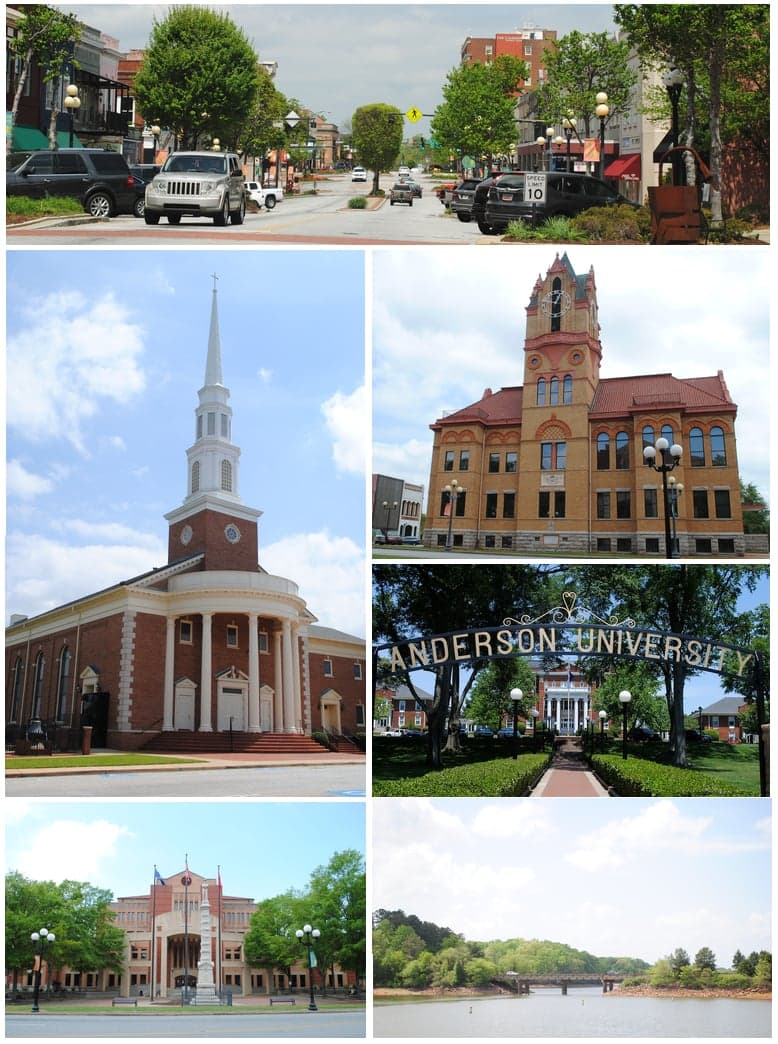
Photo: Wikipedia
Personal Sovereignty in Anderson, SC
Viable for self-reliance. Generally workable, though some barriers may limit total independence.
What does Personal Sovereignty tell us?
Personal Sovereignty measures your capacity for self-reliance and independence with minimal government friction. Higher scores mean fewer barriers between you and the way you want to live... but it assumes you have the space you need and good neighbors.
What does this tell us?
Personal Sovereignty measures your capacity for self-reliance and independence with minimal government friction. Higher scores mean fewer barriers between you and the way you want to live... but it assumes you have the space you need and good neighbors.
State Policy
Energy independence: Importer (25% of energy produced in-state)
Personal Liberty
Homesteading

Personal Liberty Analysis
Anderson, South Carolina, offers a notably high degree of personal sovereignty compared to many parts of the United States, particularly for those who prioritize minimal government interference in daily life, self-defense, and family autonomy. The city and surrounding Anderson County sit within a state that has consistently ranked among the most freedom-friendly in the nation, with low taxes, permissive gun laws, and a legal environment that generally defers to individual choice over state mandate. For a single individual or parent operating from a survivalist or prepper mindset, Anderson provides a legal and cultural foundation that allows for significant self-reliance, though some zoning and regulatory nuances require attention.
Tax burden and regulatory posture: How South Carolina’s low-tax framework supports individual autonomy
South Carolina’s tax structure is a major draw for those seeking to minimize government extraction from personal income and property. The state levies a flat income tax rate of 6.2% on all taxable income above a modest threshold, with no progressive brackets that penalize higher earners. Property taxes in Anderson County are among the lowest in the state, with an effective rate around 0.55% of assessed value, meaning a $250,000 home carries an annual tax bill of roughly $1,375. There is no state-level tax on Social Security benefits, and military pensions are fully exempt, which benefits retirees and veterans. Sales tax in Anderson County is 8%, but groceries and prescription drugs are exempt, reducing the regressive impact on daily living costs. From a regulatory standpoint, South Carolina is a right-to-work state with minimal business licensing hurdles, and Anderson County does not impose the kind of onerous environmental or land-use regulations found in coastal or urban jurisdictions. This low-tax, low-regulatory posture means more disposable income stays in your pocket, and fewer bureaucratic obstacles stand between you and self-sufficient projects like building a workshop, keeping livestock, or running a home-based business.
Self-defense and gun law specifics: Stand your ground, constitutional carry, and castle doctrine in Anderson
For anyone prioritizing the right to defend themselves and their family, Anderson sits in one of the most firearm-friendly legal environments in the country. South Carolina is a constitutional carry state as of 2024, meaning any law-abiding adult 18 or older can carry a concealed handgun without a permit. The state also has a strong Stand Your Ground law, codified in S.C. Code § 16-11-440, which removes any duty to retreat before using deadly force if you are lawfully present and reasonably believe force is necessary to prevent death, great bodily harm, or a violent felony. The Castle Doctrine applies to your home, vehicle, and place of business, with a legal presumption that an unlawful intruder intends to cause harm. There is no state-level firearm registration, no waiting period for purchases, and no magazine capacity restrictions. Anderson County itself has a sheriff’s office that is generally supportive of Second Amendment rights, and the local gun culture is strong, with multiple ranges and gun shops within a 20-minute drive. For preppers, this legal framework means you can stockpile firearms and ammunition, carry openly or concealed without bureaucratic interference, and use lethal force in self-defense without fear of prosecution, provided the circumstances are legally justifiable.
Self-reliance and homesteading viability: Lot sizes, zoning, and off-grid feasibility in Anderson County
Anderson County offers substantial opportunities for self-reliance, but the specifics depend heavily on whether you are inside city limits or in unincorporated areas. Within the city of Anderson, standard residential lots are typically 0.25 to 0.5 acres, and zoning ordinances restrict keeping livestock like chickens or goats to a limited number of hens (no roosters) and prohibit pigs or cattle. However, once you move into unincorporated Anderson County, lot sizes increase dramatically, with many parcels available at 1 to 5 acres for under $20,000 per acre, and larger tracts of 10 to 50 acres common in the northern and western parts of the county. In these areas, there are no county-level zoning restrictions on livestock, poultry, or small-scale agriculture, so you can raise chickens, goats, sheep, or even a cow for milk and meat. Off-grid feasibility is moderate: the county does not require connection to municipal water or sewer on rural parcels, and well water is common. Solar panels are permitted without special permits, and many rural homes already rely on propane or wood for heating. However, the county does enforce the International Residential Code for new construction, so building a completely off-grid cabin without permits is not legal. The local building department is known for being practical rather than punitive, but you will need to pull permits for any permanent structure. For a prepper, the sweet spot is buying 5+ acres in the unincorporated areas west of Anderson, near the Savannah River, where you can have a well, septic, solar, and livestock with minimal government oversight.
Personal liberties: Parental rights, medical autonomy, speech, and property protections
South Carolina has a strong legal framework for parental rights, codified in S.C. Code § 63-5-340, which affirms that parents have the fundamental right to direct the upbringing, education, and healthcare of their children. This means you can homeschool without excessive state oversight—just a simple notification to the school district and annual standardized testing or portfolio review. There are no vaccine mandates for school attendance beyond the standard childhood immunizations, and religious or medical exemptions are available. Medical autonomy for adults is also robust: there is no state-level vaccine passport system, no mask mandates have been enforced since 2021, and the state legislature has passed laws prohibiting discrimination against unvaccinated individuals. Speech protections are strong under both the First Amendment and the South Carolina Constitution, which explicitly protects the right to peaceably assemble and petition the government. Property rights are reinforced by the state’s Property Rights Protection Act, which requires government entities to compensate landowners for any regulatory taking that reduces property value by more than 20%. This makes eminent domain abuse and overzealous zoning less likely than in states without such protections. For a conservative-leaning individual concerned about government overreach, Anderson’s legal environment provides a buffer against many of the mandates and restrictions common in blue states, though it is not a libertarian utopia—you still need to comply with building codes, vehicle registration, and state income tax filing.
Overall, Anderson, SC ranks as a strong contender for personal sovereignty relative to other mid-sized Southern cities. It offers a better legal environment for self-defense and parental rights than states like Georgia or North Carolina, which have more restrictive gun laws or weaker parental rights statutes. Its tax burden is lower than Tennessee’s sales-tax-heavy system and far below any Northeastern or West Coast jurisdiction. The main trade-offs are the need to live outside city limits for true homesteading flexibility and the reality that South Carolina still has a state income tax, unlike Florida or Texas. For a single individual or parent who values self-reliance, minimal government intrusion, and the ability to prepare for uncertain times, Anderson provides a solid legal and cultural foundation—one that allows you to live largely on your own terms, provided you choose your specific parcel and lifestyle carefully.

* Values derived from national, state, county, city and local statistics and may differ in a specific area. Last updated: 2026-04-24T02:49:45.000Z
Narrative content on this page is AI-generated and may contain mistakes. Verify any details that matter before acting on them.
ReloMaps may earn a commission from affiliate links at no extra cost to you.

